Key takeaways
- The day is governed by the last coach out, not by closing time: in-park shuttles stop around 17:00 and the coach to the station leaves the visitor centre around 17:30–18:00.
- Two headline sites: the Three Natural Bridges (2–2.5 hr) and the Longshui Gorge fissure (1.5 hr). Combined ticket RMB 260, or 210 from 1 November.
- The ticket prices already include shuttles and lifts you cannot skip — which is why you will see the Bridges quoted at ¥70 elsewhere. That is bare admission, and nobody pays it.
- If you only have time for one, Chinese travellers pick the Gorge, not the famous Bridges — shorter, and it collects far fewer complaints.
- Rain ruins it: the canyon fogs in. Furong Cave is the weatherproof substitute, because it is underground.
Is it worth the day?
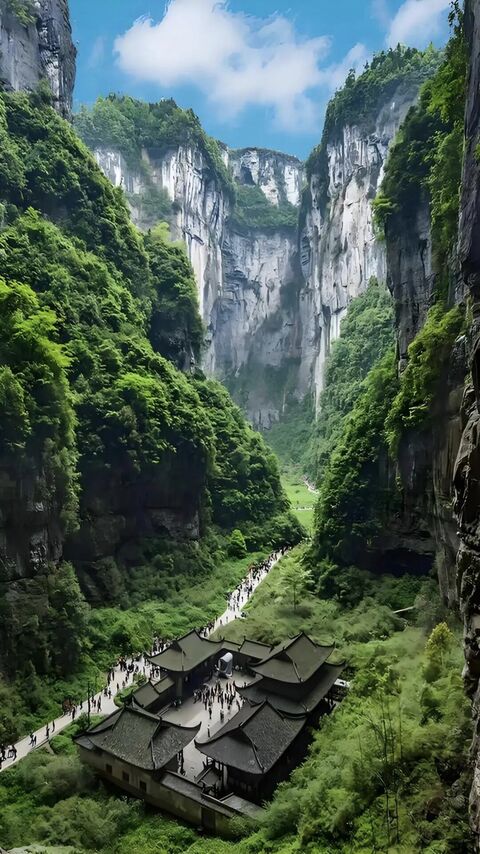
Worth it for anyone with a clear full day and a reasonable pair of knees. The scale is genuinely hard to photograph — three limestone arches in a chain with collapsed sinkholes between them, the tallest standing 281m — and the gorge next door is a corridor narrow enough that the sky closes to a slit above you. Western visitors get an extra hook the domestic crowd does not care about: the Dinobot canyon in Transformers 4 is this one, and it was shot on location.
Skip it if you have less than a full day, if stairs are a problem, or — the one most people underrate — if the forecast is rain. Wulong is unusually weather-dependent: travellers describe a wet visit as fog, wet stone and nothing to look at, and weather dominates the regrets they post afterwards. On a wet day, Furong Cave is the honest substitute, because it is underground and the weather stops mattering. With only half a day, do Dazu Rock Carvings instead — the genuinely doable half-day UNESCO option from Chongqing, in the opposite direction.
What Wulong Karst is
Wulong is a karst landscape in the mountains of south-east Chongqing municipality, and the local shorthand for its two headline sites is worth learning before you read anything else about it. Chinese guides call the Three Natural Bridges 天坑 (tiānkēng, “sky pit”) and Longshui Gorge 地缝 (dìfèng, “earth crack”) — so a phrase like “天坑地缝” is not two geological features, it is the names of the two ticketed parks you are deciding between.
The Three Natural Bridges are three enormous rock arches — Tianlong, Qinglong and Heilong — standing in a row along one canyon, with two collapsed sinkholes in the gaps between them. Chinese describes the arrangement as 三桥夹两坑, “three bridges enclosing two pits”, which is a more accurate picture than “a canyon”: you walk the floor, pass beneath an arch, come out into open sky where the roof has fallen in, and then go under the next one. It is the largest cluster of natural bridges in Asia. The Chinese formulation adds a qualifier worth keeping — 串珠式, a “strung-bead” chain — because it is the serial arrangement rather than the raw count that is unusual.
UNESCO inscribed Wulong as part of the South China Karst World Heritage in 2007, alongside Libo and Shibing. The protected area runs to hundreds of square kilometres; a visitor realistically sees two fragments of it.
Where Wulong sits
~120 km east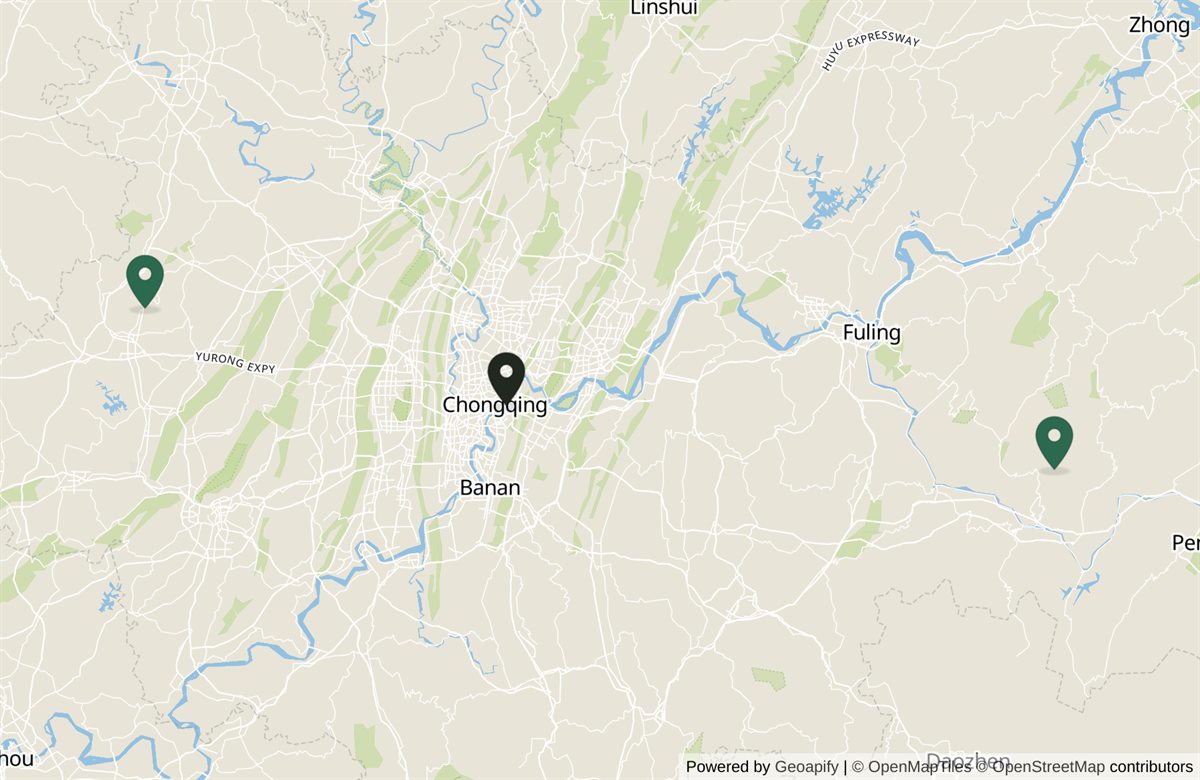 Dazu Rock CarvingsDazuWulong KarstWulongChongqingChongqing
The pop-culture hook is real rather than marketing. Transformers: Age of Extinction (2014) filmed here: the green gorge where Optimus Prime summons the Dinobots is this canyon, shot on location rather than composited. It is unusually well-documented for a Chinese filming location, partly because Wulong later ended up in a public dispute with the production over how its placement was handled in the international cut.
How to get there — 3 options compared
Everything about getting to Wulong changed on 27 June 2025, when the Chongqing–Hunan high-speed line opened. The journey that used to be a two-to-three-hour slog is now about 34 minutes on the train — but the train is only the first of three legs, and the other two are where days go wrong.
| Option | Cost · time | Best for |
|---|---|---|
| Guided day tour | From ~USD $61/pp · full day | Anyone who does not want to own the connections — hotel pickup, tickets bought in advance, and someone else watching the clock. |
| High-speed rail + coach (DIY) | ~¥300–350 total/pp · full day | Cheapest and most flexible. You handle the station coach, the ticket, and the last departure home. |
| Private driver | ¥1,500–2,500/day | Groups of 3–4 sharing (≈¥500/pp), or anyone combining Wulong with Furong Cave. English-speaking drivers are hard to find. |
Doing it yourself, leg by leg
Leg 1 — the train. From Chongqing East (重庆东站) to Wulong South (武隆南站): about 34 minutes, from ¥76 in second class. Book through the 12306 English app or an agent well ahead for weekend departures.
There are two stations called Wulong, 5.5 km apart. Wulong South (武隆南) is the high-speed station and the one you want. The older Wulong station (武隆站) is on slower conventional services. Check which name is on your ticket — they are different places, and only one of them is 34 minutes from the city.
Leg 2 — the coach. Outside Wulong South, follow the crowd to the blue dedicated-line coach (旅游专线) to the Xiannüshan visitor centre: ¥10–16, about 50 minutes for the 14 km climb. It is the official service and it is cheap. The drivers touting for business at the station exit are not it, and the standard local advice is to walk past them.
Leg 3 — the in-park shuttles. At the visitor centre the free in-park shuttles — already paid for inside your ticket — leave from basement level 2. Both headline sites are about 3.2 km from the visitor centre and you cannot walk to either; the shuttle is the only way in. Crucially, they leave when they are full, not on a timetable, so a peak-season wait can be 20–30 minutes and every leg of your day needs slack built into it.
When the tour is actually the right answer
On most Chongqing pages a guided tour is a comfort upgrade you can take or leave. Here it is doing something more specific, and it is worth being honest about what. The DIY route is not hard, and it is not much cheaper — roughly ¥300–350 against a tour from about USD $61 once you have paid for the ¥260 ticket, two train legs and two coach legs. What you are really buying is the removal of the two things that break this particular day: the last coach back, which strands you if you misjudge it, and shuttles that leave only when full, which makes the middle of the day impossible to schedule precisely.
So: if you are relaxed about improvising and happy to leave the gorge early to protect the coach, do it yourself and keep the flexibility. If a missed connection would wreck the next day of your trip, or you are travelling with people who cannot be hurried, this is the one Chongqing day trip where handing over the logistics is worth real money.
Book a Wulong day trip — 3 platforms
All take a foreign card & English checkout · sorted by what we can verify, not by commission
 ★ The one we can name
Wulong Three Natural Bridges + Longshui Gorge group day tour
Group join-inFull dayHotel pickupCombined ticket included
Verified Aug 2026 · re-checked quarterly
Why only one named product: we list a specific tour only when we have checked it ourselves. Wulong tours change constantly on the other two platforms, so rather than print a product that may not exist by the time you read this, these go to live searches.
The clock — the part that catches people out
Every guide to Wulong prints the opening hours. Almost none print the number that actually decides whether your day works, which is the last coach from the visitor centre back to the railway station. The parks are open later than you can safely stay in them.
| Deadline | Roughly when | What it means |
|---|---|---|
| Out of the gorge | ~15:00 | Gives you time for the shuttle back to the visitor centre, including a wait for it to fill. |
| In-park shuttles stop | ~17:00 | After this there is no transport between the sites and the visitor centre. |
| Last coach to the station | ~17:30–18:00 | The real deadline. Earlier in low season. Miss it and you are finding a bed. |
| Return train | Book 18:30 or later | Leaves room for the coach to run late, and for the queue at the station gate. |
Working forwards instead: a train out of Chongqing East around 08:00 puts you at the visitor centre by about 10:00, the Three Natural Bridges from roughly 10:10 to 12:10, Longshui Gorge from about 12:30 to 14:15, back at the visitor centre by 15:00, on the coach before 16:00, and home in Chongqing for a late dinner. That is comfortable. A 09:00 train is not.
Which of the two first — and why the usual reason is wrong
The standard advice is to do the Three Natural Bridges first and the Gorge second, on the grounds that the Bridges are further from the visitor centre so you finish nearer the exit and avoid doubling back. The advice is right. The reason is not. Measured between the mapped coordinates, the Three Bridges gate is 3.22 km from the visitor centre and Longshui Gorge is 3.21 km — the same distance, within about ten metres. They sit on opposite spokes, one to the north-east and one to the south-east, about 4 km apart from each other, with the visitor centre as the hub. Whichever order you take, you pass back through the middle, and the total distance is identical.
The order still matters, but for a reason to do with the clock rather than the map. The Bridges take 2–2.5 hours and the Gorge about 1.5. Doing the longer one first means that if the day slips — a slow train, a full shuttle, a long lift queue — what is left to compress is the shorter site, and the Gorge compresses gracefully, because travellers agree the first half is the best part and you are not obliged to walk it all. Do it the other way round and a delay catches you halfway through the bigger, slower park with a coach to make.
What to see on-site
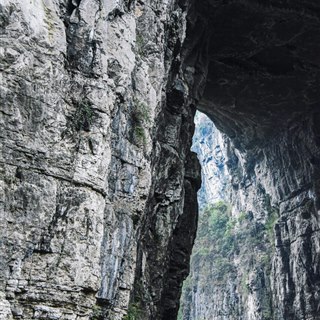
A lift drops you into the canyon and you walk the floor beneath three arches, past the Tianfu Inn. Downhill nearly all the way — until the exit, which is a sustained climb.
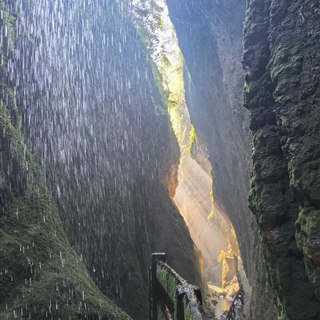
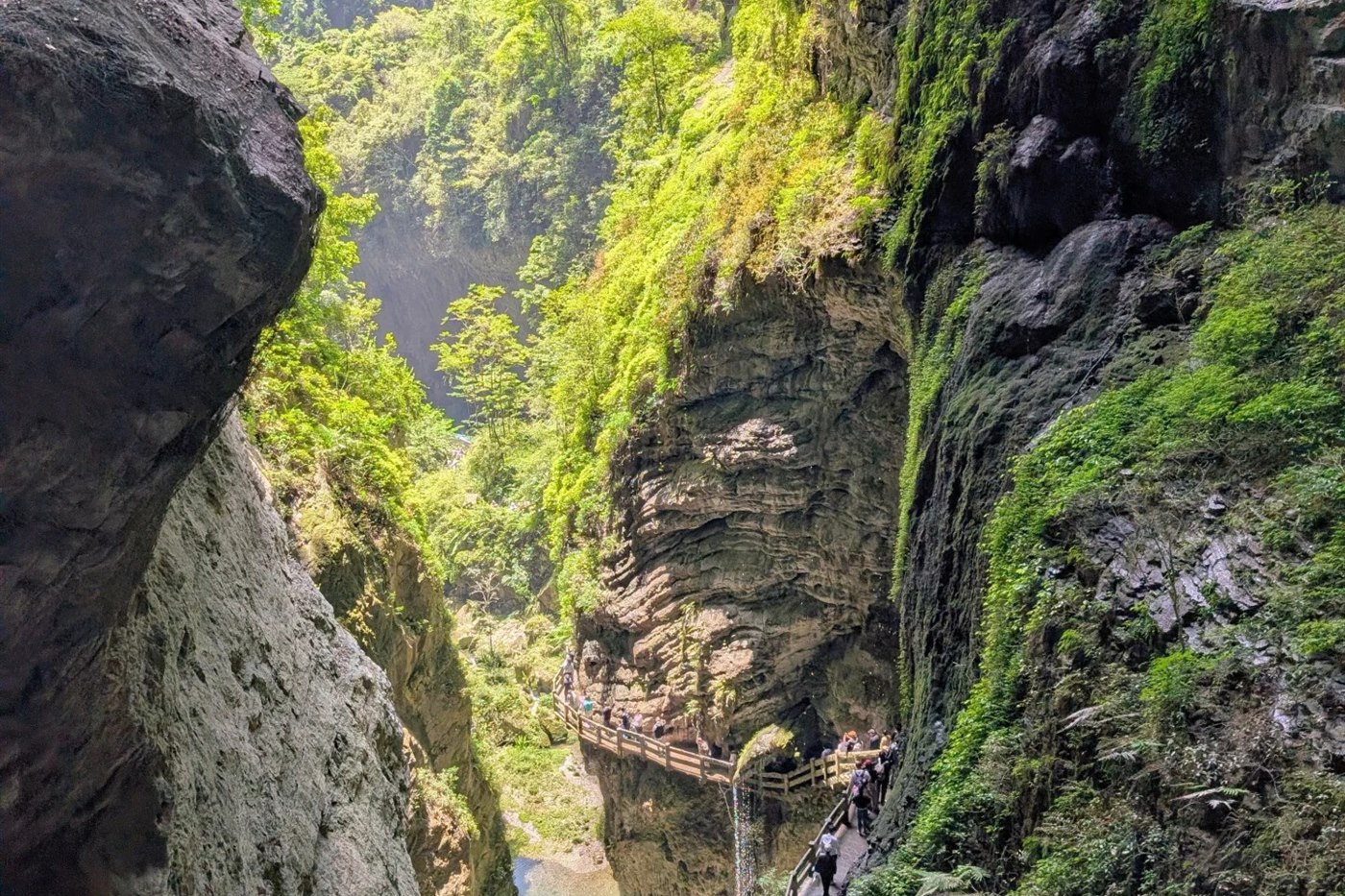
A cliff-pinned walkway through a fissure narrow enough to close the sky to a slit, with a stream and waterfalls the whole way. Wet underfoot throughout.
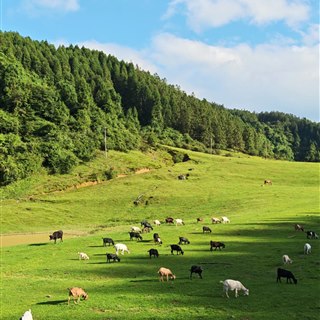
High grassland 8.8 km north on its own spur, open around the clock. Worth the detour in summer for the cool and in winter for snow — and travellers are blunt that in spring or autumn it is neither.
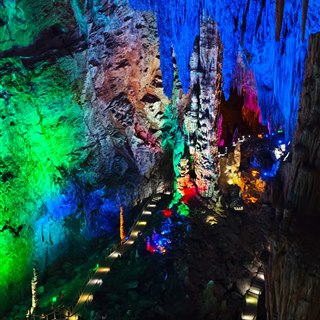
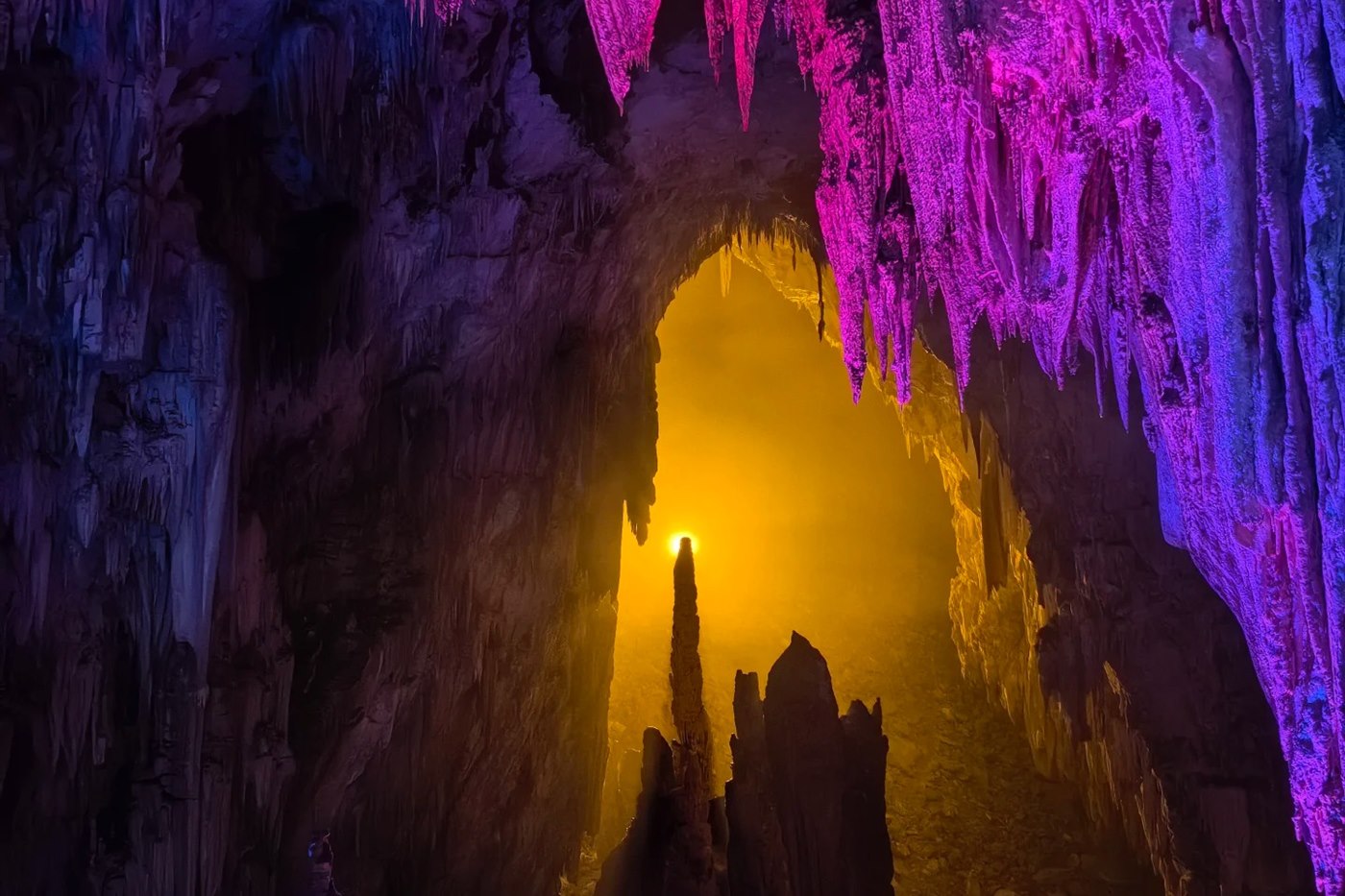
2,846 m of stalactite chambers 26 km south-east — consistently praised, and completely weatherproof. Far enough out to be a substitute for one of the others rather than an addition.
The honest ranking, which is not the famous one
If you can only fit one in, Chinese travellers overwhelmingly pick the Gorge. That is worth sitting with for a second, because the Three Natural Bridges are the name on the UNESCO listing and the reason you have heard of Wulong at all. The Gorge is shorter, it is a continuous walk beside running water, and it attracts very few complaints. The Bridges have the scale and the film location, but they also collect most of the grumbling: a long walk with few places to sit, a queue for the descent lift, and a paid buggy at the end.
This is not a reason to skip the Bridges — if you have the day, do both, because one is a landscape at a scale photographs cannot hold and the other is a corridor you walk inside. But if something has to go, the famous half is the one to lose.
Four things worth knowing before you are standing there
- The descent lift, and the alternative to it. The lift into the canyon rotates as it goes down, which is genuinely good and is why the queue exists. There is an older lift as well, and you can also walk down. In peak season, taking the old one is the standard local workaround.
- The exit is uphill, and the ¥15 buggy is not really optional. The canyon walk is downhill almost all the way, which is pleasant right up to the point where you have to get back out. There is a buggy from the exit to the transfer stop for ¥15; walking it takes about 20 minutes of climbing. If the Gorge is still ahead of you that afternoon, the ¥15 is buying schedule, not comfort.
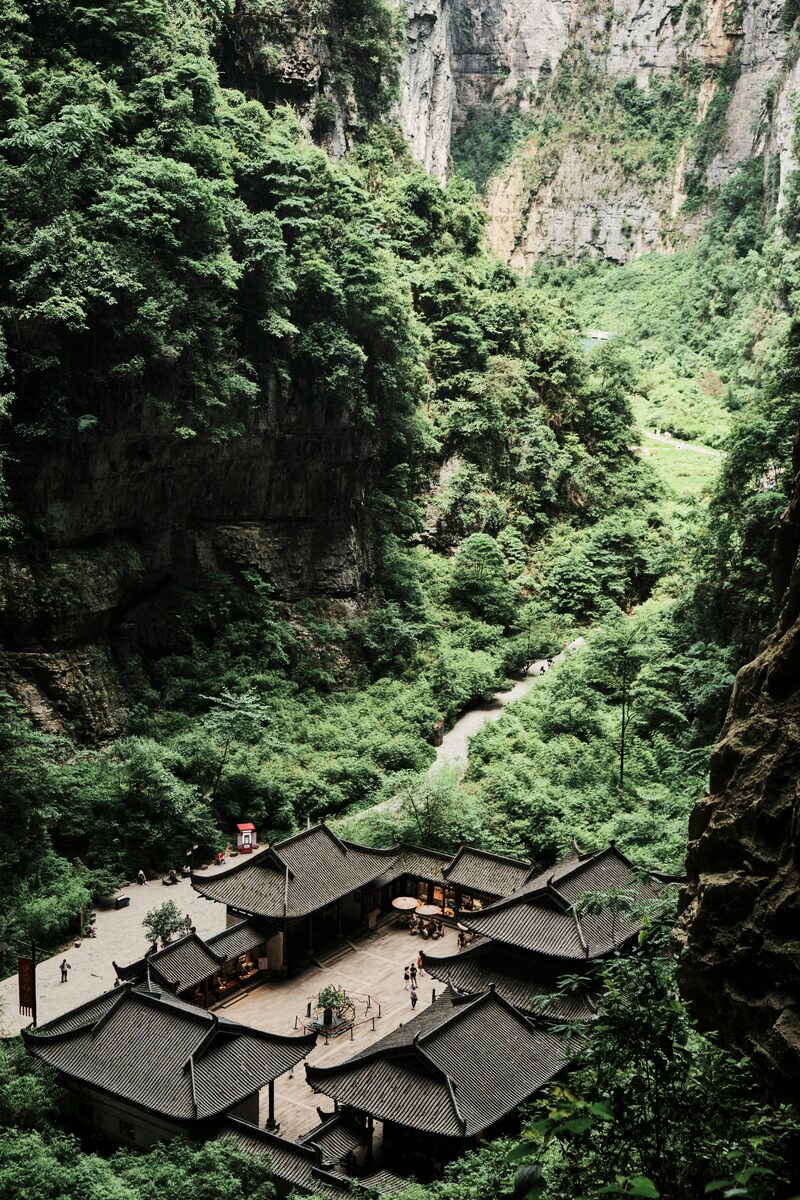
- The Tianfu Inn (天福官驿). The walled courtyard on the canyon floor is a film set, built for Curse of the Golden Flower (2006) rather than an old courier post — Amap lists it under a name meaning “the only exterior filming location” for that film. It sells drinks, takes about fifteen minutes, and is the only shade down there in summer.
- Bring your own food and water. There is very little to eat inside, the snack stands at the transfer points are expensive, and the roast corn has a reputation locally that is not a compliment. Phone signal on the canyon floor is poor, so download an offline map before you descend.
The thing a day trip cannot have. Wulong’s large outdoor evening show runs in a canyon north of the visitor centre and does not finish until after nine, which is hours past your last coach. It is the main reason Chinese visitors make this two days rather than one. If it appeals, that is the argument for staying over — not the sights, which fit in a day.
Tickets, prices and booking
Wulong prices by season — high season March to October, low season 1 November to the end of February — and every ticket already includes transport inside the park that you have no way to avoid.
| Ticket | High / low | What is bundled in |
|---|---|---|
| Three Natural Bridges | ¥155 / 125 | ¥70 admission + ¥40 shuttle + ¥45 Tianlong lift. |
| Longshui Gorge | ¥105 / 85 | Admission + ¥35 shuttle + ¥15 lift. |
| Combined (Bridges + Gorge) | ¥260 / 210 | Exactly the two added together — it saves a second queue, not money. |
| Furong Cave (separate) | ¥150 / 135 | Includes the ¥70 cableway. |
| Fairy Mountain | ¥50 year-round | Grassland shuttle train extra. |
| Exit buggy, Three Bridges | ¥15 | Optional in name only if you are short of time — see above. |
| Glass viewing platform | ¥40 | Widely described as a small platform and about two minutes. Easy to skip. |
Why you will see ¥70 quoted. Because ¥70 is the bare admission to the Three Natural Bridges, and it is not a price any visitor pays. The shuttle and the lift are compulsory — the sites are kilometres from the visitor centre with no walking route in — so the number that matters is ¥155. Sources quoting ¥70, or ¥80 for Furong Cave, are quoting the admission line rather than the ticket.
The second number in a Chinese ticket table is usually a concession, not a low-season fare. At the Three Natural Bridges: ¥155 full, ¥120 for students, children and 60–64s, and ¥85 for over-65s, military and disabled visitors — who get admission free but still pay for the compulsory shuttle and lift. Concessions generally need Chinese documentation, so budget the full fare unless you know yours will be accepted.
Booking, and getting through the gate on a passport
Wulong sells timed-slot electronic tickets, and the practical advice from recent visitors is to buy a day or three ahead rather than at the gate. Travellers report that walk-up sales have largely stopped, and the scenic area’s own tourism website routes its “tickets” link to an online booking platform rather than to a ticket office. Arriving without a ticket is a risk rather than a plan.
Entry is by scanning whatever document the ticket was bought against. Chinese visitors tap an ID card; on a passport, the gate readers are reported to be slow or to reject at busy times. The reliable move is the staffed counter (人工窗口), where a member of staff will check the passport and issue a paper entry voucher. Carry the physical passport, not a photograph of it — the in-park shuttles and spot checks ask for the original. If you would rather not deal with any of this, a tour includes the ticket and the booking is done for you.
When to go — season, fog and crowds
Opening hours shift three times a year, and none of the three bands is the constraint on your day — the coach is. They are worth knowing anyway, because the summer band opens half an hour earlier and that half hour is real when you are chasing a connection.
| Dates | Hours |
|---|---|
| 1 June – 31 August | 08:00–17:00 |
| 1 May – 31 May | 08:30–17:00 |
| 1 September – 30 April | 08:30–16:30 |
| Window | Conditions |
|---|---|
| April – early May | Comfortable and clear, before the Labour Day week. One of the two best windows. |
| Late September – October | The other best window — post-monsoon clarity and cool nights. Avoid 1–7 October. |
| July – August | Busy with domestic families, but the temperature drop is the whole point in a Chongqing summer. |
| Late November | Cold, clear, quiet, and already on low-season pricing at ¥210 for the combined ticket. |
| December – March | Cheapest and emptiest. Morning fog usually sits in the canyon until 10–11am, then lifts; walkways can ice over. |
Two things to avoid outright. The three week-long national holidays — Spring Festival, the May Day week, and the first week of October — when the canyon shuttle queue runs past 90 minutes and private cars and coaches jam a narrow entrance together. And rain: this is the most weather-dependent site near Chongqing, and a wet day is fog, wet stone and a walk you will not enjoy. Watch the forecast, and keep Furong Cave in your pocket as the wet-weather swap.
Whenever you go, bring shoes with grip — the gorge is wet the whole way — and a light layer. The canyon floor and the higher ground both run several degrees below the city.
Where to stay
Where to sleep is really a yes-or-no about the overnight, and for most visitors the answer is no: the sights fit inside a day, and the rooms are better and cheaper in the city. Staying out here earns you exactly two things, and neither of them is the scenery — the evening show, which ends long after the last coach, and Fairy Mountain early enough for the light. If you want either, the local comparison is Xiannüshan town, up by the visitor centre, against Wulong town down in the valley: convenience against price. The distances in the cards that follow are measured, not guessed.
Where to book these: China’s home-grown chains — 全季 (JI) and 亚朵 (Atour) — are listed most completely on Trip.com, with English checkout and foreign-card payment. It’s the main booking platform for mainland hotels; Western sites like Booking and Agoda carry only a fraction of their branches.
Best value — mid-range downtown (recommended)
Almost everyone does Wulong as a day trip and sleeps in central Chongqing, going out on the early train or on a tour bus that collects from the hotel door. Stay around Jiefangbei and you are walking distance from Hongyadong for the evening you get back, and a short ride from Chongqing East for the morning train out. For a first China trip a home-grown mid-range chain — 全季 (JI) or 亚朵 (Atour) — is the value pick: reliable, English-app booking, a fraction of the five-star rate.
- In the Jiefangbei downtown core — walk to Hongyadong; most Wulong day tours pick up at the door.Modern, spotless, easy English-app booking, and roughly a third what the five-stars charge.
- On the Bayi Road snack street by Jiefangbei — hot pot on your doorstep for the night you get back.Design-led mid-range chain that foreign guests rate highly — comfortable, well-run, and far better value than the luxury towers.
International luxury (closest two)
Full-service five-stars on the Yuzhong Peninsula, walking distance to Hongyadong, with day-tour pickup at the door. Listed if you want them, but the mid-range picks above are the better value on most first trips.
- In the Raffles City complex at Chaotianmen, at the tip of the peninsula where the two rivers meet.
- By Jiefangbei Pedestrian Street — walk to Hongyadong, with tour-bus pickup at the door.
Staying over near the park
Worth it for exactly two things the day trip cannot reach: the evening show, which does not finish until after nine, and Fairy Mountain early enough to matter. Chain hotels are thin out here, so search what is currently bookable near the scenic area rather than going by a brand name.
- Mid-rangeHotels near Wulong Karst →Out by the visitor centre or down in the valley town — the two bases locals weigh against each other.
Frequently asked questions
Is Wulong Karst worth visiting from Chongqing?
Yes, if you have a full day and reasonable knees. The Three Natural Bridges are the largest cluster of natural rock bridges in Asia — three limestone arches in a chain with two collapsed sinkholes between them, the tallest arch (Qinglong) standing 281m — and Longshui Gorge is a slot canyon narrow enough that the sky closes to a slit overhead. Add the Transformers: Age of Extinction filming location and it rewards the day. Skip it if you have less than a full day, if you have strict mobility limits, or if the forecast is rain: fog fills the canyon and travellers consistently report the visit is spoilt. In rain, Furong Cave is the honest substitute — it is underground and the weather is irrelevant there.
How do I get from Chongqing to Wulong Karst?
Three options. (1) A guided day tour — hotel pickup, tickets and all the connections handled; the reason to pay for one here is the connections, not the guiding. (2) DIY by high-speed rail: since the Chongqing–Hunan high-speed line opened on 27 June 2025, Chongqing East (重庆东) to Wulong South (武隆南) takes about 34 minutes, from ¥76 in second class. At Wulong South, follow the crowd to the blue dedicated-line coach (¥10–16, about 50 minutes) to the Xiannüshan visitor centre, where the in-park shuttles leave from basement level 2. (3) A private driver, roughly ¥1,500–2,500 a day, which only makes sense split across three or four people. Note there are two stations called Wulong, 5.5 km apart: Wulong South is the high-speed one, and the old Wulong station is on slower services.
What does the combined Wulong Karst ticket cost?
The Three Natural Bridges cost RMB 155 and Longshui Gorge RMB 105 in high season, and the combined ticket is RMB 260 — exactly the two added together, so it saves you a second queue rather than money. From 1 November to the end of February the same three figures are 125, 85 and 210. Those prices already include transport you cannot avoid: the Bridges ticket bundles a ¥40 shuttle and the ¥45 Tianlong lift, and the Gorge ticket bundles a ¥35 shuttle and a ¥15 lift. This is why you will see the Bridges quoted at ¥70 elsewhere — that is the bare admission, and it is not a price anyone actually pays. Fairy Mountain is RMB 50 year-round and Furong Cave is RMB 150 / 135 with its cableway.
Do I need to book Wulong tickets in advance, and can I use a passport?
Book ahead. Wulong runs timed-slot electronic tickets, and travellers report that buying at the gate on the day has become unreliable — the scenic area's own tourism site sends ticket buyers to an online platform rather than to a window. Entry is by scanning the document the ticket was bought against, which for Chinese visitors means an ID card. If you are travelling on a passport, the gate readers are reported to be slow or to error out at peak times, so the safer move is the staffed counter, where someone will check the passport and issue a paper entry voucher. Carry the physical passport, not a photo of it: the in-park shuttles and spot checks ask for the original.
Three Natural Bridges or Longshui Gorge — which one if I only have time for one?
Longshui Gorge, which will surprise anyone who has only read the famous name. Chinese travellers consistently rate the Gorge the better walk: it takes about 1.5 hours, follows a cliff-pinned walkway beside running water and waterfalls, and the narrow section is genuinely striking. The Three Natural Bridges have the fame, the scale and the film location, but they also collect most of the complaints — a long walk with few places to sit, a queue for the descent lift, and a ¥15 buggy at the end that you pay for because the exit is a sustained uphill. If you have the day and the legs, do both: one is a landscape at enormous scale, the other is a corridor you walk inside, and they are not substitutes for each other.
How long does the day actually take, and what is the deadline?
Budget the whole day: roughly 08:00 out of Chongqing and back around 19:00. The binding constraint is not the closing time, it is the last coach. The in-park shuttles wind down around 17:00, and the blue coach from the visitor centre back to the railway station has a last departure around 17:30 to 18:00 depending on season — miss it and you are staying the night. Work backwards: be out of Longshui Gorge by about 15:00, back at the visitor centre by 16:00, and hold a return train from 18:30 onwards. Build in slack at every step, because the in-park shuttles leave when they are full rather than to a timetable, and a peak-season wait can run 20–30 minutes.
Is Wulong Karst colder than Chongqing?
Yes, noticeably. The Three Natural Bridges sit at roughly 1,300m and Fairy Mountain reaches about 1,900m, so daytime temperatures run several degrees below downtown Chongqing year-round and the canyon floor stays cooler again from shade and the draught through the gap. That inversion is the whole reason Chongqing people go in August, when the city is at its worst. Bring a light layer even in summer. In winter the higher ground can see snow and the canyon walkways can ice over.
Are Fairy Mountain and Furong Cave worth adding?
Both are conditional, in opposite ways. Fairy Mountain is a high grassland plateau that is worth the detour in summer, for the temperature drop and the meadows, and in winter for snow — but in spring or autumn, with no grass and no snow and a good chance of fog, travellers describe it as not worth the ticket and the transfer. It is 8.8 km north of the visitor centre, on its own spur, and it stays open around the clock. Furong Cave is the opposite: it is consistently praised, it is 2,846m of stalactite chambers, and being underground it is completely weatherproof — which makes it the right call on a wet day when the canyon would be fogged in. It is 26 km south-east of the visitor centre, so it is a substitute for one of the headline sites rather than an addition to both.
Was Transformers 4 actually filmed at Wulong Karst?
Yes. Transformers: Age of Extinction (2014) shot at the Three Natural Bridges — the green gorge where Optimus Prime summons the Dinobots is this canyon, and the location is real rather than composited. It became unusually well documented because Wulong subsequently ended up in a public dispute with the production over how its placement was handled in the international cut. Separately, the walled courtyard you pass on the canyon floor, the Tianfu Inn, is a film set built for Curse of the Golden Flower (2006) — Amap lists that building under a name meaning 'the only exterior filming location' for that film.
Can I do Wulong Karst as a half-day trip?
No. Round-trip travel alone is about four hours before you have entered anything, and the two headline sites need three and a half to four hours between them once you add the shuttle waits. If you only have half a day, the Dazu Rock Carvings are the genuinely doable half-day UNESCO option from Chongqing — they lie in the opposite direction, 81 km west, and the downtown tourist coach gets you there and back inside a morning.
When is Wulong busiest and what should I avoid?
Avoid the three week-long national holidays — Spring Festival, the May Day week and the National Day week in early October — when the shuttle queue in the canyon can run past 90 minutes and the entrance road jams with private cars and coach traffic through a narrow gate. Mid-July to late August brings domestic family crowds, though it is also when the temperature drop is the point. The best windows are late September to October after the Golden Week, April to early May before Labour Day, and late November, which is cold and clear and already on low-season pricing. From November to March morning fog typically sits in the canyon until 10 or 11am and then lifts.
Sources
Checked August 2026 · Written from our own first-hand travel in China.