Key takeaways
- The photo is shot from the street-level platform outside the turnstiles, across the road — you do not need a metro ticket.
- Use exit 2 (nearest) and follow the signs to 观景台 (guānjǐngtái); exit 1 also reaches it but loops around.
- The train passes through floors 6–8 of a 19-floor residential tower, every 3–8 minutes.
- Allow 20–30 minutes for 3–4 passes, and come 7–9am. The face of the tower you photograph points north-north-east, so it is lit in the morning only — which is also the window before the crowd.
- Pair it the same evening with Hongyadong and a hot-pot dinner — that works as an evening, but you will be photographing the building in shade. The two are separate trips.
What Liziba actually is
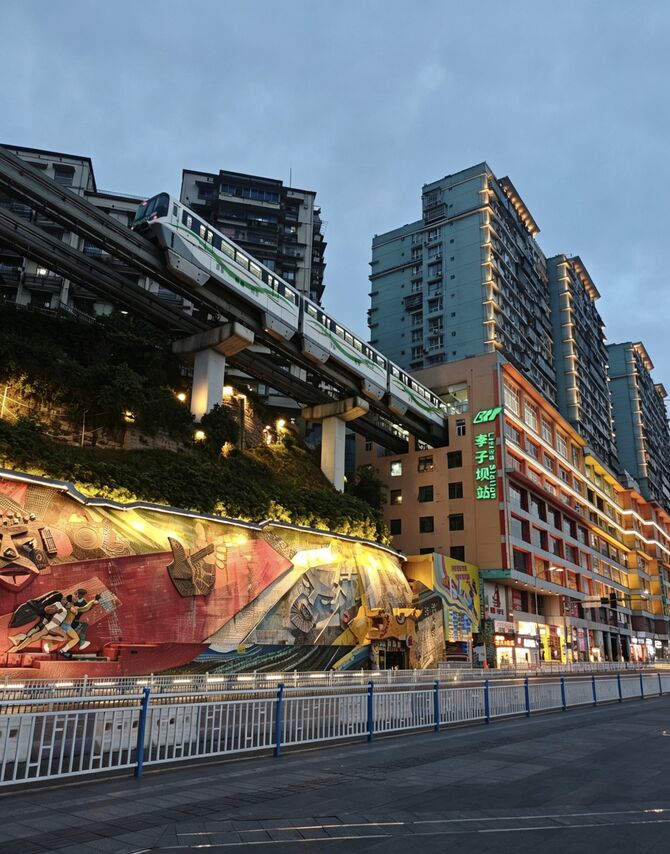
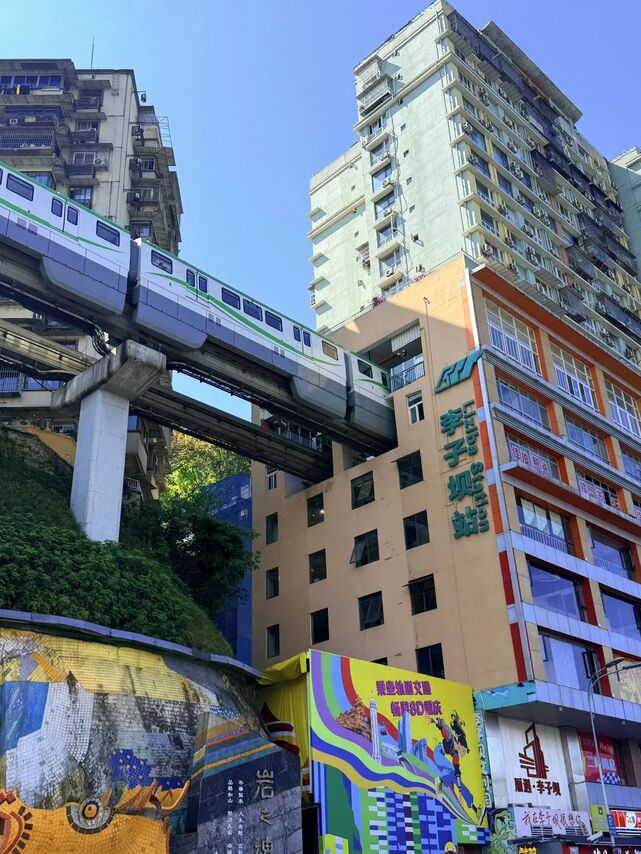
Liziba is on every “cyberpunk Chongqing” list because of one image: a monorail train, mid-journey, emerging from one side of a 19-story apartment building and entering the other. The image is real, the building is real, the residents are real, the trains pass every 3–8 minutes during the day, and you can stand 30 meters away for free.
It is also the attraction most first-time foreign visitors fail to find correctly — because the obvious move (enter the metro station, look for the train inside) is the wrong move. The viewing platform is outside the fare gates.
Two things follow from that which are worth knowing before you build a morning around it. There is nothing to do here except watch and photograph. Twenty-five minutes is the whole visit — five to reach the platform, ten waiting out a train or two, ten shooting — and the people who come away disappointed are almost always the ones who set aside half a day and found there was no second act. If you have two days in Chongqing and you would rather spend an afternoon on hot pot and the river than on a photograph, skipping this costs you very little.
And the platform is level and reached by lift from exit 2, so the photograph itself is within reach of anyone. Everything around it is not: the pavilion above, the wartime park, the walk towards Eling are all stairs and gradient, with no step-free alternative. Travelling with someone who cannot manage that does not rule out Liziba — it rules out treating Liziba as the start of an afternoon on foot.
Where Liziba sits in Chongqing
18 km across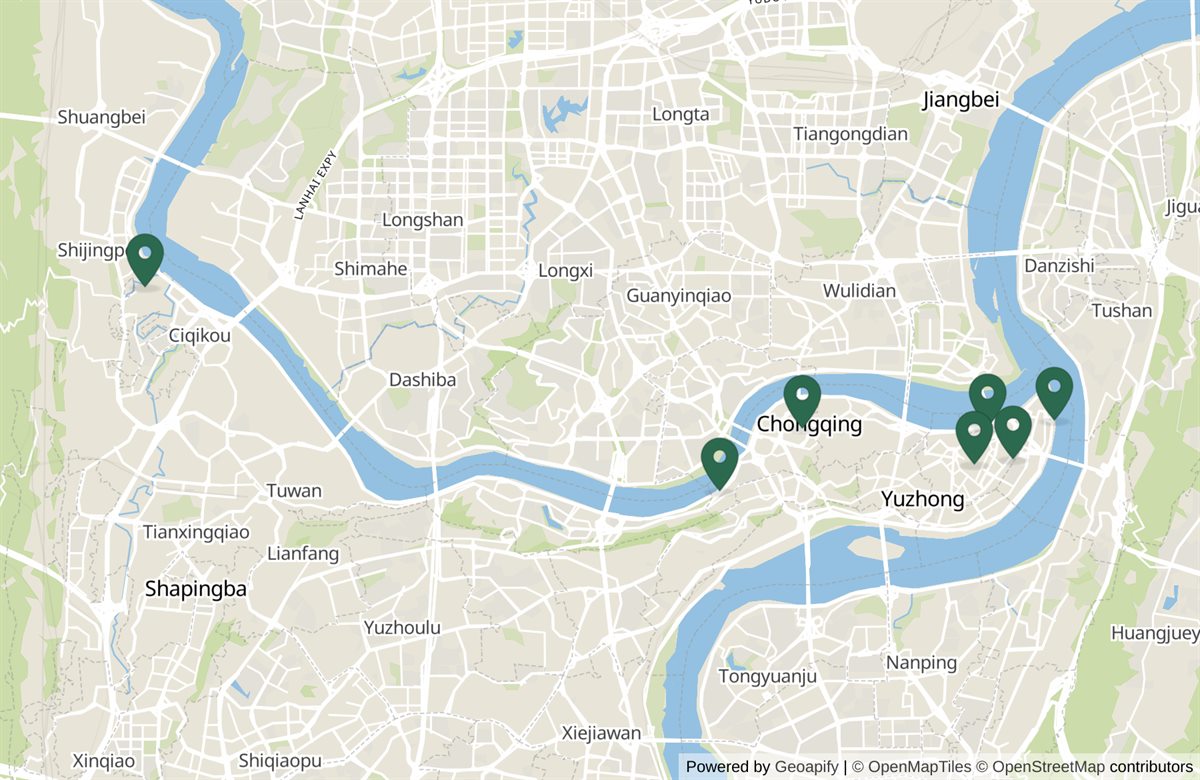 Ciqikou Ancient TownCiqikouLizibaLizibaThree Gorges Museum3 Gorges Museum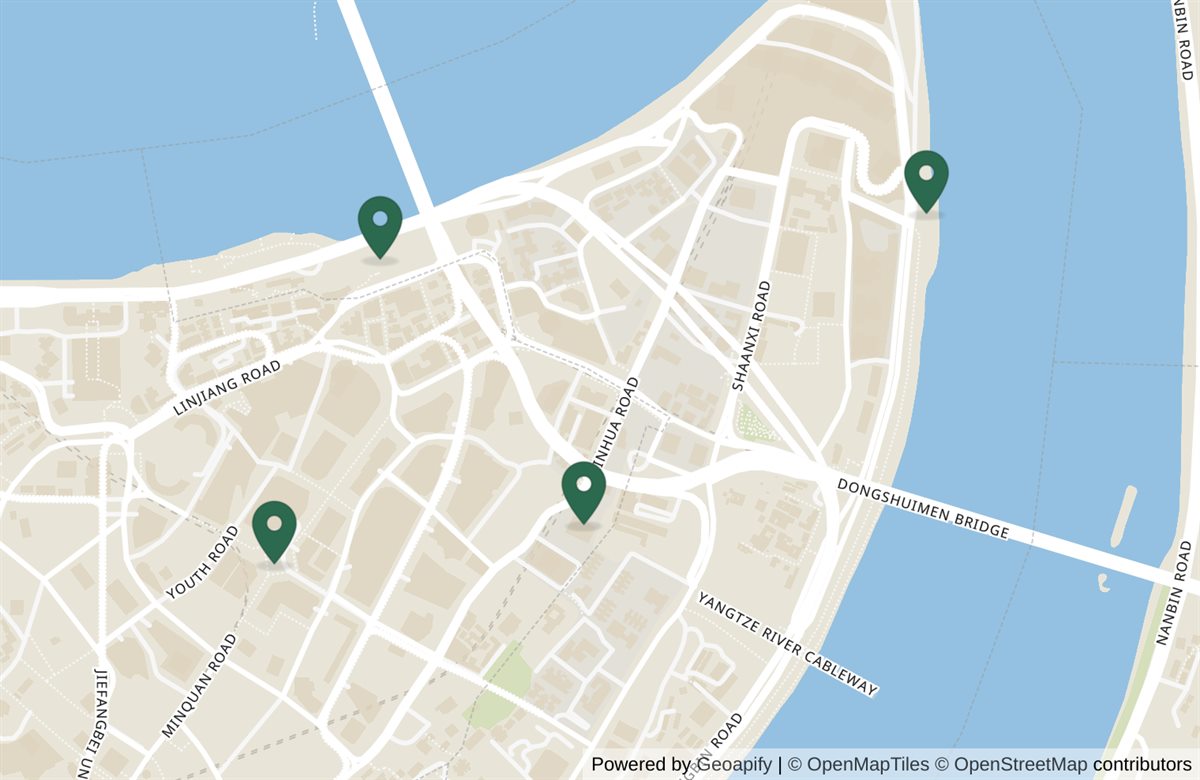
The single thing most visitors get wrong
The photograph you’ve seen is taken from the street-level viewing platform (观景台, guānjǐngtái), outside the metro fare gates, on the road across from the Liziba Building. You do not need a metro ticket, and you do not need to enter the paid metro area. The platform exists because tourists kept trying to get into the residential building’s lobby to see the train from the inside.
The common mistake: tap into Liziba metro station, ride the escalator down, look for a train passing through an apartment, and realize you’re standing on the train. The building is above your head when you’re inside. Use exit 2 — the nearest: follow the indoor 观景台 signs to the lifts, ride down to ground level, then cross the road. Exit 1 also reaches it but loops around and takes a few minutes longer.
Rebuild in progress · through 30 December 2026
Liziba station is being rebuilt in stages — the operator’s stated reason is that visitor numbers now run far beyond what the station was designed to carry. Parts of it are hoarded off behind temporary walls, and which parts changes month by month, so the exit advice above is the normal layout rather than a guarantee of what is open on the day.
- Exit 1 — hoarded in part, 16 Jun to 25 Sep 2026
- Exit 2 — the same, 22 Jun to 20 Sep
- Exit 3 and Hall B — shut completely until 31 Aug
- Hall A — shut completely 1 Sep to 31 Oct, as Hall B reopens
- Platform edges — sections fenced off until 30 Nov
The practical effect is that the station swaps halves at the start of September, and that both exits to the platform are narrowed in the meantime. Follow the temporary signage on the day; it is more current than any guide, this one included.
About the mall signage. Normally the “观景台” arrows that lead you past shops are there to make you spend, and the rule is to follow the official signs to the lifts instead. While the works are on, that rule is suspended: the published diversion for the closed exit runs through the commercial area on the same level, so a route that looks like a detour past shops may be the only way through. Follow the temporary signs.
How to read the building and the train
The Liziba Building (李子坝大厦) is a 19-floor residential tower built around 2003–2005. The bottom five floors are commercial / parking. Floors 6, 7 and 8 are the rail tunnel — a sealed concrete tube with sound insulation and vibration dampers, structurally independent of the apartment columns; no residential units sit on those three floors. Floors 9–19 are normal apartments, about 240 units, fully occupied. Residents quoted by Chongqing Daily report in-apartment noise of about 60–65 dB from a passing train — quieter than a city bus on a normal street, and most people sleep through it.
Line 2 is a straddle-type monorail (跨座式单轨, kuàzuòshì dānguǐ) — the same Hitachi-licensed system used by the Tokyo Haneda Airport monorail. The train sits on top of a single concrete beam; rubber wheels run on top and side guide wheels grip the beam. It was a deliberate choice for Chongqing’s cliff-and-canyon geography: straddle monorail tolerates much tighter curves and steeper grades than heavy-rail metro. There are dozens of elevated-rail-meets-buildings spots along Lines 2 and 3 — Liziba is just the most photogenic.
That covers the two questions visitors ask most when they have never seen a railway routed through housing — how does anybody sleep, and what happens to the flat when a train goes past. One thing to know before you raise a camera: above the tunnel band those are occupied flats, with washing on the balconies and kitchen windows propped open. Frame the train and the tunnel mouth, not the windows — residents live with a viewing platform pointed at their home every day of the year, and the lens angle is the one part of that you control.
When to go
All of the timing here turns on one fact that most write-ups get backwards: the face of the tower you photograph points north-north-east. It takes direct sun in the morning and at no other time — until about 10:30 in August, about 08:30 near the equinoxes, and in midwinter not at all. Come in the afternoon and the sky is bright, the street is bright, and the wall in your photograph is in shade.
Which makes the advice simpler than it is usually made to sound, because the quiet window and the lit window are the same window. 7–9am gives you both: be in place by 8 on a weekday and 8:30 at a weekend, ahead of the coach groups. Mid-week is emptiest in every band. Treat all of it as the ceiling on what is possible rather than a promise — Chongqing is overcast most days, and on those days none of it applies.
Three things catch people out. 10–11:30am reads as the sensible compromise and is the worst of the morning: the sun has come off the building and the queue has already formed. The platform has no shade of any kind, which in July and August matters more than the crowd does — the station’s own indoor reading room watches the same trains from an air-conditioned room. And the deck is far bigger than the queue suggests: what creates the wait is not the deck at all but the walkway serving it, which pinches at one point to about three people abreast. Train frequency by time of day:
| Window | Frequency | Notes |
|---|---|---|
| Early morning 7–9am | Every ~5 min | ⭐ The window. Direct sun on the building face, and often the platform to yourself before 8. |
| Peak hours 7:30–9:30am · 5–7pm | Every ~3 min | Trains most frequent; commuter and tourist crowds at once, and the station entrance can queue. |
| Late morning 10–11:30am | Every 5–8 min | Reads sensible, is not: the facade has gone flat and the coach groups have arrived. |
| Midday 12–3pm | Every 5–8 min | Worst of both — peak crowds on a platform with no shade. A crush on holidays. |
| Afternoon 3–5pm | Every 5–8 min | Crowd thinning, but the face is in shade. Shoot the train and the street, not the building. |
| Late evening after 8pm | Every 6–8 min | Sparse, and the tower is lit only by the street — be at Hongyadong for the light show instead. |
Public holidays (Spring Festival, May Day, National Day): the deck switches to a clockwise one-way circulation — you enter at one end, pass the viewing stretch once and leave at the other, with no going back for a second try. At peak the crossing directly outside is cordoned off as well, which adds about 120 m on foot to the next one. Queues can reach a couple of hours. If you have to go on a holiday, be there at opening; arriving later does not get you a shorter wait, it gets you a slower lap.
Plan to wait one full cycle (~8 minutes off-peak) to guarantee a pass, and stay for 2–3 passes for a few angle variations.
How to get there
Liziba is on Line 2 (yellow / monorail) in the Yuzhong district, on the Jialing River bank. Four sensible approaches:
| From | How | Time · cost |
|---|---|---|
| Jiefangbei / Hongyadong | Line 2 from Jiaochangkou (较场口), 6 stops. Line 2 itself is the straddle monorail you came to photograph. | ~15 min · ¥2 |
| Jiangbei Airport CKG | Line 10 from T3 to Zengjiayan (曾家岩), then Line 2 (2 stops) to Liziba. Heavy bags → 25-min Didi (~¥50). | ~55 min · ¥7 |
| Chongqing North HSR station | Line 10 to Zengjiayan (曾家岩), transfer to Line 2 to Liziba. | ~35 min · ¥5 |
| Hongyadong (downtown) | Walk to Jiaochangkou (较场口) and take Line 2 directly — only a few stops. | ~15 min · ¥2 |
Take the metro even when a taxi looks easier. The 500 m of Liziba Main Street (李子坝正街) outside the station has been under timed one-way traffic management since August 2025, brought in because of the visitor numbers, so a car can sit stationary within sight of the platform while the train you came for goes past. Line 2 is also the thing you came to photograph, which makes the choice easy.
One warning that applies to the whole city and bites hardest around here: walking directions will lie to you. Chongqing is built in layers, and an app that offers you a flat 200 m will not mention that the two ends of it are seven floors apart — at this station the two exits genuinely are, though there is an internal passage with a lift rather than a staircase. It is not a bad map; it is a flat instruction for a vertical city. When a distance looks trivial and the route makes no sense, look for the lift before you commit to walking it.
In a taxi, ask for this
李子坝单轨穿楼观景平台
李子坝正街 62 号
Naming the viewing platform rather than the station matters here for the same reason the rest of this page does: they are two different places, and a driver told “Liziba metro station” will reasonably drop you at the station entrance, on the wrong side of the problem. The street address is the safer thing to show, because it is unambiguous even when the name is not.
The full CKG airport guide covers T2-vs-T3 metro entry points (Line 3 enters at T2/T3, Line 10 only at T3). The interactive Chongqing metro map has all 12 lines with tourist-friendliness scores and a persona-aware view highlighting the routes around Liziba, Hongyadong and Ciqikou.
The viewing platform — what's actually there
The terrace was built in 2018, ahead of the Smart China Expo (智博会) Chongqing began hosting that August. Before it existed people stood in the road to get the shot, which is what it was built to stop — so if a route you found online has you crossing to the far kerb for an angle, it predates the platform.
The platform is an open paved terrace across the road from the building, with a guardrail and info boards in Chinese and English about the engineering. It holds a few dozen people at a time and gets packed on public holidays. It is open 24 hours and free. There is no proper cafe and no standalone public toilet — only a kiosk selling water and the novelty “through-the-building” ice cream (~¥15); the nearest toilet is inside the metro station or a neighbouring mall, so go before you come out.
The train enters the floor-6–8 tunnel from one side and emerges from the other; total visible-passage time is about 4–5 seconds. Phone night mode isn’t needed — daytime exposures are straightforward, and a low-angle 0.5× wide shot works well. For video, start recording before the train enters the tunnel so you don’t miss the framing. There is no glass skywalk here (the cantilevered glass walkway that overlooks Liziba is at Eling Park, a separate attraction); a wider street-corner angle is available from across the road, but power lines crowd the foreground.
The people who will approach you
None of this is dangerous and none of it is particular to Liziba, but it is organised enough to be worth naming in advance — all four approaches work best on somebody who has just come up from a train and is still working out which way to look.
- A ticket for something that is free. The pitch is a “VIP through-the-building experience”, or an “internal passage” that skips the crowd. Neither exists. The platform costs nothing, the ride is the ordinary ¥2 fare, and anyone selling either is charging you for a walk you can take for free.
- Photographers, at around ¥20 a shot with editing included. The complaint that recurs is not the price, it is what happens after it: the edit comes back heavily filtered and requests to redo it go unanswered. If you want somebody else holding the phone, ask another visitor.
- Costumed figures who pose with you and produce a payment QR code once the photograph exists. Some work a deaf-mute angle. Settle a price before the shutter, or decline before the handshake — afterwards is the worst moment to start negotiating.
- Kiosk and souvenir pricing. Not a scam, just a tourist markup: the novelty ice cream is about ¥15 and printed souvenirs run roughly double what the same things cost online.
Chongqing ran a tourism-market enforcement campaign in June 2026 and travellers report the scene here is calmer than it was. Nothing on the public record ties that campaign to this site specifically, so plan for the four approaches above rather than for the crackdown.
If the platform is too crowded to enjoy
There is an indoor alternative most visitors walk straight past: a reading room on the sixth floor of the through-building, with floor-to-ceiling windows onto the track. You watch the same trains from inside, sitting down, in air conditioning, with nobody’s elbows in the shot. It sells Chongqing-themed souvenirs and keeps a large set of collectible rubber stamps, which are the reason many domestic visitors go up; the stamps are free to use but you are expected to buy something first, and a bottle of water clears that bar. Traveller reports put it open from mid-morning until late evening, but the hours are posted at the door and worth a glance before you climb.
One vantage point that has gone: the gap between the two residential towers at the exit-2 end, which produced the tight head-on shots that circulated widely. It has been boarded over and is watched, so a trip made specifically for that angle is a wasted one. Given the station rebuild running through 2026, treat any single photo spot you have seen online as needing confirmation on the day.
The Yuzhong-evening route — Liziba in context
Liziba sits 3.8 km west of the Jiefangbei cluster, on the same peninsula and the same metro line — which is the whole reason it works as the first stop rather than the last. Photograph the train here, ride Line 2 east, and arrive at Jiefangbei with the light going. The other way round means doubling back over ground you have already covered. The city map at the top of this page shows the spacing.
Be clear about what that costs, because nothing else written about this route says it: an evening that starts here starts after the sun has left the building. The chain is built around Hongyadong at light-on and it is worth doing on those terms — but if the through-the-building photograph is the thing you came to Chongqing for, take it on a separate morning and begin the evening somewhere else. The good photograph and the good evening are not the same trip.
Liziba is rarely a standalone stop. The standard pairing for first-time visitors with 2–3 days in Chongqing slots it as the late-afternoon first stop, timed to put you on the bridge just before Hongyadong lights up. The clock below is the winter schedule, built around an 18:30 light-on — in summer the lights do not come on until 20:00, so shift every row about ninety minutes later.
| Time | Stop | What |
|---|---|---|
| 4:00pm | Liziba Station | Line 2 to Liziba, exit 2, viewing platform. Stay ~25 min for 3–4 train passes. |
| 4:45pm | Line 2 east | Ride to Jiaochangkou (较场口); get off near Bayi Lu (八一路), the hot-pot street. |
| 5:15pm | Hot-pot dinner | Eat before Hongyadong, not after, so you reach Qiansimen Bridge before the lights come on (about 18:30 in winter, 20:00 in summer). A split-pot (鸳鸯锅) is the standard first-timer pick. |
| 6:15pm | Qiansimen Bridge | Walk down Cangbai Road, cross to the Jiangbei side; the canonical Hongyadong night photo is from here as the lights come on. |
| 7:00pm | Walk Hongyadong | Walk down through all 11 floors to the riverside — the 8D-vertical complex is best walked downward. |
It is the standard first-timer’s evening in Chongqing for a reason: it compresses the three landmark photographs of the city — the monorail through a building, the cliff-side stilt houses lit at night, the downtown skyline across the river — into one three-and-a-half-hour run with a hot-pot dinner in the middle. See our Hongyadong night-view guide for the floor-by-floor logic.
Book a Chongqing day tour — 3 platforms compared
Sorted by format, not commission · all take a foreign card & English checkout
- GetYourGuide★ Editor’s pick
Chongqing Deep Explore — Private Car Service (incl. meals)
★ 4.9(118 reviews)Private carFull day · mealsFree cancellation
Verified Aug 2026 · re-checked quarterly
Book on GetYourGuide$189from · per person - Viator
Chongqing 8D Mountain-City Full-Day Join-In Tour
★ 4.8(43 reviews)Group join-in7–8 hoursPickupFree cancellation
Verified Aug 2026 · option pre-selected on landing
Book on Viator$49from · per person 
Chongqing 10-Hour Customized Tour (optional English guide)
Custom privateBuild your own route10 hours
Verified Aug 2026 · re-checked quarterly
Book on Trip.comCustomprice varies by configuration
Editor’s note: private car (GetYourGuide) for comfort and meals · group join-in (Viator) for value · fully custom (Trip.com) to pick the stops. We sort by format, not commission.
What's walkable from Liziba
Liziba isn’t only the train — two things sit within a short walk and pair naturally with a visit, so you’re not riding all the way in for 25 minutes and back out:
- E’ling Er Chang (鹅岭贰厂 / TESTBED2). About 360 m from the platform, but a 10-minute walk because it is all uphill. A 1950s printing-factory complex converted into an art-and-design park; the rooftop is the one from the film 从你的全世界路过 (2016), with a wide view over the Yuzhong rooftops. Free to enter. Going the other way — downhill from Er Chang to Liziba — is the version your legs will thank you for.
- Liziba Anti-Japanese War Heritage Park (李子坝抗战遗址公园). About 300 m / 5 minutes, and it shares a street number block with the viewing platform — both are addressed on 李子坝正街. A quiet hillside park of preserved 1930s–40s wartime-capital buildings — rarely crowded, free, and a calm counterpoint to the platform crush.
- Lansheng Pavilion (揽胜亭). About 370 m as the crow flies, but roughly 700 m of switchback climbing, so allow 10–15 minutes. It is the opposite view to the one everybody takes: instead of standing under the building looking up, you are above it, with the train, the tower and the Jialing River in a single frame. Far fewer people make the climb.
What to skip / watch for
- Costumed-character photos (“bronze man”, Monkey King) — they pose with you first and produce the price afterwards, and the ask has an edge to it: the usual follow-up is a printed card describing the performer as a deaf-mute collecting for charity, at which point refusing feels like the wrong thing to do. It is a fee, not a donation. Decline before the photo, not after.
- Anyone selling admission of any kind — a “fast-track” pass, a booking fee, a glass-walkway fee. There is no gate here to skip and no walkway to pay for, so every one of those is invented. The platform also keeps free wooden props for the forced-perspective “eating the train” shot, which is the same picture the roadside photographers charge for.
- Taxi drivers who say “Liziba is too crowded” and steer you to another viewpoint (e.g. “131”) — it’s a commission detour; book a DiDi on your phone instead.
- Roadside ¥50–100 day tours — most bundle forced shopping stops (jade, “specialty” shops); go DIY or use a reputable operator.
- Platform postcards / magnets and “pro photographer” offers — tourist-priced; phone shots are fine, ask another tourist to swap phones.
- Entering the residential building — the lobby is closed to non-residents (they have posted notices); nothing inside you can’t see from the platform.
Where to stay nearby
You don’t stay at Liziba — it’s residential, with no tourist hotels of consequence on the immediate block. Base on the Yuzhong Peninsula by Jiefangbei instead: walking distance to Hongyadong and about 10 minutes by Line 2 to Liziba. The sensible call for a first China trip is a home-grown mid-range chain in the downtown core.
Frequently asked questions
How do you pronounce Liziba?
[lee-dzee-bah] — three syllables, falling-rising-falling tones in Mandarin (Lǐzǐbà) but you'll be understood without them. The name 李子坝 literally means 'plum dam' — 李子 (lǐzǐ) is the plum fruit and 坝 (bà) is a Sichuan / Chongqing place-name suffix meaning 'flat ground beside water', not a literal dam. The whole area is a residential neighborhood on the Jialing River bank in the Yuzhong district — historically named for old plum orchards. Locals say it identically to the standard Mandarin pronunciation; you can also point at a phone showing 李子坝 and the metro fare-gate staff will route you correctly.
Is it free? Do I need a metro ticket to see the train?
Free, and no metro ticket is required for the canonical photograph. The viewing platform (观景台, guānjǐngtái) sits at street level OUTSIDE the metro turnstiles — you don't enter the paid metro area at all. Most first-time foreign visitors enter the station, ride the escalator down, and then have to figure out they're in the wrong place. The platform is on the street side of the building, accessed from the ground-level pedestrian walkway. If you also want to ride Line 2 to or from Liziba, the fare is ¥2-3 within central Chongqing (the city's flat-rate metro pricing) — pay by Alipay or WeChat Pay tap-in.
What's the best photo spot for the Liziba monorail?
The official viewing platform (观景台), on the road across from the building — reached from metro exit 2 (follow the indoor 观景台 signs to the lifts, ride down to ground level, then cross the road; exit 1 also works but loops around). This is where every 'monorail through a building' post was actually taken: a clean side-on view of the train passing through floors 6-8 of the tower. For variety there are two quieter angles nearby — Lansheng Pavilion (揽胜亭), where you can frame the train, the tower and the river together, and the canyon-edge street corner across the road (power lines crowd the foreground). The Eling Park glass skywalk gives a high overlook of the whole scene but is a separate, ticketed attraction. First-time visitors should default to the official platform.
How often do the trains pass through? When should I show up?
Every 3-8 minutes during the day. The station runs roughly 6:30am to 11pm; trains are most frequent during the morning and evening commute (about every 3 minutes) and least between them (5-8 minutes), so waiting is never the problem here — standing room is. Come 7-9am. The face of the tower you photograph points north-north-east, which means it takes direct sun in the morning and at no other time: until about 10:30 in August, about 08:30 near the equinoxes, and in midwinter not at all. That is also the window before the coach groups arrive, so the quiet hour and the lit hour are the same hour — be in place by 8 on a weekday and 8:30 at a weekend. Avoid 10-11:30am, which reads as the sensible compromise and is the worst of the morning: the sun has come off the building and the queue has already formed. The platform has no shade of any kind, which in July and August matters more than the crowd does. One thing worth knowing before you arrive: write off the first train. When one comes everybody surges forward at once and lifts a phone, so the first attempt is a photograph of the back of somebody's head. Watch where the gap opens, decide where you want to stand, and shoot the second one — it costs about five minutes. For evening shots, Hongyadong from Qiansimen Bridge is the better target.
How does the train actually work? Does it damage the building?
Chongqing Line 2 is a straddle-type (跨座式) monorail, not heavy rail — the train cars sit on top of a single concrete beam, rubber wheels run on top and side guide wheels grip the beam. This is the same Hitachi-licensed monorail system used in Tokyo's Haneda Airport monorail. The section through Liziba Building has a sealed sound-insulated tunnel built into floors 6-8 of the 19-floor residential tower; the tunnel is structurally independent of the apartments and has vibration dampers between the rail beam and the building frame. Residents report ~60-65 dB peak inside neighboring apartments — quieter than a city bus passing on a normal street. Chongqing Daily has published interviews with residents who genuinely sleep through trains. The arrangement is structurally similar to elevated metro lines that pass through dense urban canyons in any city; the only unusual feature is that the 'canyon' is one building.
How do I get there from downtown, the airport, or Hongyadong?
From Jiefangbei / Hongyadong downtown: Metro Line 2 (yellow / monorail) from Jiaochangkou (较场口), 6 stops, ~15 minutes, ¥2. From Chongqing Jiangbei Airport (CKG): Line 10 from CKG T3 to Zengjiayan (曾家岩), then transfer to Line 2 (2 stops) to Liziba — about 55 minutes total, ¥7. (Heavy luggage? A 25-minute Didi is ~¥50.) From Chongqing North HSR Station: Line 10 to Zengjiayan (曾家岩), transfer to Line 2 to Liziba — about 35 minutes, ¥5. The interactive Chongqing metro map at /cities/chongqing/ has all 12 lines with tourist-friendliness scores.
How long should I plan for Liziba?
25 minutes is the right answer for a first visit: 5 minutes to reach the viewing platform from exit 2, 7-10 minutes to wait through 1-2 train passes, 5-10 minutes for photos including a wider street-corner angle. Photographers chasing a specific light angle or doing video work should plan 45-60 minutes. Treating it as an area rather than a photo stop is a different budget again — climbing to Lansheng Pavilion for the view from above, going up to the sixth-floor reading room, and walking to the wartime heritage park or E'ling Er Chang turns it into a half-day, and the hills between them are why. The standard tourist evening route adds Liziba as the 4:00-4:30pm first stop, then continues via Line 2 east to Jiaochangkou → walk to Hongyadong for light-on (about 18:30 in winter, 20:00 in summer) → Bayi Lu hot pot dinner.
Is Liziba still open? I have read that the station is being rebuilt.
It is open, and the trains run normally. The viewing platform sits outside the station in any case, so the thing you came to see is unaffected. What is affected is the walk in: the station is being rebuilt in stages until 30 December 2026, with different exits and ticket halls hoarded off at different times — and at the start of September the closures swap from one hall to the other. The operator's stated reason is that visitor numbers now far exceed what the station was built to handle. Nothing about the visit is cancelled; the route in is just less predictable than any diagram, so follow the temporary signs on the day rather than a memorised exit number.
Can I ride the monorail through the building, and does it cost extra?
You can, and it is the same ¥2 as any other hop on Line 2 — there is no separate fare or experience ticket, whatever anyone at street level tells you. You also do not need a long journey to do it: the through-building section is at Liziba itself, so boarding one stop away is enough, and starting further down the line buys you nothing. Stand at the front of the leading carriage if you want the view down the track into the tunnel mouth. Be clear that riding it and photographing it are two separate visits, though. From inside it is four or five seconds of dim wall, and you cannot see the shot everybody comes for, because you are in it.
Why was a monorail built through a residential building? Which came first?
Both the Line 2 monorail and the Liziba Building (李子坝大厦) were planned in parallel from roughly 2003-2005. The 'which came first' question that foreign tourists love to ask doesn't have a clean answer — the building's structural engineering and Line 2's alignment were coordinated by the developer (a Chongqing real-estate firm) and Chongqing Rail Transit Group during design. The street axis through Liziba is constrained by river-cliff geography on one side and a steep hill on the other; the monorail's natural alignment ran exactly through the spot the developer had a land lease for. Rather than relocate either, both teams designed around the floors-6-8 tunnel from the start. Line 2 opened in June 2005 and the residential tower opened a few months earlier. The arrangement was unremarkable locally — Chongqing has dozens of elevated-rail-meets-buildings situations because of the cliff geography — until Douyin discovered it around 2016-2017 and the foreign-language internet picked it up in 2018-2019.
Are the apartments above and below the rail tunnel actually inhabited? Can I visit one?
Yes, the building is a normal residential tower with around 240 occupied units across 19 floors. The 6-8 floor band that contains the rail tunnel uses those floors for the tunnel itself plus mechanical equipment — no residential units on those three floors. You cannot tour residential units (this is a private building with controlled access); the lobby is closed to non-residents. The viewing platform was built specifically because tourists were trying to enter the lobby to see the trains 'from the inside', and that became a nuisance. A small ground-floor cafe near the platform has wall photos of the construction and a few residents' interviews — that's the closest thing to an inside view that's open to visitors.
Sources
Checked August 2026 · Written from our own first-hand travel in China.