An editorial guide from the Chongqing-based China for Travelers team. The routing, ticket process, crowd timing and site layout are aggregated from official information and 2024–2026 visitor reports; the carving dates, UNESCO inscription, Guanyin restoration figures and the Black Myth: Wukong reference are sourced. Confirm the current numbers before you book.
Key takeaways
- A UNESCO Buddhist sculpture complex — 50,000+ figures carved over 600 years, from the 9th to the 13th century.
- It is ~35 min by HSR from Chongqing North to Dazu South; from there a taxi (~¥80–100) or a 204+205 bus transfer — no direct shuttle. A downtown tourist coach (¥48 one way, ¥78 return) also runs, with one 16:00 departure home.
- Baodingshan is the headliner (31m reclining Buddha + 1,000-arm Guanyin); Beishan is older and quieter — add it only with 4+ hours.
- The combined ticket is RMB 140 (RMB 120 in low season, Dec–Feb); tickets are real-name, so bring your passport.
- Arrive 9:00–9:30am ahead of the tour-bus rush; skip Dazu if you only have a single day in Chongqing.
What the Dazu Rock Carvings are
Most travel writers underplay Dazu because “rocks with carvings” doesn’t catch the imagination the way the Avatar mountains do. But Dazu is closer to a 1,000-year-old open-air cathedral than a curiosity: 50,000+ individual figures across five cliff sites, sculptural detail that rivals Romanesque-period Europe, and a continuous tradition of Buddhist art that only ended in the late Song dynasty (about 1250 CE).
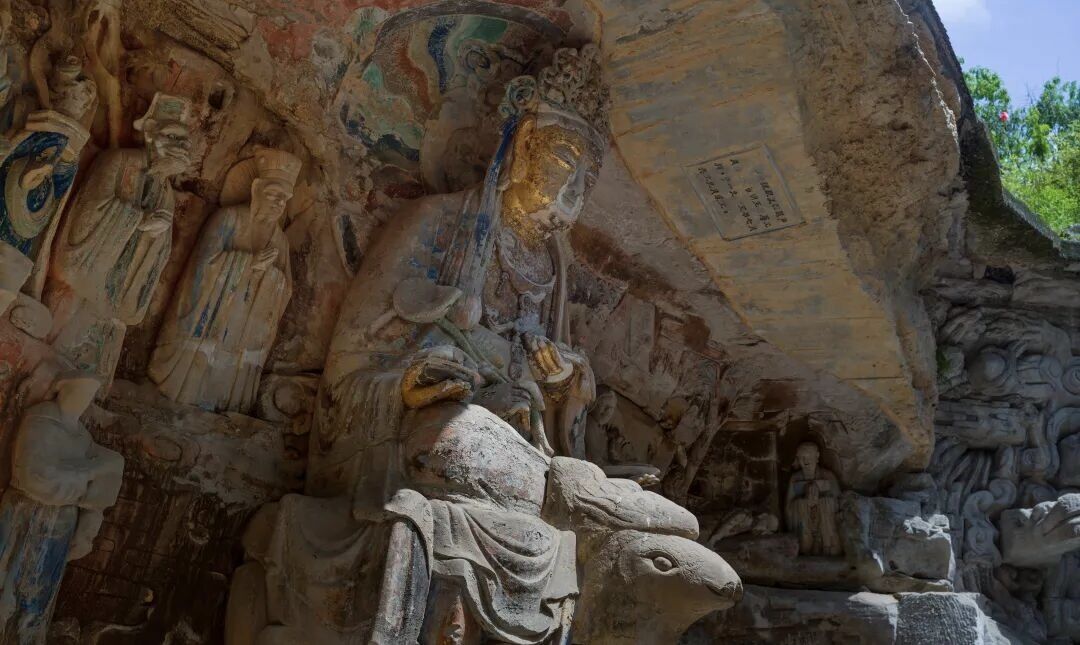
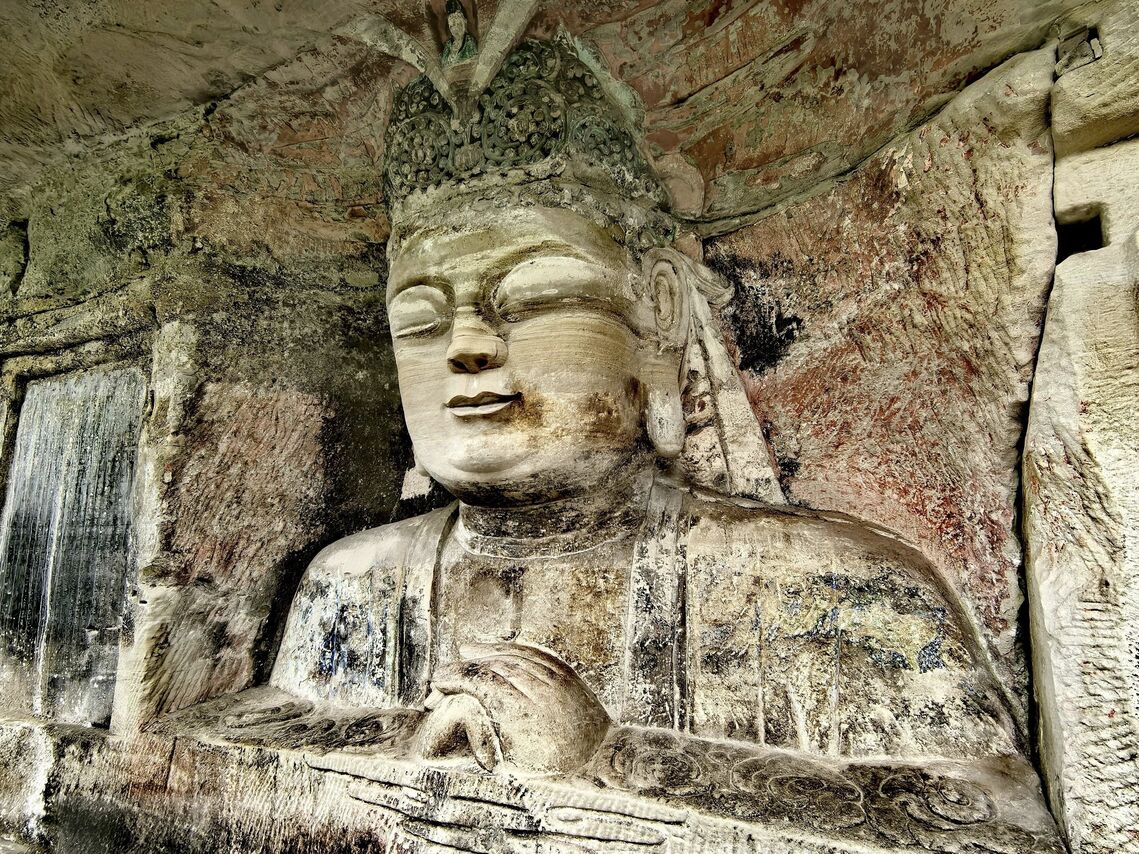
The earliest work is at Beishan (北山, “North Hill”), where 9th-century carvings line a 300 m stretch of sandstone cliff. The most famous work is at Baodingshan (宝顶山, “Treasure Summit Hill”), commissioned by the Song-dynasty monk Zhao Zhifeng from 1174 CE — about 10,000 figures organized into elaborate didactic narrative panels. UNESCO inscribed Dazu in 1999, citing its “remarkable aesthetic quality and rich diversity of subject matter, both secular and religious.” The protected area covers 75 cliff sites; only five are open to tourists, and most foreign visitors only see Baodingshan plus an optional Beishan side trip.
How to get there from Chongqing
Four sensible ways out. The downtown tourist coach is the easiest no-transfer DIY; the English group tour is the better call for a first-time foreign visitor who wants the panels interpreted.
| Option | Cost | Time | Best for |
|---|---|---|---|
| Downtown tourist coach | ¥48 one way · ¥78 return | 9–10 hrs | Easiest DIY — direct, no transfer |
| HSR + taxi / bus transfer | ~¥160–220 total / pp | 9–10 hrs | Fastest if you taxi the last leg |
| Trip.com English group tour | USD $50–70 / pp | 9–10 hrs | First-time foreigners |
| Private driver | ¥1,200–1,800 / day | 9–10 hrs | Groups of 3–4 sharing |
Option A: direct tourist coach (easiest)
A downtown tourist coach runs from central Chongqing — pickup at Jiefangbei (08:00) and Hongqihegou (08:30) — to the Baodingshan visitor centre for ¥48 one way, ¥78 return. No transfer, but a scheduled 30-minute stop at 昌州古城 is part of the fare, so allow about three hours rather than two. There is one coach back, at 16:00 — the day is built backwards from that, not from the closing time. It’s the simplest door-to-door option if your timing fits its schedule (book a day ahead in peak season).
Option B: high-speed rail + transfer
From Chongqing North Station (重庆北站) take an HSR train to Dazu South (大足南站) — about 35 minutes, ¥32–43 in 2nd class, frequent departures. Book via the 12306 English app 15 days ahead. Important: Dazu South has no direct shuttle to the carvings — the station is ~40 km out. Take a taxi / Didi (~¥80–100, 50–60 min), or the cheap two-bus route (bus 204 to Dazu bus station, then bus 205 to Baodingshan, ~2 hours, ¥9 total). Ignore touts at the exit quoting “¥80 carpool” — that’s just the normal Didi fare.
Option C: Trip.com English group day tour
USD $50–70 per person, hotel pickup around 8am, return 6pm — round-trip transport, the combined ticket, and a bilingual guide. The guide context matters more at Dazu than at most attractions: you’re looking at 800-year-old narrative panels that need interpretation to make sense.
Option D: private driver
¥1,200–1,800 for a 10-hour day — worth it for a group of 3–4 splitting the cost (about ¥400–600/pp). Less English support than the group tour but more flexible: you can add a Tujia-minority lunch stop, or a short detour to one of the lesser Dazu sites.
Book the Dazu English-guide day tourNASDAQ: TCOM
Rather not work out the coach schedule or the HSR-plus-transfer yourself? Trip.com’s English group tour bundles round-trip transport, the combined ticket and a guide who interprets the panels — which matters more at Dazu than at any other Chongqing day trip. There’s also a Black Myth: Wukong-themed version with the same itinerary.
Beishan vs Baodingshan — which one?
This is the single decision that shapes your day. Both are on the combo ticket, but they feel very different.
| Site | Era | Time | Why go |
|---|---|---|---|
| Baodingshan 宝顶山 | Song, 1174–1252 | 1.5–2 hrs | The headliner — 31m reclining Buddha, 1,000-arm Guanyin, dense narrative panels. |
| Beishan 北山 | late 9th c. onward | 1–1.5 hrs | Older, quieter, scattered over 290 niches; finest single carving at Dazu (#136). |
Baodingshan is the must-do. The 31m reclining Buddha (Sakyamuni entering parinirvana) is the largest single carving — the head alone is 5 m tall, the body extending into the cliff. Adjacent is the gilded 1,000-arm Guanyin (千手观音, actually 1,007 arms), which underwent the largest single restoration project in modern Chinese history (2008–2015, RMB 75 million, re-gilded by hand). Add the Wheel of Reincarnation, the Parents’ Kindness Sutra panels and the Pasturing-Ox sequence and most visitors spend 90 minutes; enthusiasts, three hours.
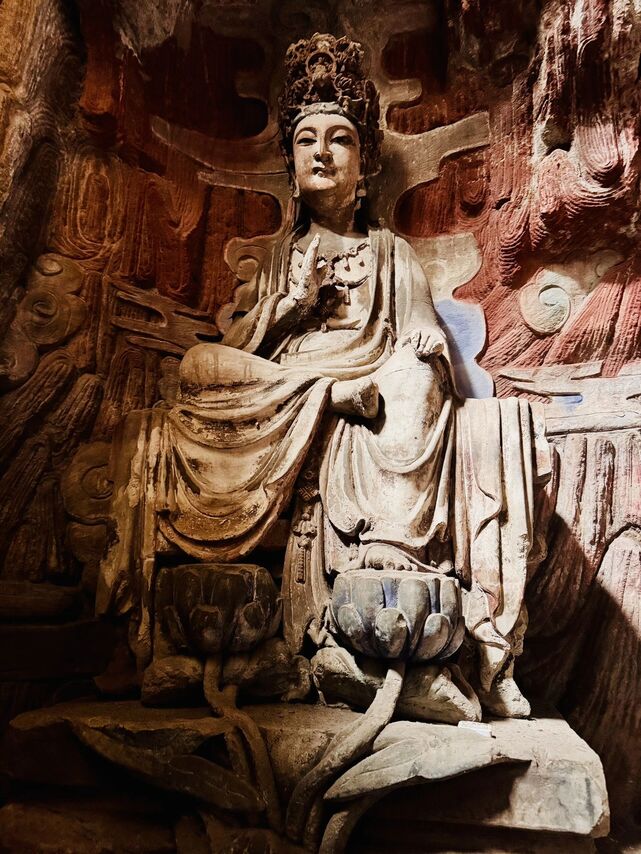
Beishan is the hidden layer — carved earlier and more scattered along a 300 m cliff face. Less dramatic than Baodingshan’s panels, but niche #136 (Cintamanicakra Avalokiteshvara, 转轮经藏窟) is widely considered the single finest carving at Dazu. Add Beishan only if you have 4+ hours on-site; with three hours or fewer, do Baodingshan and skip it. Between the two sites it is 10.6 km, about 18 minutes — a taxi (~¥30) or the flat-fare ¥3 大足旅游公交专线, which calls at both. There is no scenic-area shuttle between them.
Tickets & what they cost
Prices are seasonal — low season is Dec–Feb only, and about 15% off rather than half. Most foreigners take the combo even if they only intend Baodingshan, since Beishan is a short hop and 90 minutes there is realistic.
| Ticket | Price | Note |
|---|---|---|
| Baodingshan single | RMB 115 / 100 | High (Mar–Nov) / low (Dec–Feb). The headliner; enough for most foreign visitors. |
| Beishan single | RMB 70 / 50 | Older, quieter site ~20 min away. |
| Combined | RMB 140 / 120 | Both sites, valid 3 days — cheaper than the RMB 185 of buying separately. |
| Combined + Baodingshan transport | RMB 145 | ¥82 concession, valid two days. Covers the up/down bus and the cart — the version most people should buy. |
| Concession | RMB 53 / 31 | Baodingshan / Beishan, for students and 60–64s. Not a low-season fare. |
| English audio guide | RMB 30 | Multilingual, at the Baodingshan visitor centre. |
Inside the park: the new visitor centre is ~3–4 km from the Dabowan core carvings — you ride the up/down tourist bus, and inside the site an electric cart runs at ¥15 one way or ¥25 return. Both are covered if your ticket includes Baodingshan transport. The route is one-way, so you come back down from a different point than you went up from. Since July 2022 all ticketing happens at the visitor centre — the carvings themselves no longer sell or check tickets, so you cannot skip it. Book ahead: on weekends and in peak season Baodingshan caps numbers and can sell out — reserve on the official “大足石刻” WeChat account or Trip.com; buying on the spot can mean a 1-hour wait. Tickets are real-name (实名制) — bring your passport; pay by cash, WeChat Pay or Alipay (foreign-card POS is hit-or-miss). A valid international student ID (ISIC) gets about 50% off.
The 5 carvings worth slowing down for
If you do nothing else, find these five — four at Baodingshan, one at Beishan.
| Carving | Where | Why it matters |
|---|---|---|
| Reclining Buddha Sakyamuni Parinirvana | Baodingshan | 31 m long, head 5 m tall, body into the cliff (carved 1174–1182) — one of the largest single sculptural narratives in Chinese Buddhist art. |
| 1,000-arm Guanyin 千手观音 | Baodingshan | 1,007 hands, fully gilded; the 2008–2015 restoration replaced 270 hands using traditional lacquer-and-leaf technique. |
| Wheel of Reincarnation 六道轮回 | Baodingshan | A complete Buddhist cosmology as one mandala panel; Black Myth: Wukong references it directly. |
| Parents’ Kindness Sutra | Baodingshan | Ten panels on filial piety with rare secular detail — one of the best sources for Song-dynasty daily life. |
| Niche #136 Cintamanicakra Avalokiteshvara | Beishan | Late-Tang into early-Song style — flowing drapery, serene face; widely held as Dazu’s finest single carving. |
When to go
Arrive at Baodingshan at 9:00–9:30am, ahead of the tour-bus rush from Chongqing (which lands 10:30–11am). You get the reclining Buddha and the 1,000-arm Guanyin without crowds, then loop back for lunch around noon and do Beishan in the afternoon if you bought the combo. Baodingshan runs 9am–6pm with last ticket-check at 4:30pm; Beishan keeps similar hours and adds a summer night session (~7:30–11pm, May–Sep).
| Season | Conditions | Verdict |
|---|---|---|
| Apr–May | 18–25°C, dry, good morning light | Best window. |
| Sep–Oct | 18–25°C, dry | Equal best — but avoid the Oct 1 Golden Week. |
| Dec–Feb | 5–12°C, very clear | Often the lowest-crowd window. |
| Jul–Aug | 32–36°C, stone radiates heat | Hot and tiring by midday. |
Avoid the three Chinese Golden Weeks (Spring Festival, May 1, Oct 1) — Baodingshan can hit 90-minute queues. The carvings are sheltered, but heavy-rain weeks make the cliff paths slippery and darken the sandstone, flattening photographic contrast.
Cultural context for Western visitors
If you’ve seen European cathedral sculpture (Reims, Chartres, Romanesque-era work), Dazu sits in a similar register — religious iconography executed at the level of narrative storytelling rather than abstract devotion. The closest Western comparison is the door-jamb sculpture of French Gothic cathedrals, but carved into living cliff face rather than free-standing stone.
Don’t expect the austere serenity of the Longmen Grottoes — Dazu is more storytelling, more secular detail, more colorful, with some pieces still carrying original 12th-century pigment. It is distinctly Chinese-syncretic: Mahayana Buddhism blended with Confucian filial-piety themes and a little Daoism. If your only interest is Tibetan or Indian Buddhist art, this is a different tradition.
The Black Myth: Wukong link is real, not promotional fiction — Game Science confirmed Dazu as a primary visual reference, and the Wheel of Reincarnation and Demon-Subduing Vajra carvings appear in the 2024 game. For Western gamers visiting in 2026, Dazu is the closest “real” location to the game’s Buddhist visual language.
How Dazu fits in a Chongqing trip
Most foreigners do Dazu as Day 3 of a three-day Chongqing trip — Day 1 the city core, Day 2 either Wulong Karst or a Yangtze cruise embarkation, Day 3 Dazu. See the city page for the full 2/3/5-day Chongqing itinerary. If you only have two days in Chongqing total, pick Wulong Karst over Dazu — Wulong’s landscape is more universally photogenic, while Dazu rewards a specific interest in Buddhist art history.
When NOT to visit
- A single-day Chongqing trip — Dazu eats the whole day.
- The three Golden Weeks (Spring Festival, May 1, Oct 1) — queues and crush.
- Heavy summer rain weeks — cliff paths get slippery and the stone darkens.
- Strict mobility limits — some Beishan niches need uneven stair climbs.
- If your only Buddhist-art interest is Tibetan or Indian — Dazu is distinctly Chinese-syncretic Mahayana.
Where to stay
Dazu is a ~1.5-hour day trip, so for almost everyone the honest answer is: don’t stay at Dazu at all — base in central Chongqing and come back the same evening. The sensible call for a first China trip is a home-grown mid-range chain in the downtown core.
Frequently asked questions
Are the Dazu Rock Carvings worth it?
Yes — particularly if you have an interest in Buddhist art, Tang-Song Chinese history, or you played Black Myth: Wukong (the 2024 game references Dazu's iconography heavily). Most foreigners who skip Dazu cite 'just rocks with carvings' but the actual experience is closer to a 1,000-year-old open-air museum: 50,000+ figures across 5 cliffs, the level of detail rivals European cathedral sculpture, and the colors on some pieces are still original. Allow 4-6 hours including travel. Skip if you only have 1 short day in Chongqing.
How do I get to Dazu Rock Carvings from Chongqing?
Three options. (1) Tourist coach (easiest DIY): a coach runs from downtown Chongqing — Jiefangbei at 08:00, Hongqihegou at 08:30 — to the Baodingshan visitor centre for ¥48 one way or ¥78 return. No transfer, but not direct either: a 30-minute stop at 昌州古城 is part of the product, so allow about three hours. ⚠️ It runs ONE return, at 16:00 from the Baodingshan car park — that, not the 18:00 closing time, is what the day has to be planned backwards from. (2) HSR then transfer: Chongqing North → Dazu South (~35 min, ¥32–43 in 2nd class, frequent trains), but Dazu South has NO direct shuttle to the carvings — it's a taxi (~¥80–100, 50-60 min) or a two-bus transfer (204 then 205, ~2 hours, ¥9 total). (3) Trip.com group day tour with English guide (USD $50-70, hotel pickup, combined ticket) — best for first-time foreign visitors who want the panels interpreted.
How old are the Dazu Rock Carvings?
The earliest carvings date to around 650 CE (Tang dynasty) and the cluster expanded continuously through the Song dynasty until about 1250 CE — so roughly 600 years of continuous Buddhist sculpture. Beishan (北山) was carved earliest, starting in the late 9th century. Baodingshan (宝顶山), the most-visited site, is mostly Southern Song work from 1174-1252, when monk Zhao Zhifeng commissioned the elaborate didactic narrative scenes that distinguish Dazu from other Chinese Buddhist grotto sites.
Are the Dazu Rock Carvings a UNESCO World Heritage site?
Yes. UNESCO inscribed Dazu Rock Carvings as a World Heritage Site in 1999, citing the 'unique aesthetic of secular and religious carvings' and the harmonious blending of Buddhism, Daoism, and Confucianism. The protected area covers 75 separate cliff sites; only 5 are open to tourists (Baodingshan, Beishan, Nanshan, Shimenshan, Shizhuanshan). Most visitors only see Baodingshan, which contains the most famous individual sculptures.
Should I visit Beishan or Baodingshan first?
Most foreigners only need Baodingshan — it's the headliner with the 31m reclining Buddha, the 1,000-arm Guanyin (the largest single restoration project in modern Chinese history, completed 2015), and the elaborate Wheel of Reincarnation panel. Allow 1.5-2 hours. Beishan is older (9th century) and quieter but more scattered — worth adding only if you have 4+ hours on-site and care about historical depth. The combo ticket includes both; if you have 3 hours total, do Baodingshan and skip Beishan.
What does the Dazu combo ticket cost in 2026?
Prices are seasonal, but not on the calendar most guides print: high season runs Mar 1–Nov 30 and low season only Dec 1 to the end of February, and low season is about 15% off rather than half. Baodingshan single: RMB 115 at the gate, ¥110 online, 100 in low season. Beishan single: RMB 70 at the gate but ¥58 online — worth knowing, because almost every guide prints the gate figure. Baodingshan + Beishan combo: RMB 140 / 120. Students and 60-64s pay a concession instead — roughly RMB 53 for Baodingshan and 31 for Beishan — which is the figure often misquoted as a low-season price; over-65s go free on ID. The version worth buying is the combined ticket WITH Baodingshan transport at ¥145 (¥82 concession, valid two days), because the buses inside are not really optional. Tickets are valid 3 days. A multilingual audio guide (English included) rents for ¥30 at the Baodingshan visitor centre.
What is the Black Myth: Wukong connection at Dazu?
Black Myth: Wukong (the 2024 Chinese-developed action game) draws heavily on Buddhist sculpture iconography from across China, and several locations in the game reference Dazu specifically — particularly the Wheel of Reincarnation panel at Baodingshan and the Demon-Subduing Vajra carvings. The game's success drove a 2024-25 visitor surge; Trip.com now sells a Black-Myth-themed Dazu tour. For Western gamers visiting in 2026, Dazu is the closest 'real' location to the game's Buddhist visual language. The connection isn't promotional fiction — Game Science (the developer) confirmed Dazu as a primary visual reference.
When is the best time to visit Dazu and what should I avoid?
April-May and September-October are the best windows — comfortable 18-25°C, dry, and the cliff faces have good morning light. Summer (July-August) is hot (32-36°C) and the stone paths radiate heat by midday. Winter (December-February) is cool (5-12°C) and very clear, often the lowest-crowd window. Avoid the three Chinese Golden Weeks (Spring Festival, May 1, Oct 1) — Baodingshan can hit 90-minute queues. Heavy rain weeks make the cliff paths slippery; the carvings themselves are sheltered but the walking routes get treacherous.
Sources
Checked August 2026 · Written from our own first-hand travel in China.