Key takeaways
- For 80% of foreign visitors the answer is the Chengdu Research Base — ¥55, ~40 min by metro from downtown, the most pandas visible.
- Pandas are active and feeding 7:30–10:00am only, then sleep or go indoors in the heat. Arrive at the 7:30am opening.
- ⚠️ The paid keeper experience day that English guides still sell is not currently bookable on published terms. The base that ran it — 中华大熊猫苑, a different site from Panda Valley — closed on 23 April 2026 with no reopening date announced.
- Paid hold-a-panda is gone — close-contact programs are discontinued nationwide as of 2026; any “hold a panda” tout near the bases is a scam.
- Wolong is a 3-hour mountain drive for dedicated enthusiasts; you may see fewer pandas there than in 30 min at the flagship.
Sichuan holds roughly 75% of the world’s wild giant panda population, and the four panda viewing bases that foreign travellers realistically consider are all within three hours of Chengdu. The choice between them is not which has the “best” pandas — it’s which experience matches what you actually want. A first-time photographer wants a different base than someone who would rather have thirty quiet minutes at one enclosure, and both want a different base than a naturalist trying to see pandas in a habitat closer to wild.
Where the four bases actually are
Flagship is inside the city68 · 106 · 155 km by roadTwo roads, opposite ways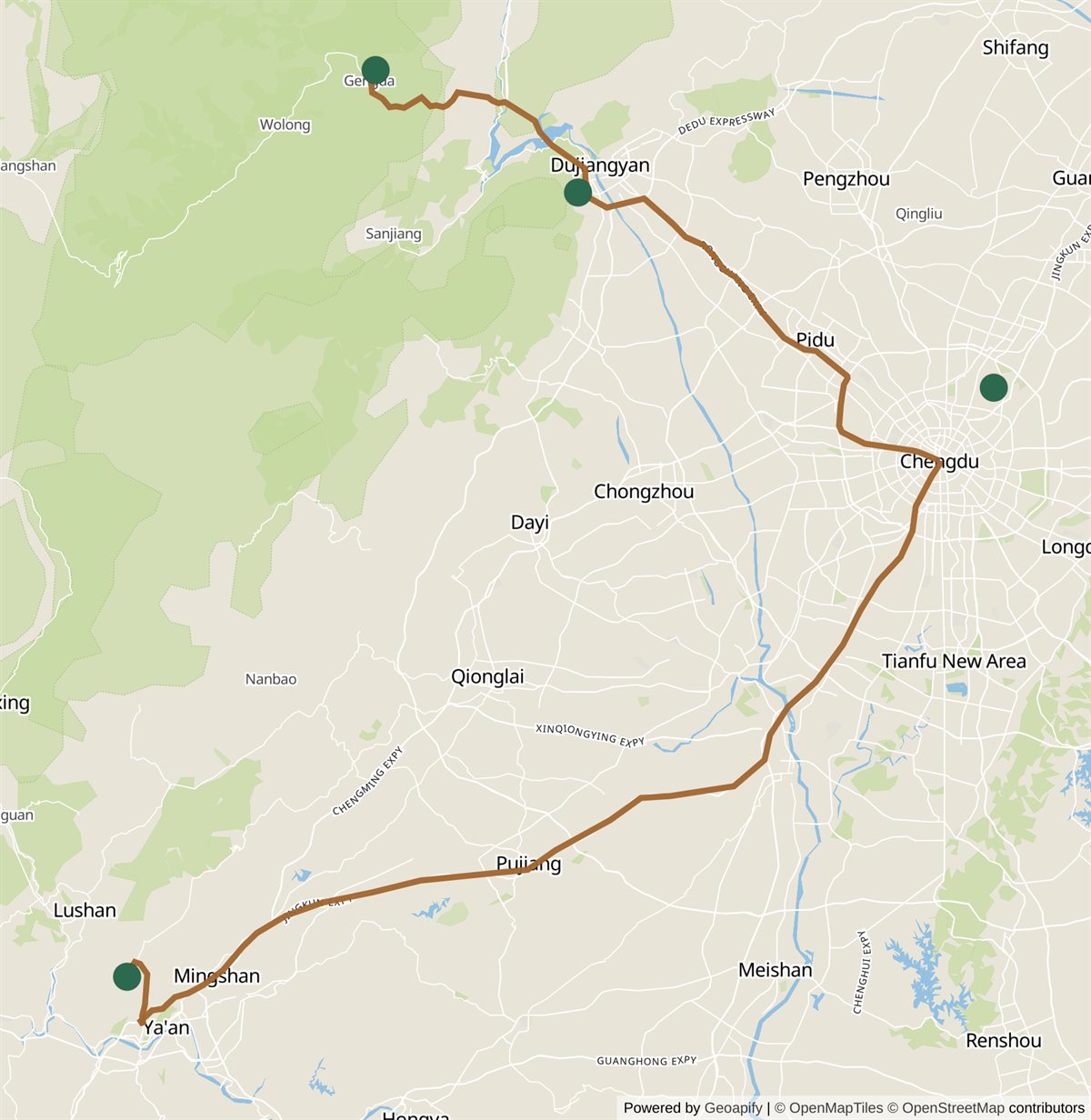 Chengdu Research BaseChengdu basePanda ValleyPanda ValleyWolong · ShenshupingWolongBifengxia (Ya’an)Bifengxia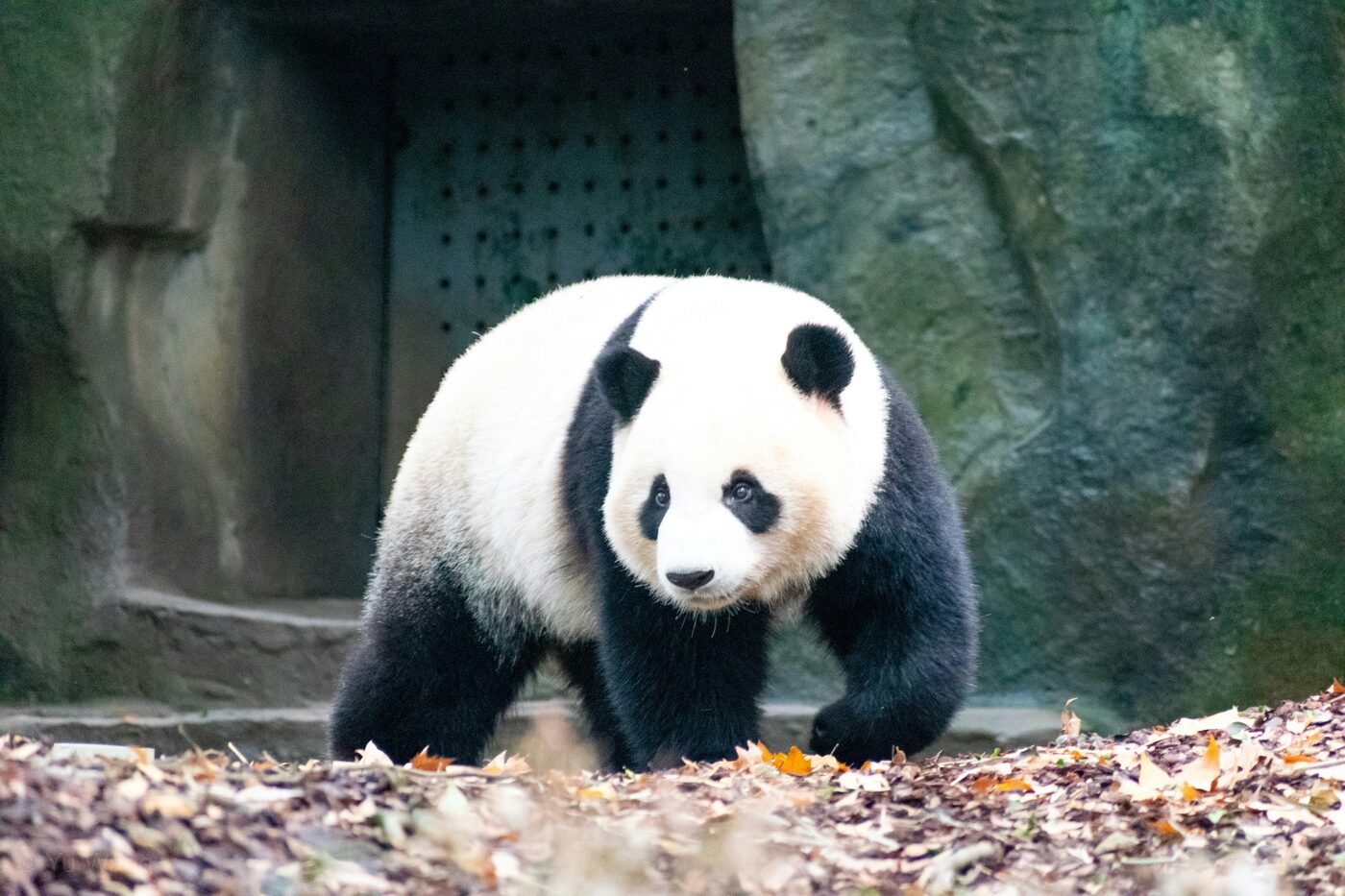
Which panda base is right for you?
The four bases compared on the variables that actually shape the decision — distance from Chengdu, ticket price, and crowd level. The two right-hand columns are the ones English guides still fill in, and both are now a flat “no” at every base.
| Base | From Chengdu | Ticket | Keeper day bookable? | Hold-a-panda? | Best for |
|---|---|---|---|---|---|
| Chengdu Research Base | ~40 min metro / 25–30 min taxi | ¥55 / ¥40 off-peak | No — its 科普 volunteer scheme needs fluent Chinese and 60 hours | No — discontinued | First visit, families, photographers, 花花 / Hua Hua |
| Panda Valley 熊猫谷 (Dujiangyan) | 1 hr drive | ¥55 (student ¥27) | No — and it never ran one; that was 中华大熊猫苑, closed Apr 2026 | No — discontinued | A quiet second visit, forested enclosures |
| Bifengxia Panda Base | 2 hr drive | ~¥100 (panda base) | No published terms | No — discontinued | Wilder feel, photographers |
| Wolong · Shenshuping | 2–3 hr drive | ~¥150 combo | No published terms | No — discontinued | Dedicated enthusiasts, naturalists |
For 80% of foreign travellers the answer is the Chengdu Research Base — it’s easy, has the most pandas visible, and combines with everything else in Chengdu. The other three are add-ons or substitutions for specific reasons.
Why timing is everything (the 7:30–10am rule)
The single most important fact about panda viewing: adult giant pandas eat 12–14 hours a day and sleep the rest, and their feeding windows cluster heavily in 7:30–10:00am, just after they wake — with keeper feeding around 9:00am and again about 2:00pm, and a weaker secondary window from 2:00–4:00pm. By 10:30am nearly all of them are asleep, and once it climbs above about 26°C they retreat indoors entirely, so heat — not season — is the limiting factor. Outside the morning window you watch a bear-shaped lump in a tree from a distance.
The first-timer mistake is to treat the base like a normal attraction and arrive between 10am and noon after a leisurely breakfast. By then the entrance queue is 30–45 minutes, the popular enclosures (the Sunshine Nursery and Moonlight Nursery for sub-adults) are 4-deep at the rail, and most adults have gone horizontal or indoors for the day. Foreigners who do this report the visit as “underwhelming” — but it’s a timing failure, not a panda failure.
The fix is simple: arrive at the 7:30am opening. Take a taxi from your hotel (¥40, 25–30 min from the city centre) rather than the metro for the very early start — the metro plus its shuttle bus is about 40 minutes door-to-gate, and Line 3 doesn’t start until about 6:30am. Walk straight to the Sunshine Nursery first; the crowd doesn’t arrive until about 9:30am, and by the time the tour buses unload you’re finishing the red-panda enclosure and ready to leave.
1. Chengdu Research Base — the easy first visit
The Chengdu Research Base of Giant Panda Breeding (成都大熊猫繁育研究基地, often abbreviated “Chengdu Panda Base”) is the flagship — and for nearly every foreign first-timer, the right answer. Established in 1987 on six rescued pandas, it now maintains 30+ giant pandas plus roughly 100 red pandas across four major giant-panda enclosures, two red-panda enclosures, and the 3-acre sub-adult habitat where the cubs and juveniles live.
It is the most accessible base (about 40 minutes door-to-gate from downtown by Metro Line 3 plus a short shuttle bus, or ¥40 by taxi door-to-door in 25–30 min), the cheapest in peak terms (¥55 May–October, ¥40 November–April), and the only one with extensive English signage on every enclosure and most panels. The Giant Panda Museum near the entrance covers conservation history in English; the gift shop runs from ¥10 fridge magnets to ¥800 hand-stitched plush.
The downside is the upside: every Chengdu first-timer comes here. Peak-season weekends (May, July–August school holidays, October Golden Week) push the queue past an hour and crowd density at the nurseries to uncomfortable levels. The fix is the 7:30am rule — arrive at opening, do the loop in three hours, leave by 10:30am, and miss the worst of it.
Practical: getting there, hours, costs
| Address | 1375 Panda Road, Chenghua District (成都市成华区熊猫大道1375号) |
| Metro to West Gate | Line 3 to 军区总医院 (Junqu Zongyiyuan), exit B → 409 shuttle bus (¥2) to the West Gate (西门) — the main, closer downtown entrance |
| Metro to South Gate | Line 3 to 熊猫大道 (Panda Avenue), exit A/D → 408 shuttle bus (¥2) to the South Gate (南门) |
| Metro cost / time | Metro flat ¥4 + ¥2 shuttle; ~40 min door-to-gate from downtown |
| Tourist shuttle | 景区直通车 from Chunxi Road / Kuanzhai Alley / Chengdu East railway station, ~¥8–10 |
| Taxi from centre | ¥40, 25–30 min (Amap: ~13 km) |
| Hours | 7:30am–6pm (last entry 5pm) |
| Ticket | ¥55 peak (May–Oct) / ¥40 off-peak (Nov–Apr); student ¥27; ¥30 unlimited park shuttle (观光车) |
| Time on-site | ~3 hours |
Best route through the park: West-in, South-out (西进南出)
The base spreads across a hilly hillside with two main entrances, and the order you walk it matters. The editor’s recommended loop is West Gate in, South Gate out (西进南出): you start at the closer, less-crowded West Gate, hit the denser cluster of panda enclosures around that side first while the animals are still active, and exit at the South Gate without backtracking uphill. If your single priority is seeing the celebrity panda Hua Hua, flip it — enter at the South Gate instead and accept the queue (more on that below).
Inside, the 观光车 park shuttle (¥30, unlimited rides) is worth it if your energy is limited — the park is hilly and the stops are spread out. On a cool morning with time to spare, walking lets you linger at the quieter enclosures; in summer heat or with kids, take the shuttle.
Hua Hua (和花 / 花花) — the celebrity panda
花花 / Hua Hua is the single biggest reason many visitors now come, and she draws her own crowd. She lives on the South Gate side, at Villa 6 (6号别墅). Be realistic about the experience: expect a 1–2 hour queue for roughly 3 minutes of viewing — batches are capped at 3 minutes each — and she is off on Mondays (周一花花 不上班). To have a real shot, queue from about 6:30am before opening. It is a long wait for a short look, so decide in advance whether Hua Hua specifically is worth reshaping your morning around, or whether the dozens of other equally photogenic pandas elsewhere in the park are enough.
Practical tips that save the day
- The stone paths are bumpy and have steps — bring a baby carrier (腰凳), not a stroller, if you have a small child.
- The bamboo groves have aggressive mosquitoes — bring mosquito patches or repellent.
- In-park food is pricey and limited — bring your own snacks and water.
- No flash photography, no feeding, no tapping the glass. The base takes this seriously; violations can mean a lifetime ban.
Book the Chengdu Panda Base ticketNASDAQ: TCOM
Trip.com sells day-of and advance Chengdu Research Base tickets (~$10) and guided panda tours that bundle the early-morning entry with hotel pickup — booked in English on a foreign card. Real-name ticket: bring your passport to the gate.
2. Panda Valley (Dujiangyan) — the quiet second visit
“Dujiangyan panda base” is two different places
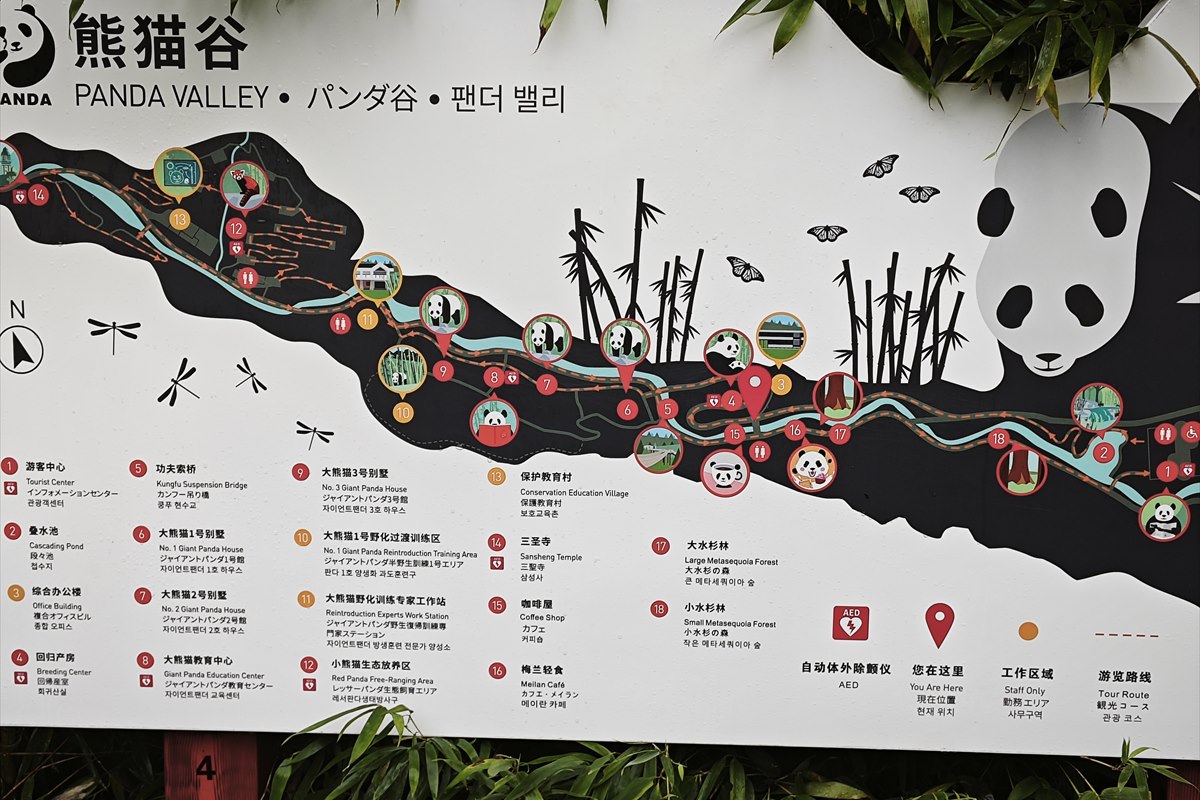
Panda Valley (熊猫谷) at Yutang is run by the Chengdu Research Base and is open normally. 中华大熊猫苑, the China Conservation and Research Centre’s Dujiangyan base at Qingchengshan, is a different site 11 km away — and it is the one that ran the keeper-experience day. It closed on 23 April 2026 「为完善园区配套设施」, with 「具体开园时间另行通知」 — no reopening date. Almost every English page still merges the two and sells the closed one’s programme. This section is about Panda Valley.
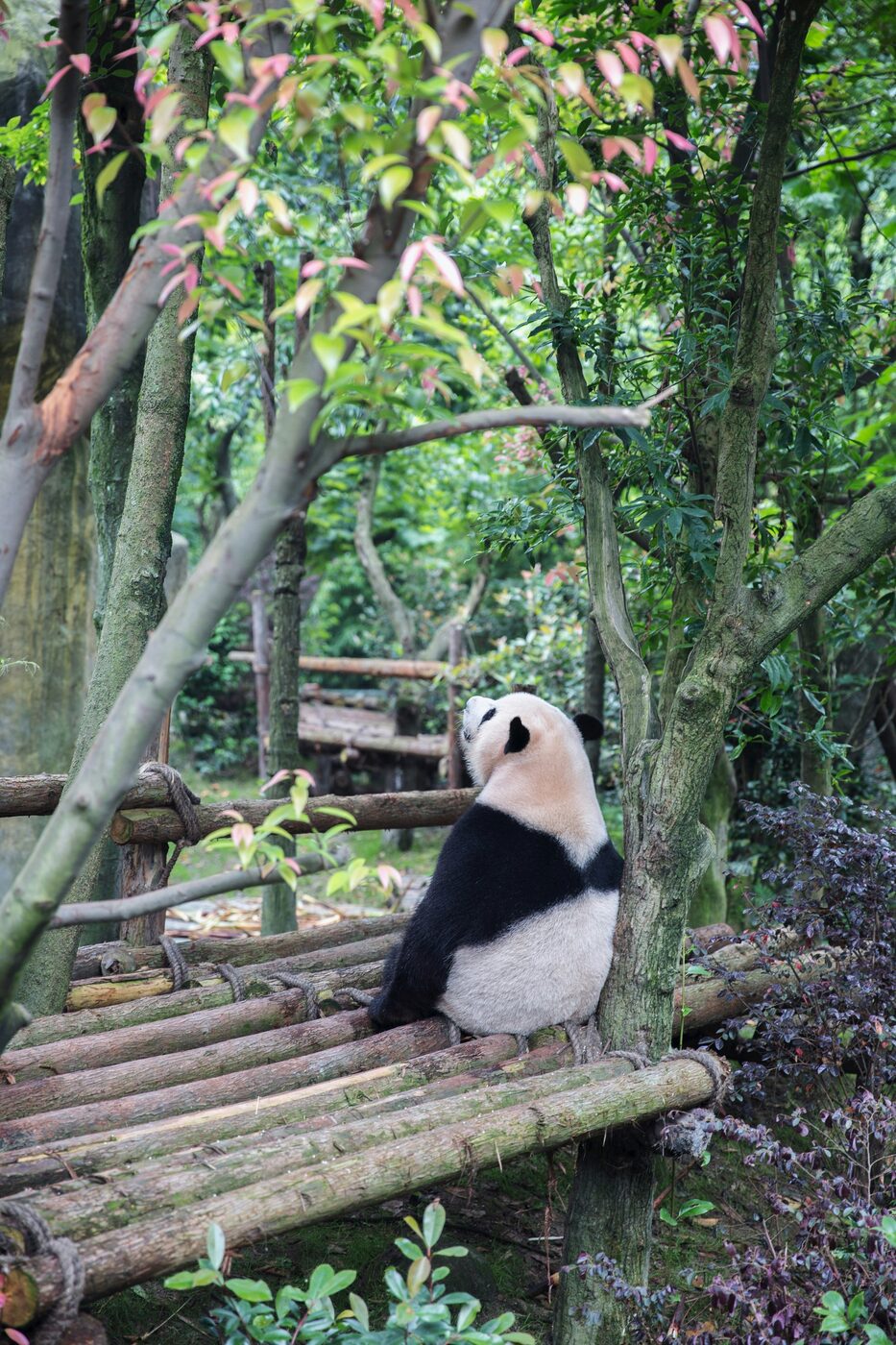
Panda Valley (熊猫谷, officially the Dujiangyan field-release research base) sits about an hour’s drive northwest of Chengdu, in the same county as the UNESCO World Heritage Dujiangyan irrigation system — 6.0 km from the irrigation system’s main gate, about 17 minutes by road. It’s smaller than the flagship — 30–50 pandas depending on the breeding season — the enclosures are forested rather than manicured, and the slower pace is the whole point: you can watch one animal for fifteen minutes without anyone behind you.
Two things work differently here from the flagship, and both are in the table below. The number that catches people out is not the closing time but the entry cut-off, which moves an hour between seasons — arrive at 5:30pm in November and the gate has already stopped admitting. And the booking is its own island: online and real-name through the base’s own 「熊猫谷」 WeChat account rather than a third-party platform, with no routine gate sales at all. Travellers report it showing sold out from early afternoon in peak season, so book it the day before rather than on the way. Once inside, the red-panda free-range area needs a further QR booking.
The other reason to come is the pairing. The irrigation system is one of the oldest still-functioning waterworks on Earth (256 BCE, Qin dynasty) and Mt Qingcheng nearby is one of the four sacred Daoist mountains. Two days in the area covers Panda Valley plus the irrigation system on day one and Mt Qingcheng on day two — three world-class sites in one county. ⚠️ Both scenic areas require an advance timed reservation year-round, which is a separate booking from Panda Valley’s: see the Dujiangyan day-trip guide for that procedure.
Practical: getting there, hours, costs
| From Chengdu | 1-hr drive (68.2 km, Amap-measured 2026-08-14); or HSR Chengdu North → Dujiangyan (30 min, ¥15–25) plus a 20-min taxi |
| Hours | 1 May–31 Oct 7:30am–6pm, entry stops 5:00pm · 1 Nov–30 Apr 8:00am–5:30pm, entry stops 4:30pm |
| Entry ticket | ¥55 (student ¥27); free under 6 / under 1.3 m and at 60+ |
| Booking | Online real-name on the 「熊猫谷」 WeChat account; no routine gate sales |
| From the irrigation system | 6.0 km / ~17 min from the main (Lidui Park) gate; 13.5 km / ~28 min if you leave by the north gate |
| Time on-site | 3–4 hours |
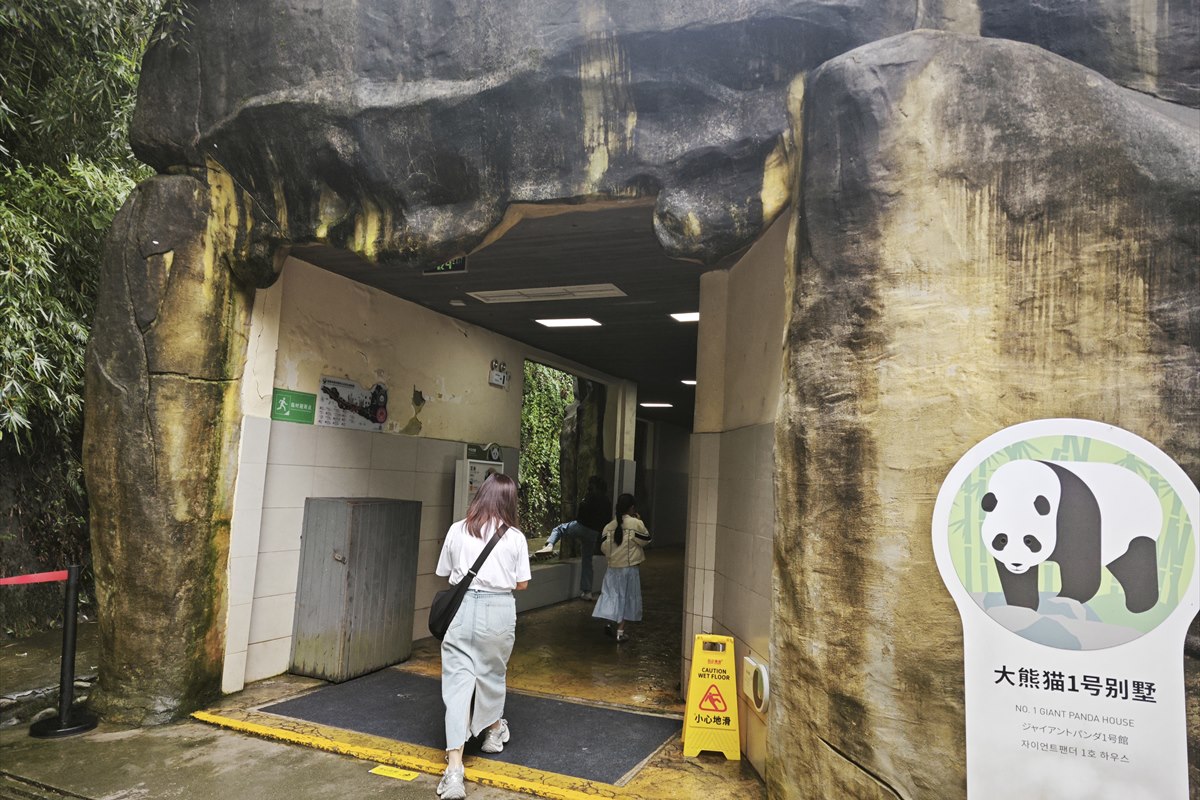
3. Bifengxia Panda Base — the wilder-feel option
Bifengxia Panda Base (中国大熊猫保护研究中心碧峰峡基地) is two hours by car from Chengdu, in the Ya’an region. It is the “wilder” option — larger, more semi-natural enclosures with bamboo groves and stream features rather than the manicured lawns of the flagship. The panda research base costs about ¥100, included within the Bifengxia (碧峰峡) scenic-area ticket. Open 8am–5pm.
One common booking trap: the 碧峰峡野生动物园 (Bifengxia wildlife / safari park) is a separate attraction, roughly ¥175–180 (including the bus through the predator zone, 猛兽区), and it is not where the research pandas live. If you’re coming for the giant pandas, you want the panda research base inside the scenic area, not the safari park.
One piece of context that matters: after the 2008 Sichuan earthquake severely damaged Wolong Reserve, the China Conservation and Research Center for the Giant Panda relocated most of Wolong’s breeding population to Bifengxia, which became the de facto largest single panda population for over a decade. Wolong has been rebuilding since 2010, but Bifengxia retains a substantial number of pandas, and many of the adults you see there have a Wolong origin.
Bifengxia is where English pages send you for the keeper day once they discover the Dujiangyan site is shut. It has no published terms either — not on the scenic area’s own site, not on the research centre’s notice board. The keeper-day section below sets out what we could and could not confirm; the short version is to come here for the enclosures, not for a programme.
Scam warning: paid “hold a panda” no longer exists
Bifengxia’s old hold-a-panda photo program is gone. As of 2026 the bases have discontinued close-contact programs nationwide, for panda-welfare and disease-control reasons — there is no official paid hold-a-panda experience anywhere in China now. Treat any third-party tout or agency near the bases advertising “内部抱熊猫 / hold a panda” as a scam: they are selling something that either no longer officially exists or is unsafe. Don’t pay. The keeper experience day was the closest legitimate hands-on option and never involved holding either — and it is not currently bookable, so in 2026 the viewing rail is as close as it gets.
Practical: getting there, hours, costs
| From Chengdu | 2-hr drive; or HSR Chengdu West → Ya’an (50 min, ¥45) plus a 30-min taxi (¥80–100) |
| Hours | 8am–5pm |
| Panda base ticket | ~¥100 (within the 碧峰峡 scenic-area ticket) |
| Wildlife / safari park | ~¥175–180, separate attraction — NOT where the research pandas are |
| Keeper experience day | No published terms — see the keeper-day section |
| Hold-a-panda photo | Discontinued nationwide as of 2026 — not offered |
| Time | Full day given the 2-hr transit each way |
4. Wolong Reserve — the dedicated enthusiast pick
Wolong National Nature Reserve (卧龙自然保护区) is the “real” panda place — 200,000 hectares of mountainous protected habitat in the Aba Tibetan Autonomous Prefecture, three hours’ drive west of Chengdu through narrow mountain roads. Roughly 150 giant pandas live in the reserve, of which only a small fraction are visible to public visitors.
The Hetaoping Center for Giant Panda Conservation (卧龙核桃坪基地), rebuilt after the 2008 earthquake, houses the flagship wild-release training program — a multi-year regimen where captive-born pandas progressively learn foraging, predator avoidance, and territorial behaviour in increasingly wild enclosures, eventually released into unmonitored forest. Several have been successfully released since the early 2010s.
What a visitor books is a different address from the one the reserve’s name suggests. The ticketed site is the Shenshuping base (中华大熊猫苑神树坪基地) at Gengda (耿达) — ticket office, visitor centre and numbered viewing enclosures, 105.8 km from Chengdu by road. Wolong town, where the reserve headquarters and the Hetaoping research site are, is another 24.6 km and roughly 40 minutes further up the valley, so give a driver 神树坪 rather than “Wolong”. Not confirmed: whether Hetaoping admits general visitors on any current basis — unlike Shenshuping it carries no public map listing of its own, and we found no published visiting terms for it, so build the day around Shenshuping. Addresses and distances Amap-checked 2026-08-14.
Be honest about who Wolong is for: it’s a long mountain drive, English support is significantly weaker than at the Chengdu base, the visitor infrastructure is more basic, and you see fewer pandas than at any of the other three. Wolong rewards travellers who care about the conservation story, the wild-release program, and the mountain landscape. For a first-time visitor on a 14-day China itinerary it’s overkill; for a panda-focused traveller spending a full week in Sichuan with a private driver it’s worth the day.
Practical: getting there, hours, costs
| From Chengdu | 3-hr mountain drive, no HSR. Private driver ¥1,500–2,000 round-trip is the realistic option |
| Hours | 8am–5pm |
| Combined ticket | ~¥150 (Hetaoping + main breeding centre) |
| Stay overnight? | Realistic for serious visits; the reserve guesthouse is basic, Wolong town has small hotels |
| Pair with | Mt Siguniang (四姑娘山), ~2 hr further over the Balang Pass (104.9 km from the reserve, Amap-measured Aug 2026) — the natural 2-day enthusiast itinerary |
The keeper experience day, and why you cannot book it
The paid keeper day (研学, marketed in English as “panda volunteer for a day”) is the single most-searched panda experience and the reason many people plan a Sichuan trip at all. Almost every English page still describes it in the present tense, at ~¥700, bookable by email. That description is out of date, and the reason is specific rather than vague.
It ran at 中华大熊猫苑 — the China Conservation and Research Centre’s Dujiangyan base — and that site closed on 23 April 2026 「为完善园区配套设施」, with 「具体开园时间另行通知」: no reopening date. This is the fact the English-language pages miss, because they had already merged that base with Panda Valley, which is 11 km away, is run by a different institution, and never hosted the programme.
What we could and could not confirm
- Confirmed: the Dujiangyan base that ran it is closed with no reopening date (state media, 15 April 2026).
- Confirmed: Panda Valley’s own ticket page lists tickets, hours and booking, and no experience programme of any kind.
- Confirmed: the Chengdu Research Base’s 科普 volunteer scheme is not a substitute — it is unpaid, needs fluent written Chinese, is open from age 14, recruits twice a year, and asks for a minimum of 60 hours.
- Not confirmed: whether any operator runs a bookable keeper day today. Bifengxia’s own site and the research centre’s notice board both carry nothing. Travellers report a version at about ¥700 with an age floor of 8 and no foreign nationals accepted; no published statement supports either restriction.
What to do with that. Do not build an itinerary around the keeper day, and do not pay a reseller who is still quoting the old ¥700 description — they are selling a programme whose host site is shut, and the ¥1,000–1,500 agency markup buys a booking nobody has shown can be honoured. If a hands-on day is the whole reason you were coming to Sichuan, that reason is currently gone; if it was a bonus, the ordinary visit is unaffected. We re-check this monthly and will restate the procedure the day an operator publishes one.
And the harder truth underneath it: even when it ran, no programme anywhere let you hand-feed or touch a panda. You made food, cleaned enclosures, and watched a keeper feed from a safe distance. Anyone offering closer than that is not offering the keeper day.
Booking: what actually works for foreigners
- Chengdu Research Base entry: real-name and online, up to 14 days ahead, and a foreign passport is an accepted booking document. Trip.com is one of its authorised platforms (~$10, English checkout); the base’s own WeChat mini-program is a little cheaper but Chinese-only.
- Panda Valley (熊猫谷): this is the awkward one. It sells through its own 「熊猫谷」 WeChat account rather than any third-party platform, online and real-name, with no routine gate sales — and a WeChat mini-program needs an existing WeChat user to scan you through registration before you can open it at all. The door that is left: the operator states that someone who genuinely cannot pay online can top up in cash at the gate while tickets remain. That is a fallback, not a plan, so treat a Panda Valley morning as the thing you sacrifice if the day runs short.
- Bifengxia entry: through the 「碧峰峡景区」 channel or a booking site; foreign-card POS on site is hit-or-miss, so carry cash or use Alipay/WeChat Pay.
- Keeper experience day: not bookable on any published terms — see above.
- Hold-a-panda: discontinued nationwide. Ignore touts and “internal” agency offers.
- Wolong · Shenshuping: tickets at the gate; advance booking rarely needed. Most foreign visitors come with a private driver who handles it.
Real-name booking applies at all four — bring the physical passport you booked with, not a photo of it, because the gate verifies the document against the booking.
When to visit: weekday, early morning, shoulder season
The combination that gives the best panda experience anywhere in China is weekday + early morning + shoulder season.
| Factor | The call |
|---|---|
| Day of week | Tuesday–Thursday is the lowest-crowd window. Weekends double the entrance queue and rail density. |
| Time of day | 7:30am opening at the Chengdu base and at Panda Valley in summer (8am from November), 8am at Bifengxia and Wolong. By 10am the active window is closing. |
| Best seasons | April–May and September–October — pandas active, 15–25°C, crowds manageable. |
| Winter advantage | Nov–March pandas are markedly more active in the cool (heat is the limiting factor); Chengdu-base tickets drop to ¥40. Downside: overcast skies hurt photography. |
| Avoid | The three Golden Weeks (Spring Festival mid-Feb, May 1, Oct 1) — queues over 90 min, top enclosures unviewable. July–August is hot, pandas sleep more, school-holiday crowds heavy even on weekdays. |
Pair pandas with the rest of Sichuan
Pandas are rarely a standalone trip. The natural Sichuan itinerary pairs panda viewing with the best surrounding UNESCO and cultural sites:
- Day 1: Chengdu Research Base 7:30–10:30am, then Wuhou Temple + Jinli Old Street + a Sichuan-opera face-changing evening show.
- Day 2: Dujiangyan day trip — Panda Valley in the morning, irrigation system + Mt Qingcheng in the afternoon. All three need separate advance bookings.
- Day 3: things to do in Chengdu — Leshan Giant Buddha day trip or Mt Emei overnight.
- Day 4–5: HSR to Chongqing for Yangtze-cruise embarkation, or fly out.
For dedicated panda travellers willing to add a day, swap the Chengdu day for a Bifengxia day or a Wolong + Mt Siguniang two-day combination.
Final recommendation
- First-time China traveller, 1 panda day: Chengdu Research Base, 7:30am opening, weekday if possible. Done by 11am, full afternoon for the rest of Chengdu.
- Second-timer / enthusiast, 2 days: Day 1 Chengdu Research Base, Day 2 Panda Valley at Dujiangyan — fewer pandas, far fewer people, and time to watch one of them properly.
- Photography priority: Bifengxia — larger, more semi-natural enclosures photograph better. Day-trip or overnight in Ya’an.
- Naturalist / conservation-focused: Wolong — the wild-release program is the only foreign-accessible window on rewilding. Full day or overnight; combine with Mt Siguniang.
Where to stay for a panda trip
You don’t stay at a panda base — base in central Chengdu and take a taxi out for the 7:30am opening (¥40, 25–30 min). The sensible call for a first China trip is a home-grown mid-range chain near Chunxi Road or Tianfu Square: metro-connected, English-app booking, and a fraction of the five-star rate.
Frequently asked questions
Which panda base in China is best for foreigners?
For most first-time visitors, the Chengdu Research Base of Giant Panda Breeding (成都大熊猫繁育研究基地) is the right pick — it's about 40 minutes from downtown Chengdu on metro Line 3, has the largest visible population (30+ giant pandas plus ~100 red pandas across 4 enclosures and the sub-adult habitat), extensive English signage, and a ¥55 peak-season ticket. If you want somewhere quieter and have a spare day, Panda Valley (熊猫谷) at Dujiangyan is an hour out, costs the same ¥55, and has forested enclosures where you can watch one animal for fifteen minutes without a crowd behind you; Bifengxia is two hours out in the Ya'an region with larger semi-natural enclosures. Note that the paid keeper 'experience day' many English pages attach to Dujiangyan is not currently bookable — it ran at 中华大熊猫苑, a separate site 11 km from Panda Valley, which closed on 23 April 2026 with no reopening date. Wolong is for dedicated enthusiasts only — a long mountain drive into the Aba Tibetan Autonomous Prefecture, fewer pandas visible to the public.
Can foreign tourists do the panda volunteer program?
Not at the moment, and the reason is specific. There are two different things people call 'the volunteer program'. (1) The official 科普 (science-education) volunteer program at the Chengdu Research Base is open to foreigners in principle, but it requires fluent written Chinese, is for ages 14+, is unpaid, recruits twice a year, and asks for a minimum of 60 hours of service — community-education work, not a tourist day-out. (2) The paid keeper 'experience' / 研学 day is the one most travellers mean, and it ran at 中华大熊猫苑, the China Conservation and Research Centre's Dujiangyan base — a different site from Panda Valley, 11 km away. That base closed on 23 April 2026 for reconstruction 「为完善园区配套设施」 with no reopening date announced, and no operator has published bookable terms since; Bifengxia's own site and the research centre's notice board both say nothing about it. Travellers report a version continuing at around ¥700 with an age floor of 8 and no foreign nationals accepted, but neither restriction appears in any published statement. So: do not build a trip around it and do not pay an agency the ¥1,000-1,500 marked-up rate on the old description. One thing has not changed — no program anywhere ever let you hand-feed or touch a panda; you made food, cleaned enclosures and watched a feed from a safe distance.
Can you still pay to hold a panda in China?
No. As of 2026 the bases have discontinued close-contact 'hold a panda' programs nationwide, for panda-welfare and disease-control reasons — there is no official paid hold-a-panda experience anywhere in China now (Bifengxia's old ¥1,800-2,000 photo program is gone). Treat any third-party tout or agency near the bases advertising '内部抱熊猫 / hold a panda' as a scam: they are selling something that either no longer officially exists or is unsafe — don't pay. The nearest thing was the paid keeper 'experience' day, which never involved holding or hand-feeding either — and it is not currently bookable on published terms, because the base that ran it closed in April 2026. So in 2026 there is no legitimate way to get closer to a giant panda than the viewing rail.
What time should I arrive at Chengdu Research Base?
Arrive for opening — and note that this is a decision you make when you BOOK, not on the day. The base sells a morning ticket and an afternoon ticket at the same price, and they admit you to different halves of the day: March–October the morning ticket admits 7:30am–12:00 and the afternoon one 12:00–5:00pm; November–February it is 8:00am–12:00 and 12:00–4:30pm. Buy the morning one. Pandas are active and visibly feeding from roughly 7:30 to 10:00am — they've just woken — with keeper feeding around 9:00am and again about 2:00pm; by 10:30am nearly all of them are asleep or have gone indoors (they retreat inside above ~26°C), and a weaker second window runs 2:00-4:00pm. By 9:30am the entrance queue routinely hits 30-45 minutes in peak season (May–October), and the most-popular Sunshine Nursery enclosure can have 4-deep crowds at the viewing rail. Foreigners who arrive at 10am repeatedly report seeing only sleeping pandas at distance and call the visit underwhelming — it's a timing problem, not a base problem. Take a taxi (¥40, 25-30 min from city center) for the early start; the metro plus its shuttle is about 40 minutes door-to-gate and Line 3 doesn't start running until ~6:30am. ⭐ And pick your gate before you set off, because the base has two and they are 2.3 km apart — Line 3 serves both, and the station names say which: 熊猫大道 (Xiongmao Avenue) is the SOUTH gate, exit A then bus D025/198/198A; 军区总医院 (Junqu Zongyiyuan) is the WEST gate. The base itself points public-transport arrivals to the west gate, which has no car park and therefore no coach queue; the south gate is the one nearest the museum and the older enclosures most people picture. Inside, a ¥30 hop-on-hop-off shuttle runs between the two across eight stops, so entering one gate and leaving by the other is a normal way to do it.
Are pandas active or sleeping when I visit?
Active 7:30-10:00am, asleep most of the rest of the day. Adult giant pandas eat 12-14 hours a day and sleep the remaining 10-12, but their feeding windows cluster in early morning (just after waking), with keeper feeds around 9:00am and 2:00pm; a weaker second active window runs 2:00-4:00pm. They also go indoors once it's above about 26°C, so heat — not season — is the limiting factor. The sub-adult pandas at the Sunshine Nursery and Moonlight Nursery enclosures are the most reliably active during morning hours — they tumble, climb, and play-fight in ways that look exactly like the YouTube videos. By 10:30am most adults are flat on their backs or wedged in trees. The single most useful piece of advice for any panda base visit is: arrive at opening, and don't be the family that shows up at 11am.
How do I see Hua Hua (花花) at the Chengdu base?
Hua Hua (和花 / 花花), the celebrity panda, lives on the South Gate side at Villa 6 (6号别墅). Be realistic: expect a 1-2 hour queue for roughly 3 minutes of viewing, with batches capped at 3 minutes each, and she's off on Mondays (周一花花不上班). For a real shot, queue from about 6:30am before the 7:30am opening, and enter via the South Gate (Metro Line 3 → 熊猫大道 station, exit A/D → 408 shuttle bus). If Hua Hua isn't a must-see, the dozens of other pandas elsewhere in the park are just as photogenic with no queue — and the West-Gate side has the denser enclosures.
How do I get to the Chengdu Panda Base by metro?
Take Metro Line 3 (flat ¥4). For the West Gate (西门) — the main, closer downtown entrance with the denser panda enclosures — get off at 军区总医院 station, exit B, then the 409 shuttle bus (¥2) to the gate. For the South Gate (南门), near Hua Hua, get off at 熊猫大道 (Panda Avenue) station, exit A/D, then the 408 shuttle bus (¥2). Total is about 40 minutes door-to-gate from downtown. A tourist shuttle (景区直通车) also runs from Chunxi Road, Kuanzhai Alley, and Chengdu East railway station for ~¥8-10. A taxi is ¥40 and 25-30 min (about 13 km) — the better choice for the very early start since Line 3 doesn't open until ~6:30am.
How do I get from Chengdu to Bifengxia or Wolong?
Bifengxia Panda Base is about 2 hours by car from Chengdu in the Ya'an region. The simplest path is HSR Chengdu West → Ya'an (50 minutes, ¥45 in 2nd class, frequent trains) followed by a 30-minute taxi to the Bifengxia entrance (¥80-100). Trip.com group day tours bundle round-trip transport with the entry ticket for $90-130. Wolong National Nature Reserve is harder — there's no HSR access; it's a 3-hour mountain drive from Chengdu through the Aba Tibetan Autonomous Prefecture. Most foreign visitors arrange a private driver (¥1,500-2,000 per day round-trip) or join a 2-day tour that pairs Wolong with Mt Siguniang. Wolong public transport is theoretical: a daily bus from Chengdu Chadianzi Bus Station exists but runs erratically and English support is near-zero. Don't attempt Wolong as a same-day round trip — overnight at the reserve guesthouse is realistic.
Do I need to book panda base tickets in advance?
For the main Chengdu Research Base, yes — and 'book ahead' is not advice here, it is how the base sells tickets. Everything is online and real-name, up to 14 days ahead, and the day's stock simply stops when it is gone. ⚠️ Do not plan on a ticket window: the base states one exists only as a fallback for people who genuinely cannot pay online, and only while stock remains, so it is a rescue rather than an option. The good news is that a foreign passport is an accepted booking and entry document — the base names it alongside mainland ID and the HK/Macau/Taiwan permits — and Ctrip is one of its authorised platforms, so an English-language booking is not a workaround. Most foreign visitors use Trip.com (about $10, in English with a foreign card); the official WeChat mini-program is a little cheaper but Chinese-only. Daily visitor caps tighten on weekends and during the three Chinese Golden Weeks (Spring Festival, May 1, October 1). Tickets are real-name (实名制), so carry the physical passport you booked with — a QR code on its own will not open the gate. Panda Valley (熊猫谷) at Dujiangyan runs its own separate booking on the 「熊猫谷」 WeChat account — online and real-name, with no routine gate sales at all, and travellers report it showing sold out from early afternoon in peak season, so book it the day before rather than turning up. Bifengxia is less crowded; same-day walk-up usually works on weekdays, but book 1-2 days ahead for any weekend or holiday visit. There is nothing to book for the keeper experience day — see the FAQ above for why.
Are there pandas anywhere outside Sichuan?
Wild giant pandas live only in three Chinese provinces — Sichuan, Shaanxi, and Gansu — and Sichuan holds roughly 75% of the wild population. For tourists, Sichuan is the only realistic option: the Chengdu Research Base, Dujiangyan, Bifengxia, and Wolong cover virtually every captive-panda viewing opportunity foreigners attempt. Beijing Zoo and Shanghai Zoo each have 2-3 giant pandas on loan, and a handful of provincial zoos host pairs, but the experience is single-cage viewing in concrete enclosures — not comparable to the dedicated bases. The Foping Nature Reserve in Shaanxi houses a separate sub-species of wild panda (the Qinling panda, slightly browner coat) and is occasionally accessible by appointment, but logistics for foreign visitors are difficult and the wild-panda sighting rate is near-zero. If you want pandas, fly to Chengdu.
Sources
Checked August 2026 · Written from our own first-hand travel in China.