Most foreign visitors come to Chengdu with one item locked in: pandas. The good news is the city overdelivers in three other categories you probably weren't expecting — Sichuan Opera face-changing, the tea-house culture in People's Park, and a cluster of UNESCO day trips (Leshan Buddha, Mount Qingcheng, Dujiangyan) that any one of which would be a city's headline attraction elsewhere.
Below: 17 things ranked by what foreign travelers actually rate highest, grouped into 5 categories. Two of them are judgement calls that cut against the local ranking — the poet's cottage everyone lists and we would drop, and the temple inside the shopping district that nobody mentions. At the end, three sample itineraries (2-day, 3-day, 5-day) and a practical FAQ.
The pandas (the reason you came)
1. Chengdu Research Base of Giant Panda Breeding (大熊猫繁育研究基地)
The default panda experience and rightly so — about 40 minutes from downtown by Metro Line 3, ¥55 entry, opens 7:30 AM, 30+ giant pandas plus around 100 red pandas across four enclosures and the sub-adult habitat. Get there at opening. Pandas eat between 8:30–10 AM, sleep through midday, and the difference between an early-arrival visit and a 10:30 arrival is the difference between watching pandas eat bamboo at arm's length and watching their black-and-white butts.
Allow 3–4 hours for the full circuit — adult pandas, juvenile enclosure, and the nursery viewing window where you might see newborns. The on-site museum is skippable; the Sun Bear and red pandas (also at the base) are not.
2. Panda Valley, Dujiangyan (熊猫谷)
Smaller and quieter than the city base, an hour out, the same ¥55 — forested enclosures where you can watch one animal for fifteen minutes without a crowd behind you. Booked online and real-name on its own WeChat account, with no routine gate sales, and it shows sold out from early afternoon in peak season, so book the day before. Mind the name trap: the paid keeper "experience day" English guides attach to Dujiangyan ran at 中华大熊猫苑, a different site 11 km away that closed on 23 April 2026 with no reopening date — see the FAQ before you pay anyone for it.
3. Bifengxia Panda Base (碧峰峡熊猫基地)
The largest semi-natural enclosures of the four, about two hours from Chengdu in the Ya'an region — the research base runs ~¥100 (the ¥175–180 wildlife park next door is a separate attraction, so check which one you are buying). It held the largest single panda population after the 2008 Wolong earthquake relocation. Paid hold-a-panda photos are gone — close-contact programs were discontinued nationwide on welfare and disease-control grounds, so treat anyone offering one near the bases as a scam. Come for the enclosures, not for a photo.
4. Wolong Panda Center (卧龙熊猫中心)
The mountain reserve where most reintroduction work happens. 4 hours from Chengdu, more for serious panda enthusiasts than first visits. Skip unless you have 5+ days in Sichuan and want the full conservation tour.
Sichuan culture (the unexpected best part)
5. Sichuan Opera Face-Changing (川剧变脸)
The single most photogenic 90 minutes of your Chengdu trip. Performers swap painted silk masks faster than the eye can track — this is real ancient stagecraft, not a tourist gimmick. Shu Feng Ya Yun (蜀风雅韵) at the Cultural Park is the long-running foreigner-friendly venue (¥80–260 with tea, one 90-minute show nightly at 8pm with English subtitles, includes hand puppetry and shadow play — the mid-tier 贰品 seats run ¥180–200 and give a clear central view). The teahouse stages inside Jinli and Kuanzhai Alley run cheap rolling versions through the afternoon and evening for ¥18–48, but the ¥18 seats usually carry a forced tea or minimum spend once you sit down, and the face-changing itself can be trimmed to 10–15 minutes.
6. People's Park + Heming Tea House (人民公园·鹤鸣茶社)
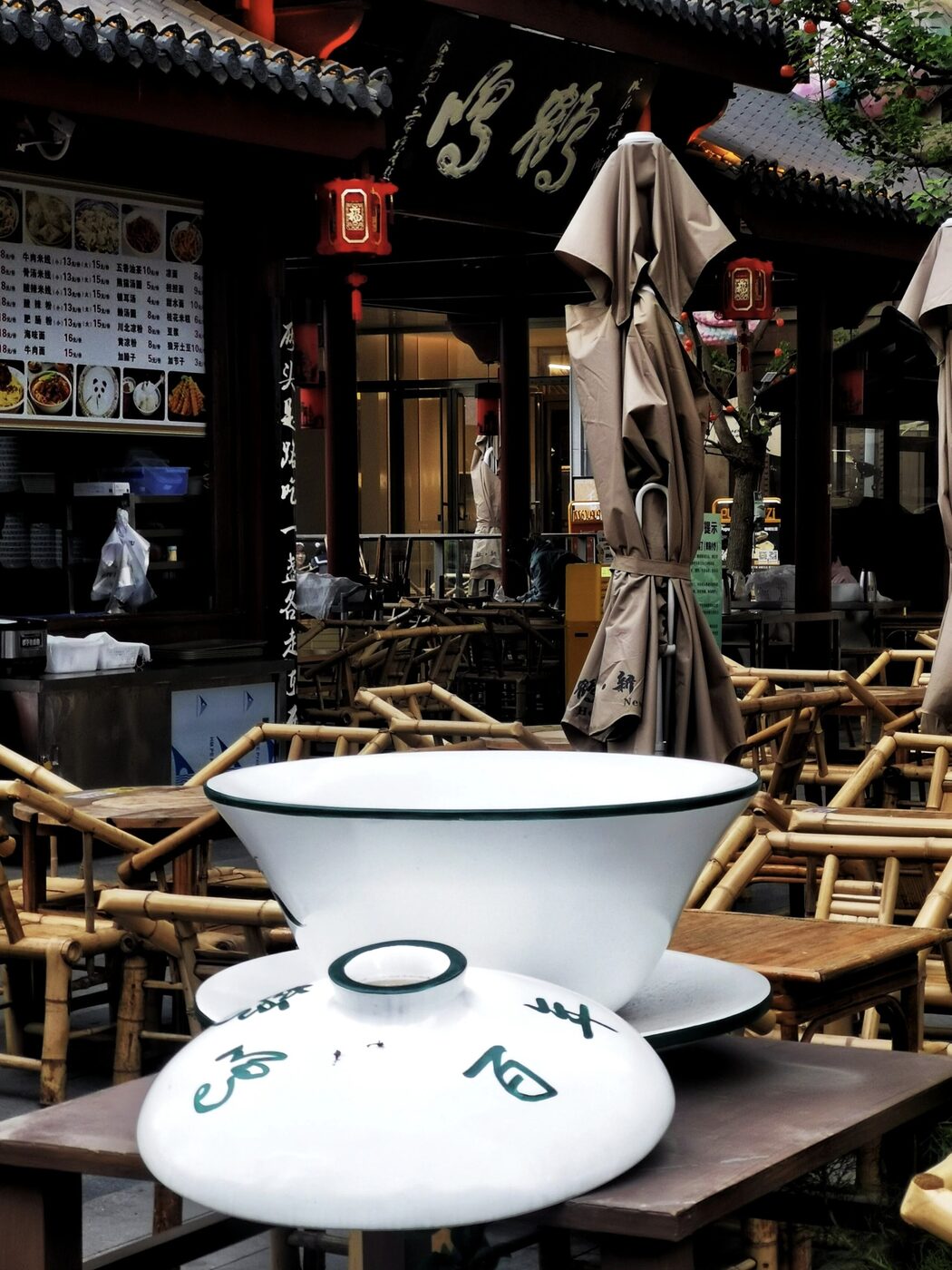
The most underrated thing in Chengdu and the one most travel sites skip. Heming Tea House dates to 1923, sits inside People's Park, and is where locals drink green tea (¥15–18 a gaiwan, free refills), play mahjong for hours, and hire roving ear cleaners (采耳) who use fine metal picks and a tuning fork — a ¥30–40 session (plus a ~¥10 tool fee) that's part ASMR, part reflexology, and entirely uniquely Chengdu. Free to enter; Metro Line 2 to People's Park (Exit B), a 14-minute walk from Kuanzhai Alley (#9).
You don't need to do the ear cleaning; just sitting with tea for two hours while watching the park life is the experience. Full guide: Heming Tea House — tea & ear-cleaning prices, the upsell to watch, and how it fits a Chengdu day →
7. Cooking Class — Sichuan Cuisine
Chengdu hosts dozens of cooking schools that take walk-in foreign students for half-day classes. Standard format: morning market tour, learn 3–4 dishes (mapo tofu, kung pao chicken, dan dan noodles, dumplings), eat what you cook for lunch. ¥300–500 (~$45– 70) for 4 hours. Most are clustered near Kuanzhai or in the Tongzilin area; book a day or two ahead.
Old streets (Instagram + actual local food)
8. Jinli Ancient Street (锦里)
Adjacent to Wuhou Temple, walkable and lit beautifully at night. More performative than authentic — most stalls are tourist food, most shops sell mass-produced trinkets — but the lantern atmosphere plus the upstairs teahouse face-changing stages (¥18–48, see #5) plus dan dan noodle stands make it a worthy 90-minute night stop. Skip the daytime visit; come after 7 PM.
9. Kuanzhai Alley (宽窄巷子)
Three parallel hutong-style alleys (Wide Alley, Narrow Alley, Well Alley) restored from Qing-era Manchu housing. More upmarket than Jinli, with proper restaurants, bars, and tea houses inside courtyards. Allow 2 hours. Best time: 4–7 PM, when the late afternoon light hits the gray brick and the courtyards aren't yet packed for dinner.
Temples and history
10. Wuhou Temple (武侯祠)
The most-visited Three Kingdoms shrine in China, dedicated to the strategist Zhuge Liang and Liu Bei. ¥50, 90 minutes, and tickets go on sale 14 days ahead through the museum's own site and WeChat account — it states it has authorised no third-party ticket agents. If you read Romance of the Three Kingdoms or played the Koei games, this is essential pilgrimage; if you didn't, the architecture and gardens still earn their keep, and it pairs naturally with Jinli right next door.
11. Du Fu Thatched Cottage (杜甫草堂) — the one we'd drop
This is on every Chengdu itinerary, and for most foreign visitors it is the pick to cut. Du Fu spent roughly four years here in the 760s and wrote some 240 poems; what ¥50 buys today is a 20-hectare memorial garden built around that fact. The halls on the central axis keep the layout of rebuilds in 1500 and 1811, the thatched cottage the place is named for was reconstructed in 1997 from descriptions in the poems, and the tower at the back went up in 2005.
Language is not the barrier, whatever you may read. English audio costs ¥18 by QR code at the gates (seven other languages too), the museum's own account carries a free Chinese-and-English version, and an English-speaking guide is ¥180 for up to three people for about an hour. The barrier is that the poems are the exhibit. Chinese visitors arrive carrying them from school, so a thatched roof and a red-walled lane called Flower Path land as lines they have known since they were eight. Without that, you are walking in a very good park with a gate fee — which is close to what Chinese visitors who go without a guide say themselves.
Go if Tang poetry is a reason you came to China, and then pay for the interpretation, because the genuinely old material is not labelled as the old material and is easy to walk straight past: a Qing-era stele, and a layer of Tang foundations under glass. Skip if the choice is between this and a slow afternoon at People's Park (#6), which costs nothing and gives you the same hour. If you do go, Metro Line 13 opened in December 2025 with a station named after the museum, replacing a 1.5 km walk from Line 4 — and Sichuan Museum is a few hundred metres further along the same street, free with an advance ID booking, closed Mondays.
12. Wenshu Monastery (文殊院)
Working Buddhist temple, free entry, locals pray here daily — the only major site on this list that doesn't feel curated for tourists. Vegetarian temple lunch (¥30–60) is genuinely good. The surrounding Wenshu hutong is one of the few neighborhoods where old Chengdu courtyards are still residential, not commercial.
13. Daci Temple (大慈寺) — inside the luxury mall
Ask people in Chengdu what a visitor can skip and Taikoo Li comes up quickly: a luxury shopping district, glass and stone, the same brands as everywhere. Ask the same people what their European and American guests reacted to best and it returns near the top — because of what is standing in the middle of it. Daci Temple is a working monastery, Tang in origin, that the shopping district was built around: red walls and curved eaves sharing a boundary with the shopfronts, 360 m from Chunxi Road metro (Exit C). Step through the gate and the traffic and mall music stop dead.
Free, no booking, and three sticks of incense handed to you at the entrance. The halls standing today were rebuilt between 1866 and 1878; the Tang monastery on this spot was recorded at 96 courtyards and more than 8,500 bays, against 11,530 m² now — so what survives is a fragment, and the mall is standing on the rest of it. It is often linked to Xuanzang, the monk behind Journey to the West, who was ordained in Chengdu in 622; the early sources name no temple, so treat that as local tradition rather than record.
Halls open 8:00–17:30 with last entry at 17:00. Most people photograph the red wall from outside and walk on, which is about fifteen minutes; going in properly is an hour, and there is a tea courtyard (from around ¥30 a bowl, still serving after the halls shut) and a cheap vegetarian canteen at lunchtime where you queue, eat, and wash your own bowl. Don't photograph the monks, or the images inside the halls.
Day trips (where Chengdu actually shines)
14. Leshan Giant Buddha (乐山大佛) — UNESCO
The 71-meter, 8th-century Buddha carved into a cliff at the confluence of three rivers. Tallest stone Buddha in the world, UNESCO listed since 1996. 1 hour from Chengdu East by HSR, then 15 minutes by taxi. ¥80 entry. Allow 5 hours on-site for the full stair descent from the head to the feet plus the river boat option (¥70, gives you the head-on view used in most photos). Easy day trip.
15. Mount Qingcheng (青城山) — UNESCO Taoist Mountain
The birthplace of Daoist organized religion in the 2nd century CE. Front Mountain (前山) is the popular half-day climb with temples; Back Mountain (后山) is the longer, quieter, properly mountain-y hike. ¥80 front / ¥20 back. 30 minutes from Chengdu by HSR + 10-minute taxi to the front gate. Combine with Dujiangyan irrigation system in one full day — but book both first; see the reservation rule under #15.
16. Dujiangyan Irrigation System (都江堰水利工程) — UNESCO
A 2,260-year-old irrigation system still in active use, controlling the Min River that flows through Chengdu plain. Less visually spectacular than Leshan Buddha but historically extraordinary — this is what made Chengdu agriculturally rich enough to support its later cultural flourishing. ¥80, 2–3 hours, often combined with Mount Qingcheng (10 km away) or Panda Valley (熊猫谷, 6 km away) for a full day.
Both Dujiangyan and Mount Qingcheng have to be booked in advance — you cannot just turn up. Since 4 February 2026 the two scenic areas require an online real-name reservation with a timed entry window, released up to 15 days ahead and split across four slots a day. They hold separate allocations, so a combined ticket still needs a slot booked at each, and summer weekend morning slots can go about three days out. Foreign visitors book with a passport and enter through the staffed lane — the automatic gates read mainland ID cards only.
17. Sanxingdui Museum (三星堆博物馆) — the bronze masks
Bronze heads with protruding eyes and gold masks, from a civilisation nobody knew existed until farmers dug into a pit in 1929 — and the reason it belongs on a Chengdu list is that the in-city alternative is shut. The Jinsha Site Museum, which every English guide still recommends for exactly this story, closed on 5 December 2025 for a rebuild and does not reopen until 30 April 2027. Sanxingdui is where ancient Shu is told now. ¥72 (¥36 students, free over 60), halls 08:30–18:00, about half a day plus the travel.
Two things catch people out. It is not in Chengdu — it is at Guanghan, about an hour out, in Deyang prefecture, so it is a day trip rather than an afternoon. And there are no ticket sales at the gate at all: entry is a real-name online booking on a rolling five-day window, released at 20:00 each night for the fifth day ahead, and holiday dates go within minutes of release. A passport works as the booking document in the official mini-programme — check the number twice, because a mistyped one cannot be fixed at the door — and you enter through the staffed lane rather than the automatic gates. The official audio guide switches to English and costs about ¥10 on your own phone, which is the cheapest useful thing on this list.
Mount Emei is the obvious 18th pick — UNESCO Buddhist holy mountain with the gold summit at 3,099 m, monkey troops along the paths. It's a proper 1.5–2 day trip, not a day trip from Chengdu, so it sits outside this list. Pair with Leshan if you have 2 spare days. Full guide: Mt Emei — the half-price ticket on a foreign passport, Golden Summit sunrise logistics, and the Leshan two-day combo →
Sample itineraries
3-day Chengdu (the most popular length)
| Morning | Afternoon | Evening | |
|---|---|---|---|
| Day 1 | Chengdu Panda Base (7:30 AM) | Wuhou Temple + Jinli Ancient Street | Sichuan Opera at Shu Feng Ya Yun |
| Day 2 | Leshan Giant Buddha (HSR from Chengdu East 7 AM) | Return Chengdu, walk Kuanzhai Alley | Hot pot at Yulin or Lao Ma Tou |
| Day 3 | People's Park tea house + ear cleaning | Wenshu Monastery, then Daci Temple inside Taikoo Li | Cooking class or food walking tour |
2-day quick visit
- Day 1: Pandas (early) → Wuhou Temple → Jinli → Sichuan Opera evening
- Day 2: Leshan Buddha day trip OR Mount Qingcheng + Dujiangyan
5-day Chengdu (lets you slow down)
- Day 1: Pandas (Chengdu Research Base) → Jinli/Wuhou
- Day 2: Leshan Giant Buddha day trip
- Day 3: Sichuan Opera + cooking class + Kuanzhai dinner
- Day 4: Mount Qingcheng + Dujiangyan irrigation
- Day 5: People's Park morning + Wenshu Monastery + Daci Temple and Taikoo Li + flexible afternoon
Practical: getting around, where to base yourself
Metro covers everywhere on this list except day-trip destinations. Buy a Tianfu Tong card or use Alipay's metro QR code (set up before you arrive) — our Chengdu Metro guide walks through the ride-code setup, the lines that reach the panda base and Chunxi Road, and the security check at every entrance.
Where to stay: anywhere on Metro Lines 1, 2, or 4. Tianfu Square area is the most central; Chunxi Road/Taikoo Li for shopping; Wuhou/Jinli area if you want to wake up walking distance from #8/#10. Avoid hotels labeled "near Tianfu Airport" — that's 50 km from downtown. Full guide: where to stay in Chengdu, district by district →
Day-trip transport: every day trip on this list is reachable by HSR from Chengdu East (成都东) or Chengdu South (成都南) stations. Use our interactive HSR map to plan, or book directly via Trip.com if you want English UI and foreign-card support.
What I'd skip
- Chengdu Zoo — go to the panda base instead, the zoo's own pandas are an afterthought.
- Anshun Bridge night photos — unless you're specifically chasing the "Hong Kong-style" reflective night shot, it's a 10-minute attraction.
- Chengdu "Tibet quarter" — small, uneven quality shopping. If Tibetan culture is the goal, Chengdu is the gateway to actual Tibet (separate permits required).
Plan the trip
For getting to Chengdu, the HSR map shows train options from Beijing, Shanghai, Xi'an, Chongqing, and 18 other cities. Trip.com books trains, hotels, and most attraction tickets (panda base, Leshan Buddha, Sichuan Opera) in one English flow.
FAQ
- How many days do I need in Chengdu?
- Three days covers the must-dos — pandas, Sichuan Opera, the two old streets, and one day trip (Leshan or Mt Qingcheng). Five days lets you fit a slower temple morning, a cooking class or hot-pot deep-dive, plus both Leshan and Mt Qingcheng. One day is too short — you can do pandas plus one street, but the day trips are the best part of Chengdu and you skip them.
- Which panda base is best for first-time visitors?
- Chengdu Research Base of Giant Panda Breeding (the city one) for first-timers — close, clean, accessible, ¥55 entry. Get there for opening at 7:30 AM; pandas eat between 8:30–10 AM and sleep most of the afternoon. Panda Valley (熊猫谷) at Dujiangyan is an hour out, costs the same ¥55, and is the pick if you want forested enclosures with nobody queued behind you. Bifengxia is about two hours out in the Ya'an region and has the largest semi-natural enclosures — go for the enclosures, not for a photo opportunity.
- Can I still do a panda keeper or volunteer day?
- Not on published terms right now. The paid keeper "experience day" most travellers mean ran at 中华大熊猫苑, the research centre's Dujiangyan base — a separate site 11 km from Panda Valley — and it closed on 23 April 2026 for reconstruction, with no reopening date announced. No operator has published bookable terms since, so do not build a trip around it, and do not pay an agency a marked-up rate on the old description. Paid hold-a-panda photos are finished separately: close-contact programs were discontinued nationwide on welfare and disease-control grounds, so anyone near the bases advertising one is selling a scam. No program ever let you touch or hand-feed a panda in any case — you prepared food, cleaned enclosures, and watched a feed from a distance.
- Where is the best place to see Sichuan Opera face-changing?
- Shu Feng Ya Yun (蜀风雅韵) at Cultural Park is the long-running, foreigner-friendly venue with English subtitles on side screens — ¥80–260 with tea included, one 90-minute show nightly at 8pm, covering face-changing, hand puppetry and shadow play; the mid-tier 贰品 seats run ¥180–200 and give a clear central view. The teahouse stages inside Jinli and Kuanzhai Alley run cheaper rolling shows for ¥18–48, but the ¥18 seats usually carry a forced tea or minimum spend once you sit down, and the face-changing itself can be trimmed to 10–15 minutes.
- How early should I arrive at the Chengdu Panda Base?
- By 7:30 AM, when it opens. Pandas are most active 8:30–10 AM during morning bamboo feeding. By noon, most are asleep in trees and you'll be looking at panda butts. Crowds also build sharply after 9:30 AM — being there at opening cuts wait times for the popular nursery viewing window from 30 minutes to 5.
- Can I do Leshan Giant Buddha as a day trip from Chengdu?
- Yes — 1 hour by HSR from Chengdu East to Leshan, then 15 minutes by taxi to the entrance. Allow 5 hours on-site (entry queue, summit-to-feet stair descent, boat option). Can be combined with Mount Emei in 2 days if you want both UNESCO sites.
- Is Chengdu safe for solo female travelers?
- Yes, comparable to or safer than most Western cities. Common-sense precautions apply (don't accept drinks from strangers in clubs, watch your bag in crowded markets at Wenshu or Jinli). Solo dining is normal — hot pot restaurants are used to single foreign customers; just point at items on the picture menu.
- What is the People's Park ear-cleaning experience?
- A uniquely Chengdu thing — at Heming Tea House inside People's Park, ear cleaners (采耳) walk around with fine metal picks and a tuning fork. A basic session is about ¥30–40 for 3–5 minutes, usually plus a ~¥10 disposable-tool fee; they'll offer a longer ¥100-ish combo, so agree the price first. Sounds bizarre, feels weirdly relaxing, makes for the most-shared travel video your trip will produce. Pair with a gaiwan of green tea (¥15–18, free refills) and an hour of watching old men play mahjong — see the full Heming Tea House guide for prices and directions.
- Is Du Fu Thatched Cottage worth ¥50?
- Only if Tang poetry is a reason you came to China — and then pay for the interpretation as well. The site is a 20-hectare memorial garden: the halls keep the layout of rebuilds in 1500 and 1811, the thatched cottage the place is named for was reconstructed in 1997 from descriptions in the poems, and the pagoda-like tower dates from 2005. Language is not the barrier — English audio is ¥18 by QR code at the gates, the museum's own account carries a free Chinese-and-English version, and an English-speaking guide is ¥180 for up to three people. The barrier is that the poems are the exhibit, and Chinese visitors arrive already carrying them from school. Without that, ¥50 buys a walk in a very good park, and People's Park is free.
- Is there anything worth seeing at Taikoo Li besides shopping?
- Yes, and it is the thing most visitors walk past: Daci Temple, a Tang-founded working monastery that the shopping district was built around. Free, no booking needed, incense handed to you at the gate, and a tea courtyard that serves after the halls shut. Chengdu residents rank Taikoo Li as skippable because they read it as a luxury mall; foreign visitors consistently rate the red-walled temple wedged among the glass shopfronts as one of the most striking things in the city. It is a detour of a few minutes from somewhere you were probably going anyway.
Related
- Chengdu to Chongqing by HSR — extend your Sichuan trip to the cyberpunk neighbor (1h15m by HSR).
- What is KTV in China? — how karaoke rooms work, and the booking price to ask for, if your evening ends in one.
- Best time to visit China — Sichuan is best April–May and September–October.
- Interactive HSR map — plan trains in and out of Chengdu.
- Visa requirement checker — confirm you can enter China on your passport.
- 240-hour visa-free transit (2026 rules) — relevant if Chengdu is part of a multi-country trip.
Prices, opening hours, and metro routes verified on-site in spring 2026. Sichuan Opera show times and panda feeding windows shift seasonally — confirm with the venue or check Trip.com listings on the day of your visit.
The two judgement calls above were added 11 August 2026. The Du Fu Thatched Cottage admission, hours and guiding prices come from the museum's own service pages; the Daci Temple hours, free admission and walking distance from the metro from the scenic listing carried by Amap (高德), with its rebuilding dates and site area from published records. Metro Line 13 opened 16 December 2025. Tea-courtyard and temple-canteen prices are traveller-reported.