Key takeaways
- One of China’s four sacred Buddhist mountains and UNESCO World Heritage (1996, jointly with Leshan, ID 779).
- The headline is sunrise on the Golden Summit (3,077m) above a cloud sea — ~5:58am at midsummer to ~7:48am in late December (the summit runs on Beijing time but sits far to the west of it).
- Reach it in about 1h15 by rail from Chengdu East (not Chengdu South — East has ~16 departures a day and the only early ones), then a coach + the Jinding cable car to within a 10-minute walk of the summit.
- ⭐ A valid foreign passport is a half-price document here — ¥80 instead of ¥160 — but only at a staffed ticket window, because the official app has no passport path.
- For sunrise you must sleep high on the mountain — the summit or Leidongping (the cable base, ~half the price); a day trip reaches the top around noon and misses the point.
- Book up to 15 days ahead, stock released 08:00 daily. The Golden Summit area is capped at 8,000 entries a day and the coach is capped with it — but a walking ticket is outside the cap and sells on the day.
- Best for cloud sea & 佛光 in September–November (and clear-but-cold winter); avoid July–August fog and the three Golden Weeks.
Is Mt Emei worth the trip?
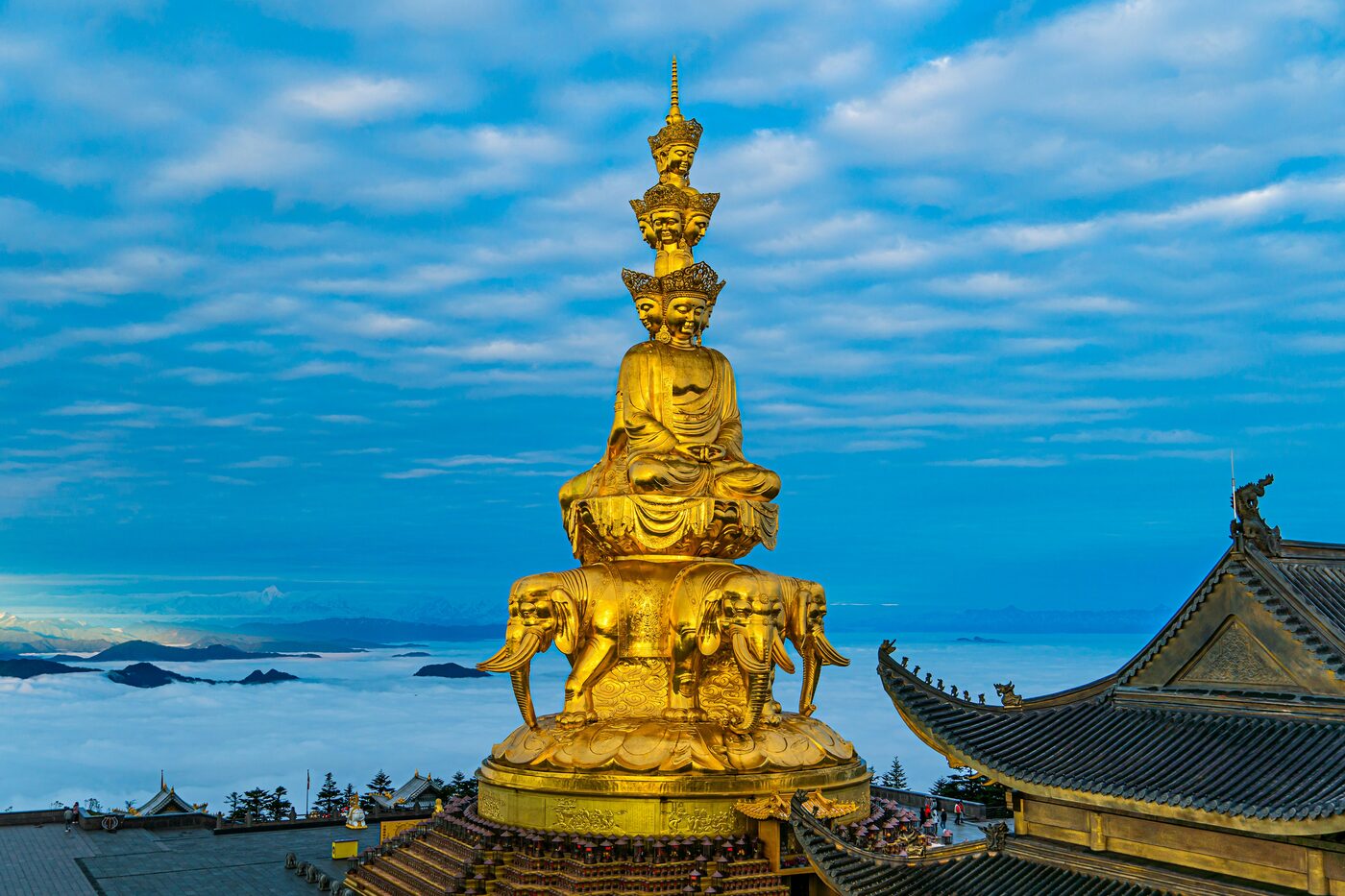
Of the four sacred peaks, this is the one nearest a major foreign-tourist hub, and the only one most English-speaking travelers actually attempt. From Chengdu East it’s about 1h15 on the high-speed rail; from the base at Baoguo Temple a bus-plus-cable-car ascent reaches the Golden Summit at 3,077m, where a clear dawn puts you above a cloud sea as the sun catches a 48m gilded Samantabhadra Buddha. UNESCO inscribed Mt Emei jointly with Leshan Giant Buddha in 1996 (World Heritage ID 779), making the combined 2-day trip the strongest cultural pairing available from Chengdu.
| Worth it for | Skip if |
|---|---|
| At least 1.5–2 days to spend; you value UNESCO + alpine scenery over urban sightseeing. | Less than 1.5 days from Chengdu — a same-day trip reaches the summit around noon, missing sunrise. |
| Photographers — sunrise on the cloud sea is genuinely cinematic. | Severe altitude sensitivity — 3,077m is mild but real, with no acclimatization layover. |
| Buddhist-history visitors — this is the mountain of Samantabhadra, one of the four great bodhisattvas. | Strict mobility limits — even the cable-car route involves stair climbs at the summit platform. |
| Travelers building toward the full Mt Emei + Leshan UNESCO double-feature. | Visiting July–August, when monsoon fog blanks the summit on roughly 60% of mornings. |
What Mt Emei is (and why foreigners come)
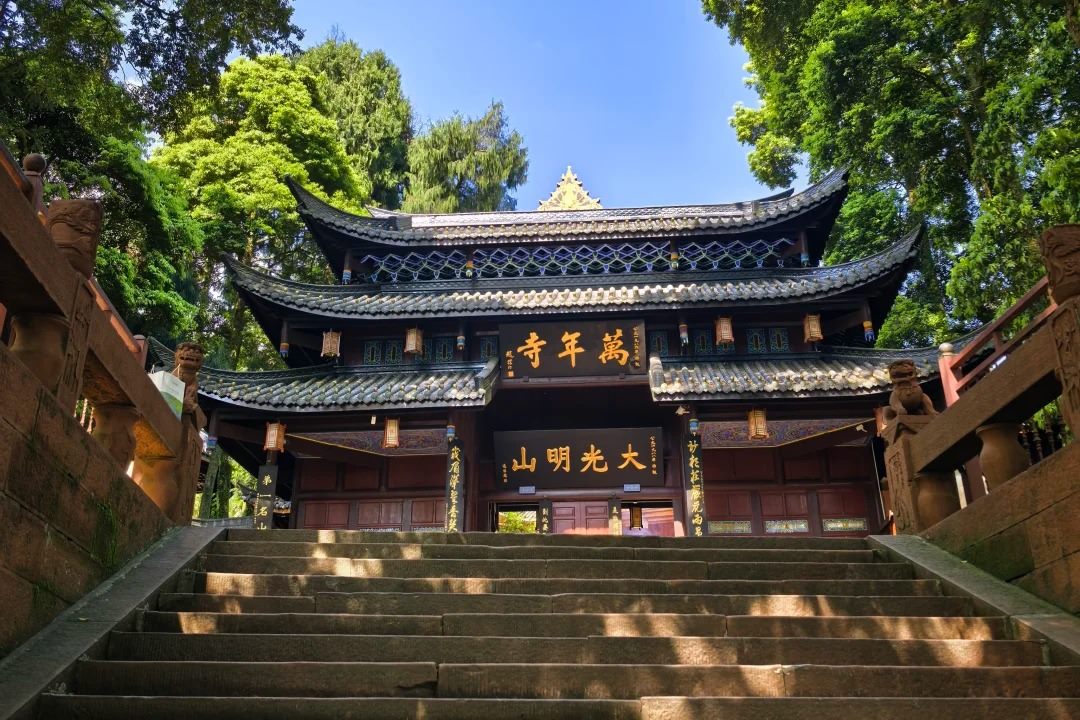
Mt Emei (峨眉山, Emeishan) is one of the four sacred Buddhist mountains of China — alongside Wutai (Shanxi, dedicated to Manjushri), Jiuhua (Anhui, Ksitigarbha), and Putuo (Zhejiang, Guanyin). Mt Emei is dedicated to Samantabhadra (普贤菩萨), the bodhisattva of practice and meditation, and the 48m gilded statue at the Golden Summit is the world’s tallest monumental sculpture of him. The mountain has hosted Buddhist monastic life continuously since the 1st century CE; the oldest surviving structure, the bronze hall at Wannian Temple, dates to 1601 and houses a 7.85m Samantabhadra-on-elephant bronze cast in 980 CE.
UNESCO inscribed Mt Emei in 1996 as a mixed cultural and natural World Heritage site (rare — only ~40 mixed sites globally), jointly with the nearby Leshan Giant Buddha as a single listing (ID 779). The dual inscription recognizes Mt Emei’s 1,500+ year monastic tradition AND its biodiversity — the protected area shelters 2,300+ plant species and around 30 mammals including the habituated Tibetan macaques you’ll meet on the lower slopes.
The Western pop-culture hook is thinner here than at Wulong (Transformers 4) or Dazu (Black Myth: Wukong), but the drawing power is straightforward: sunrise on the Golden Summit. On a clear morning you stand at 3,077m above a complete cloud sea, with the sun rising through it and the gilded Samantabhadra statue catching first light. That image — and “Buddha’s Halo” (佛光), a circular rainbow appearing in the cloud below your shadow when conditions align — has been a Chinese Buddhist pilgrimage payoff for over a millennium.
Where Mt Emei sits, relative to Chengdu
~130 km~1h15 by rail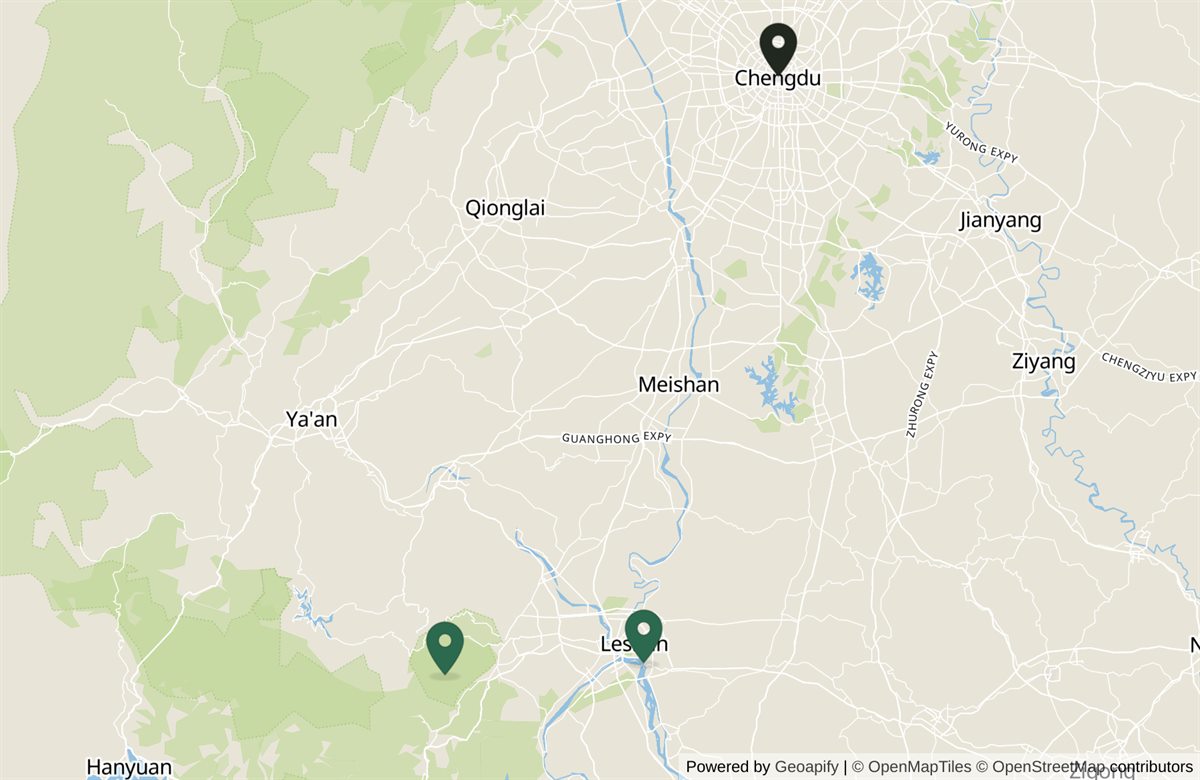 Mount EmeiMt EmeiLeshan Giant BuddhaLeshanChengduChengdu
How to get there from Chengdu — all 3 options
| Option | Cost | Time | Best for |
|---|---|---|---|
| Trip.com English tour | USD $80–120/pp day · $180–280/pp overnight | 1–2 days | First-time foreigners |
| HSR + bus + cable (DIY) | ~¥500 total/pp (day) · ~¥1,200/pp (overnight) | 1–2 days | Budget + flexible itinerary |
| Private driver | ¥1,500–2,500/day | 1–2 days | Groups of 3–4 sharing |
Option A — Trip.com English tour (recommended for first-timers)
The least-friction path. Day trips run USD $80–120 with hotel pickup, round-trip transport, mountain entrance ticket, Jinding cable car, and an English-speaking guide; overnight versions (USD $180–280) include the Jinding-area hotel that lets you actually catch sunrise. The guide adds genuine value at Mt Emei — the Buddhist iconography at Wannian Temple (that 980 CE Samantabhadra-on-elephant bronze, the bronze hall) and the summit platform context (which way Samantabhadra faces, why the mountain is dedicated to him) is hard to extract without interpretation.
Option B — high-speed rail DIY (best for budget and flexibility)
The cheapest path — and the first decision is which Chengdu station, because the two are not interchangeable. Take it from Chengdu East (成都东站) to Emeishan Station (峨眉山站): about 16 departures a day, first around06:35 and last around 21:50, in roughly 1h05–1h45 for ¥65 in second class. Chengdu South (成都南站) also serves the line but has only about six departures and nothing before 08:05, which quietly wrecks any plan built on an early start. (Sampled on 12306 for Monday 24 August 2026; frequencies move with the seasonal timetable, so check your own date.) Book via the 12306 English app 15 days in advance; weekend sunrise-trip slots fill 7–10 days ahead in spring and autumn.
From Emeishan Station to Baoguo Temple (the mountain base) is a 10–15 minute hop: city bus 12 (¥1, a ride-hail (~¥7), or a taxi (~¥15). Make sure your rail ticket reads 峨眉山站 (Emeishan), not the older 峨眉 station — Emeishan is the one near the mountain. The mountain entrance (¥160 peak / ¥110 low season, valid 48 hours) is real-name and timed-slot, so reserve it — and the coach and cable slots — when your date enters the 15-day window, not the night before (details in the tickets section). The full-mountain sightseeing coach (¥90 round-trip) then climbs to Leidongping at 2,430m — a winding 1.5–2-hour ride — and the Jinding cable car (¥120 peak round-trip) finishes the climb to within a 10-minute walk of the Golden Summit. Budget roughly ¥370 on the mountain plus ~¥130 rail for a day trip, or ~¥1,000–1,500 all-in if you sleep high for sunrise. Claiming the foreign-passport half price at the window takes the on-mountain figure to about ¥290.
Option C — private driver / car rental
¥1,500–2,500 for a 1-day round trip from Chengdu, ¥3,000–5,000 for an overnight package. Worth it for groups of 3–4 splitting the cost (≈¥500–700/pp) or travelers wanting to chain Mt Emei with Leshan in a single 2-day private car. Most Chengdu drivers don’t speak fluent English; book through your hotel concierge or via Trip.com’s private-tour listings to get one with English skills. The driver waits at Baoguo while you’re on the mountain.
The interactive Chengdu city guide has the 2/3/5-day itinerary breakdowns that this trip slots into.
Day trip vs overnight on the Golden Summit
This is the single most important decision for the whole trip. The two formats compared:
| Format | How it runs | Cost · verdict |
|---|---|---|
| Day trip (don’t, for sunrise) | 6:30/7am HSR from Chengdu, Baoguo by 9am, bus + cable car, summit 11am–12pm; back on the descent by 2–3pm for the late-afternoon HSR home. | ~¥500 all-in. Misses sunrise entirely — the headline experience, with no substitute. |
| Overnight high on the mountain (right for most) | Midday HSR, ascend by mid/late afternoon, sleep at the summit or at Leidongping (the cable base). Evening at the gilded Buddha or an early night; up about an hour before the posted sunrise time (~5:58am midsummer, ~7:48am midwinter); descend after breakfast. | ~¥1,000–1,500/pp DIY (less from Leidongping). The only way to see the cloud-sea dawn. |
Where you sleep is the real choice. The summit itself is most convenient — Jinding Hotel / 金顶大酒店 (¥800–1,500/night peak, ¥400–700 off-peak) is the lowest-friction option because you are already beside the sunrise platform. Leidongping (雷洞坪, 2,430m) is cheaper and has more food options, but in 2026 it is less comfortable than old reports suggest: the station is under reconstruction, temporary boarding areas are in use, and you still have an early walk to the Jieyin Hall (接引殿) cable station. Taiziping (太子坪) can be the cheap hardy-hiker fallback because it avoids the dawn cable-car queue, but expect monastery-basic rooms, shared facilities and no reliable online inventory. Book 1–3 months ahead for Chinese holidays, 3–7 days for an ordinary weekend.
2026 construction note: the Leidongping parking lot and station are being rebuilt, with reopening expected before Spring Festival 2027. Coaches still run, but boarding and waiting use temporary areas, the old station hall no longer offers overnight shelter or indoor rest, and traveller reports mention noise near some Leidongping rooms. If you sleep there, confirm the room is away from the work area and avoid bringing large wheeled luggage above the base.
Book the overnight Mt Emei packageNASDAQ: TCOM
Rather not DIY the summit-hotel room on a Chinese-only platform? Trip.com’s overnight Mt Emei packages bundle the HSR or coach transport, mountain ticket, cable car and the Jinding-area hotel that lets you catch sunrise — booked in English on a foreign card. Day-only and 2-day Mt Emei + Leshan combos are also listed.
What you'll see — the 4 zones
Mt Emei is large (154 km² protected area, 50+ km from base to summit on the pilgrim trail) and visitors who don’t know the structure over-allocate to the base and run out of time for the summit. A 2-day itinerary should hit zones 1 + 3 + 4, with zone 2 as an optional descent stop.
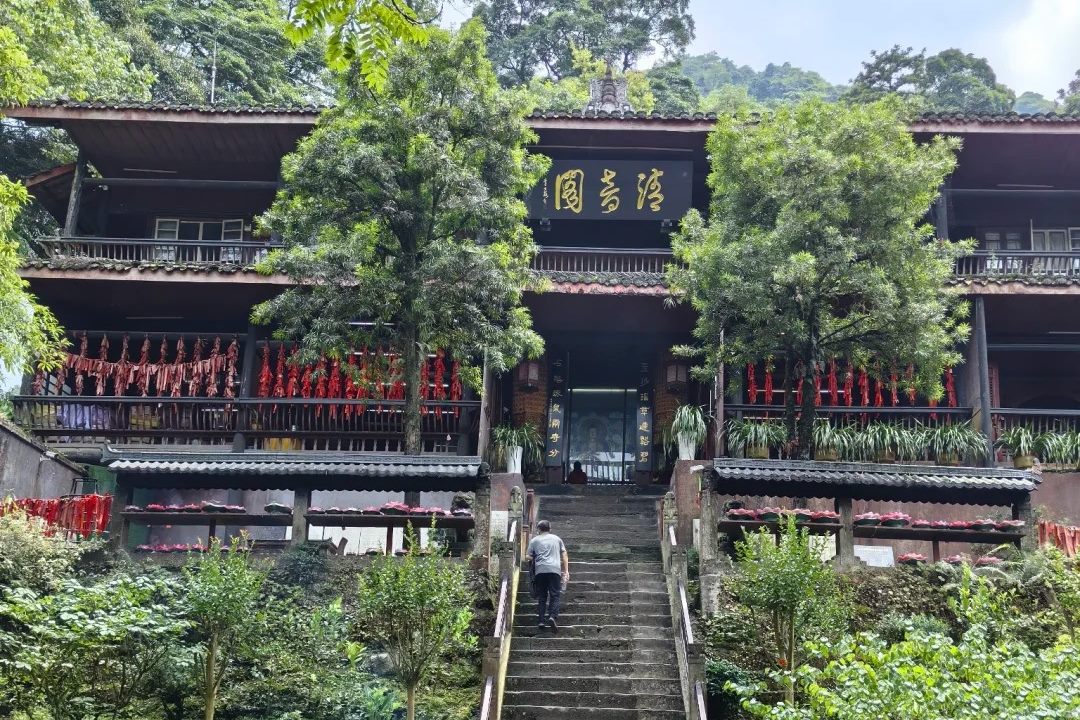
16th-century working Chan (Zen) monastery, 4 main halls, where the pilgrim trail begins — free to enter since Jan 2026 (the temple dropped its incense ticket). Allow 30–45 min. Quieter Fuhu Temple nearby (also free) is a working nunnery with a Luohan hall.
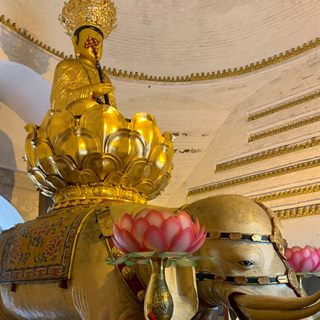
The bronze Samantabhadra-on-elephant described above, inside its 1601 fireproof bronze hall — the single most significant individual piece on the mountain. The temple is free since Jan 2026, but you still pay the coach + Wannian cable car to reach it. Allow 1.5h.
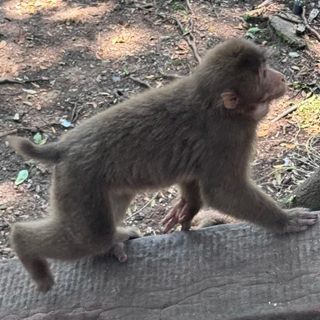
The managed zone where the Tibetan macaques congregate — the largest, most-visited troop, habituated and aggressive when food is involved. (五显岗 is the bus drop-off; the monkeys are along the Qingyinge trail, not at the stop.) Traveller reports also flag 洗象池 / 钻天坡, 灵觉寺, 九十九道拐 and the Leidongping–Jieyin Hall approach as places to keep bags zipped. Rules below.
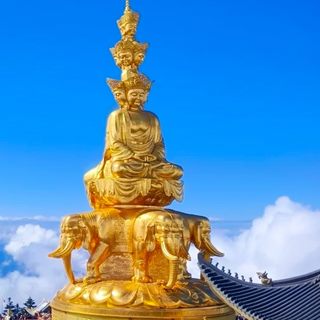
The 48m four-faced gilded Samantabhadra statue (2006), the Golden Buddha hall, the older Huazang Temple, and viewing platforms in three directions. Allow 2–3h plus dawn. The true peak, Wanfo Summit (万佛顶, 3,099m), is 2–3km further on a boardwalk — which we could not confirm is open on any given day — 40min–1h each way — but note that there is no cable car to it. Guides that describe one are describing a monorail sightseeing train that stopped running decades ago; the peak is not formally open, sells no ticket, and the walk needs a clear morning, a 16:00 turnaround and grip for shaded ice even in summer.
Sunrise on the Golden Summit
The reason for the trip — and the first thing to fix is the clock, because Mt Emei is much further west than the timetable suggests. All of China runs on Beijing time, and the summit sits about 17° of longitude west of the meridian that time is set by, so everything solar happens about an hour later here than the same date in eastern China. Computed for the summit: sunrise is around 5:58am at midsummer, 6:47am in late September, 7:02am at the March equinox and 7:48am at the winter solstice. Guides quoting “5:30am” are quoting Beijing’s clock, not this mountain’s, and following them in December puts you on an exposed platform two hours early in sub-zero wind. Hotel front desks post tomorrow’s exact time — ask.
Practical sequencing:
- Work back about an hour from the posted time if you are sleeping at the summit. The platform area opens roughly 20 minutes before sunrise; you want time to pick a spot, not to arrive into a crowd.
- From a Leidongping bed, allow about 1h15 in total: 20–30 minutes on foot to Jieyin Hall (接引殿) from Leidongping station (雷洞坪车站) — 1.5km, unlit, so bring a head torch — then the queue and the ride. The first cable car runs 20–30 minutes before sunrise, so the first car does get you up in time. In summer that means an alarm around 3:45–4:00am; in spring and autumn nearer 5:00am. Start earlier on holidays.
- The classic spot is Sheshen Cliff (舍身崖), where the sun breaks over the cloud sea beside the gilded Buddha.
- Wear all your layers. Summit overnight lows run −5 to −15°C in winter, 0–5°C in spring/autumn, 5–10°C in summer; wind is constant. A hard shell over an insulating layer over a base layer, plus hats and gloves year-round.
- Hot tea sellers set up on the platform 10–15 minutes before sunrise — ¥10–20 a cup, cash.
- The cloud sea (云海) forms below the summit on roughly 50–70% of clear-weather mornings spring/autumn, 30–40% in summer, 60–70% in winter.
- Buddha’s Halo (佛光) — the rare circular rainbow in the cloud below your shadow — appears when sun angle, cloud density and observer height align. Modern viewer odds: 5–10% on any morning, slightly better in late autumn.
Mt Emei + Leshan — the 2-day double-UNESCO
Mt Emei and Leshan Giant Buddha are listed as a single UNESCO World Heritage site (ID 779) for a reason: they sit 35km apart and have shared Buddhist heritage for over a millennium. The natural sequence:
| When | What |
|---|---|
| Day 1 morning | Chengdu East → Emeishan (~1h15). Arrive Baoguo Temple by lunch. |
| Day 1 afternoon | Bus + Jinding cable car to the summit. Settle into the Jinding hotel by 4–5pm. |
| Day 1 evening | Golden hour at the gilded Samantabhadra statue, dinner, early bed. |
| Day 2 dawn | Sunrise on the summit — ~5:58am at midsummer, ~7:48am at the winter solstice. |
| Day 2 morning | Descend cable car + bus to Baoguo. Optional Wannian Temple stop (the cable car branches off). |
| Day 2 afternoon | Emeishan Station → Leshan by HSR (15m, ¥11) or 50-min taxi. Boat tour of the 71m Tang-dynasty Giant Buddha (carved 713–803 CE), the largest stone Buddha in the world. |
| Day 2 evening | Leshan → Chengdu (~50 min). Back in Chengdu by 8–9pm. |
This is the strongest cultural pairing available from Chengdu, and most English-language tour packages structure themselves around it. If you only have one day, pick Leshan over Mt Emei — the Buddha boat is doable in a half day and you don’t miss the headline experience the way you do with a Mt Emei day-only.
Tickets, cable cars, and the payment reality
The booking window is 15 days, and stock drops at 08:00. The entrance, the high-mountain coach and the Golden Summit cable car are all real-name and sold by timed slot, and they go on sale up to fifteen days out with new stock released each morning at eight. So the rule is not “book a day or two before” — it is book the morning your date enters the window. Since 23 May 2026 the Golden Summit area has also been capped at 8,000 entries a day, with the coach capped alongside it; the cap was announced by the listed operator rather than on the scenic area’s notice board, which is why almost no English source carries it. A weekend usually needs 2–3 days’ notice, a public holiday 3–5, and the 06:00–09:00 slots can go within minutes of release. The coach uses natural-hour windows, one slot per passenger per date; miss it and you may change to a later slot if capacity remains, or board after 14:00 once none does.
| Item | Price | Notes |
|---|---|---|
| Mountain entrance | ¥160 peak / ¥110 low season ¥80 / ¥55 on a foreign passport | Low season is only Dec 15 – Jan 15; the rest of the year is peak. Valid 48 hours. Real-name and timed-slot — book up to 15 days ahead, stock released 08:00 daily. The half price is issued at staffed windows only (see below). Every temple on the mountain has been free since 1 Jan 2026, but you still pay this entrance. |
| Full-mountain sightseeing coach | ¥90 round-trip (no concession) | Emeishan station / Baoguo / Huangwan ↔ Leidongping (2,430m) — a winding 1.5–2h ride, so take motion-sickness tablets, and use the visitor-centre toilets first because the coach has none. Uphill departures 06:00–17:00 Apr–Oct and 07:00–16:00 Nov–Mar. Last coach down from Leidongping 18:00 Apr–Oct, 17:30 Nov–Mar — on a day trip that, not the closing time, is your deadline. |
| Jinding cable car | ¥120 RT peak (up ¥65 / down ¥55) ¥50 RT low season | Jieyin Hall ↔ summit; low season is up ¥30 / down ¥20, and there is no concession fare. Runs from 20–30 min before sunrise to 18:00, last car down ~17:30 — start queueing to descend by 15:00. Two separate lines board here on one ticket — which to pick is explained below. |
| Wannian cable car | ¥110 RT peak (up ¥65 / down ¥45) ¥50 RT low season | Separate, mid-mountain, and the way you reach Wannian Temple. Same low-season fares as Jinding. Runs 07:00–18:00 Apr–Oct, 07:30–18:00 Nov–Mar. |
| Golden Summit fast-track | ¥50 | An optional queue-skip on the Jinding cable car, sold in the official mini-program and at the ticket window. Pointless off-peak, when the queue is 15–20 minutes; the best-value ¥50 on the mountain at a weekend or on a public holiday, when it runs 1.5–3 hours. |
| Jinding-area hotel | from ~¥1,200 peak | Traveller-reported: standard rooms commonly from about ¥1,200 in peak season and higher at weekends, against roughly half that at Leidongping. Monastery guesthouses ¥200–400, basic and some unheated. |
Two cable lines, one fare — and the queue trick nobody writes down
Jieyin Hall is not one cable car but two, boarding side by side for the same fare on the same ticket. The jig-back tram loads on the left: a single cabin taking about a hundred people standing, stable, no vertigo, no view to speak of from the middle — and usually the faster queue, because each trip clears so many people at once. The detachable gondola loads on the right: six seated, 360-degree views, and a sharp acceleration off the station that travellers with a fear of heights dislike. Whichever queue is shorter is the right answer, and riding up on one and down on the other means the station steps run downhill both times. One caveat worth planning around: travellers report the jig-back line is often taken out of service for maintenance on weekday afternoons from about 15:00, so an afternoon descent wants either an early queue or the gondola. High wind and thunderstorms suspend both.
Cash, Alipay, and where foreign cards fail
The ticket office at Baoguo, the coach windows, and all three cable car stations accept WeChat Pay and Alipay. Cash is accepted at the entrance office and most cable car stations but increasingly rare on the mountain. Foreign credit cards work at almost no point on the mountain — Visa/Mastercard POS exists at the Jinding Hotel front desk and maybe one or two restaurants near Baoguo, nowhere else. Bring ¥800–1,200 cash backup, and bind a foreign card to Alipay before you leave Chengdu — it’s the most important payment prep for this trip.
The half-price ticket a foreign passport gets you
This is the part almost nothing in English says. The scenic area’s published concession policy puts holders of a valid foreign passport in the half-price tier, alongside permanent residents of Hong Kong, Macau and Taiwan — ¥80 instead of ¥160 in peak season, ¥55 instead of ¥110 from 15 December to 15 January. Visitors aged 65 and over go free; children under 1.2m or under 6 are free and 7–18s pay half.
The catch is the channel, not the entitlement. The official mini-program is built around Chinese ID cards and has no passport path, so the discount is only issued in person at a staffed window — the Baoguo (报国寺) or Huangwan (黄湾) visitor centre, or the ticket counter inside Emeishan railway station (峨眉山站). Show the passport and ask for 半价票 (bàn jià piào, half-price ticket), and buy the coach and cable-car slots in the same transaction while you are there, because those are the ones that run out. Two things not to expect: the discount covers the mountain entrance only (the coach and both cable cars are full price for everyone), and a photo or photocopy of the passport is refused — it has to be the document. Travellers report the gates have read passports directly since April 2026, so later entries need no paper-ticket exchange, and the three largest visitor centres have self-service machines with English, Korean, Japanese and Arabic interfaces.
So there is a real trade here, and it is worth making deliberately rather than by accident. Booking the entrance through an English booking site is faster, works on a foreign card and handles the real-name slot for you — but it bills the full ¥160. Turning up at a window with your passport costs you a queue and saves you ¥80 a head. If you are going to the window anyway for the coach slot, take the discount; if you are landing on a holiday weekend and the slots are what worry you, book ahead in English and treat the ¥80 as the price of certainty. Either way, refuse anyone at the station or the gate offering to obtain a “passport ticket” through an inside channel — that is the pitch the scenic-area police notice warns about, and it is described in the practical section below.
When to go (and when to skip)
| Window | Verdict |
|---|---|
| Sep–November | Best overall. Post-monsoon clarity, the best cloud-sea and Buddha’s-Halo odds, golden larch and red maple peaking mid-Oct–early Nov (Leidongping–Xixiangchi trail). Avoid Oct 1–7 Golden Week. |
| Late April–May | Strong second window: 8–15°C base / 0–8°C summit, azaleas mid-mountain, fewer crowds than autumn. |
| July–August | Avoid. Monsoon fog blanks the summit on roughly 60% of mornings and thins the cloud sea; heavy rain makes some mid-mountain trails slippery. |
| Dec–February | Highest sunrise/Halo odds and the emptiest platform — snow, rime and ice make it the most photogenic season, but summit lows hit −15°C and ice can suspend the upper cable car and force crampons. Not a first-timer’s default. |
| Golden Weeks | Avoid. Spring Festival (mid-Feb), May 1–5, Oct 1–7: cable-car queues 2+ hours, hotel rates 2–3×, elbow-jostling at the platform. |
See our best time to visit China guide for the broader regional picture.
Practical for foreign travelers
Monkey rules (take seriously)
They are Tibetan macaques, a nationally protected species, and the scenic area puts them at roughly 15 troops totalling more than 500. Its own posted rules forbid feeding, calling to, teasing or touching them — and equally forbid staring at, chasing, shouting at or kicking them. Minors must be accompanied; pregnant visitors and anyone with a heart condition are asked to be careful. In May 2026 a visitor who shoved a feeding monkey was banned from the scenic area for three years, so this is enforced rather than advisory. The biggest troop is in the managed Ecological Monkey Zone (生态猴区) on the Qingyinge–Yixiantian section, but traveller reports also warn about 洗象池 / 钻天坡, 灵觉寺, 九十九道拐 and the Leidongping–Jieyin Hall approach — do not treat the cable-car walk as monkey-free.
- Keep both hands empty. A plastic bag, a loose bottle or food in your hand is what gets taken.
- They have learned to open backpack zips — a small padlock through the zip pulls is worth carrying, and a phone wants a wrist strap.
- Don’t make eye contact, don’t smile (showing teeth reads as a threat), don’t move in close for photos.
- If one blocks the path or grabs at a bag, stay still — don’t run, shout or pull back. Find a member of staff.
- If bitten or scratched, wash the wound with soap and running water for at least 15 minutes, then get to a medical point. Rabies post-exposure treatment is why this matters; don’t skip it.
Two rules that catch foreign visitors out
- Night walking is banned, and the trail gates shut at 20:00. The scenic area controls the Leiyin Temple–Qingyinge, Qingyinge–Leidongping, Qingyinge–Wannian and Wannian–Jiulinggang trails and the Zero-Kilometre–Leidongping road after dark, closing the barriers at Hongchunping, the Wannian back gate, Xianfeng Temple and Xixiangchi at 20:00. The night-ascent plans still circulating online date from before this; they don’t work now, and with the Leidongping station shut for rebuilding there is nowhere to shelter either. The pre-dawn walk from a Leidongping bed to the cable station is a different thing and is unaffected.
- Drones are prohibited without prior approval — across the whole scenic area. It is designated controlled airspace. Non-commercial photography needs written approval from the scenic-area development bureau in advance, and temples, historic buildings, the museum, the cable cars and the reservoir catchment are no-fly regardless. If a cloud-sea drone shot was the plan, plan something else.
Touts and scams to skip
This is not folklore: the scenic-area police opened a campaign against it on 24 March 2026, targeting forced soliciting at the station, the piers and the gates, and forged credentials used to tout tours. The notice singles out anyone offering a “shortcut, cheaper way in” — organising ticket evasion is treated as a criminal matter, not a bargain. There is a report line, 0833-5590110.
- Roadside “cheap tours” and fake guides at the HSR station, hotel doors and the base — the ones promising “skip the queue, cheaper, I’ll take you up.” They pull you onto a van, then upsell “cable-car insurance,” “monkey insurance,” a “temple pass” and headset fees, and end at a shopping stop. Wave them off.
- The “temple pass” con. Every temple on the mountain has been free since Jan 2026 — anyone claiming you must buy an ¥18 temple ticket to reach the summit is lying.
- Book lodging on a real platform, not a roadside flyer — cheap “homestays” near the base can be grubby or jack up the price on arrival, and summit/Leidongping rooms are limited in peak season.
- Skip the “free” bracelet/charm handouts and fortune-teller “healers” on the trail — they end in a demand for money.
Layered clothing and altitude
The base at Baoguo is 550m, the summit 3,077m — a 2,500m gain in one cable-car ride. The drop runs 12–18°C base-to-summit at any time of year, and Jinding’s wind adds ~5°C of windchill. Layer: base layer + insulating mid (fleece or light down) + hard-shell wind/rain jacket; hats and gloves year-round on the summit. Some Jinding hotels rent down jackets for ¥30–50/day, but supply runs out on peak weekends. Altitude is mild (3,077m is ~1,000m below the symptomatic threshold for most healthy adults), but summit front desks sell small oxygen canisters (¥30–50) if you’re prone to it. In winter and early spring, add slip-on crampons for the iced-over paths. Bring a full power bank too — batteries drain fast in the cold and shared chargers are scarce up top.
Monastery vegetarian meals & English signage
Several monasteries serve simple vegetarian set meals (素斋, sucai) — ¥15–30/person, communal tables, no reservation; Baoguo and Wannian have the best-known halls (walk in 11:30–12:30 or 5:30–6:30). English signage is better than most Chinese mountains: the Jinding summit, the Samantabhadra statue, the Golden Buddha hall and the cable car stations are fully bilingual, and Huazang Temple has English-speaking monks — genuinely useful for Buddhist-history visitors and rare among Chinese mountains.
How it fits a Chengdu trip: for most foreign travelers Mt Emei is Day 3–4 of a 5-day Chengdu base — Day 1–2 the city core (pandas, Jinli, hot pot, Wenshu), Day 3–4 the Mt Emei + Leshan double-UNESCO overnight, Day 5 flexible. See the full Chengdu itinerary. With only 2–3 days, Mt Emei competes with the panda bases and Leshan for the one day-trip slot — choose it if you have 1.5–2 days and value alpine + sunrise above all.
Where to stay
Two layers to the lodging question. For sunrise you sleep on the mountain near the Jinding summit platform; for everything else you base in Chengdu and ride the ~1h15 train out. Most travelers do both: Chengdu nights bookending one night at Jinding. The sensible Chengdu pick for a first China trip is a domestic mid-range chain within reach of the first Emeishan departures; distances below are indicative.
Where to book these: China’s home-grown chains — 全季 (JI) and 亚朵 (Atour) — and the summit/Baoguo lodges are listed most completely on Trip.com, with English checkout and foreign-card payment. It’s the main booking platform for mainland hotels; Western sites like Booking and Agoda carry only a fraction of their branches, and the on-mountain lodges barely at all.
On the mountain — for the sunrise (book ahead)
If sunrise on the Golden Summit is the point of the trip, you sleep high on the mountain. Supply near the top is limited, the high-mountain coach is now time-slotted, and Leidongping is under reconstruction until around Spring Festival 2027, so book 1–3 months ahead for Chinese holidays; an ordinary weekend needs only 3–7 days.
- Within a few minutes of the Golden Summit platform, 3,077m — the closest beds for sunrise, and the priciest.Travellers report peak standard rooms commonly from ¥1,200, and higher at weekends, against roughly half that at Leidongping. Supply near the top is small, so book one to two weeks out. Taiziping (太子坪) is the cheap monastery-style fallback closer to the summit, but conditions are basic and advance online booking is not dependable.
- The cable-car base — 1.5km and 20–30 minutes on foot to the Jieyin Hall cable station, then the ride to the summit for dawn.About half the summit price and what most people actually do — and it does make sunrise, because the first cable car runs 20–30 minutes before it. Two caveats: there is no lighting on the path, so bring a head torch, and the car park and station are closed for reconstruction until around Spring Festival 2027, so there is nowhere sheltered to wait.
- Mid-rangeBaoguo Temple base hotels (报国寺) →At the mountain base by Baoguo Temple, 550m — about 10–15 min from Emeishan HSR station (city bus 12 ¥1 ride-hail ~¥7); a sensible base without the mountain premium.Cheaper than up top and useful if you ascend at dawn rather than sleeping high — but you cannot make the summit for sunrise from here — the first coach up leaves at 06:00 at the earliest.
Best value — base in Chengdu (recommended for most)
Most foreign travelers do Mt Emei from a Chengdu base, riding the ~1h15 train out and back (with one night high on the mountain for sunrise). For the Chengdu nights, a domestic chain like 全季 (JI) or 亚朵 (Atour) is the reliable pick — English-app booking and a fraction of the five-star rate. Two international five-stars are listed if you want them.
- Central Chengdu, with branches across the city core and good access to the first Emeishan departures.China's most popular home-grown mid-range chain — modern, spotless, easy English-app booking, roughly a third the price of the five-stars.
- Central Chengdu — design-led mid-range, well placed for the South Station HSR to Emeishan.Design-led mid-range chain that foreign guests rate highly — comfortable, well-run, and far better value than the luxury towers.
- Central Chengdu by Tianfu Square — full-service international five-star, listed if you want it.
- LuxuryNiccolo Chengdu →Atop the IFS tower in central Chengdu — the other top international option for a city base.
Frequently asked questions
Is Mt Emei worth visiting from Chengdu?
Yes — for most foreign travelers Mt Emei is the highest-payoff day or overnight trip from Chengdu. It's one of China's four sacred Buddhist mountains, UNESCO World Heritage since 1996 (jointly listed with Leshan Giant Buddha), and the Golden Summit at 3,077m delivers the cloud-sea sunrise that's the trip's defining experience. Reachable in about 1h15 by rail from Chengdu East. Skip if you have less than 1.5 days, severe altitude sensitivity, or you're visiting July-August when fog blanks the summit on roughly 60% of mornings.
How do I get from Chengdu to Mt Emei?
Three options. (1) Trip.com English-friendly day tour from Chengdu (USD $80-120, 12-13 hours, hotel pickup, cable car included) — best for first-time foreign visitors who want the summit without the overnight. (2) DIY by rail: take it from Chengdu East, not Chengdu South. East runs about 16 departures a day, first around 06:35 and last around 21:50, in roughly 1h05-1h45 for ¥65 in second class; South has only about 6 and nothing before 08:05, which breaks a plan built on an early start (12306, sampled Monday 24 Aug 2026). From Emeishan station (峨眉山站) it is 10-15 minutes to the Huangwan visitor centre where the mountain coaches begin. On-mountain costs run about ¥370 (entrance ¥160 + full-mountain coach ¥90 round-trip + Jinding cable car ¥120 peak round-trip) — or about ¥290 if you claim the foreign-passport half price at a ticket window, which is the discount described below. Since 2026 the entrance, the high-mountain coach and the Golden Summit cable car are all real-name, timed-slot and capacity-limited, so DIY means booking those slots ahead. (3) Private driver from Chengdu, ¥1,500-2,500/day — flexible, English-speaking driver harder to source. Most independent travelers pick the train plus an overnight near the summit.
Should I stay overnight on the mountain?
If sunrise on the Golden Summit matters to you, yes — and for most foreigners it should. The summit cloud-sea sunrise is the single experience that distinguishes Mt Emei from any other Sichuan day trip, and there is no way to be up there for it from Chengdu without sleeping high on the mountain. Sleeping at the summit is easiest: a few minutes' walk from the platform, no pre-dawn walk, and the priciest option — travellers report peak standard rooms commonly from ¥1,200 and weekends higher, with only a week or two of supply. Leidongping at 2,430m costs roughly half and is what most people actually do, and it does work: the walk to the Jieyin Hall cable station is 1.5km and 20-30 minutes, the first cable car runs 20-30 minutes before sunrise, so the first car puts you on the platform with time to find a spot. Two things to plan for — there is no lighting on that path, so a head torch is not optional, and the Leidongping station building is closed for reconstruction until around Spring Festival 2027, so there is nowhere sheltered to wait. Taiziping is a cheap monastery-style fallback near the summit, basic and not reliably bookable online. Book 1-3 months ahead for Chinese holidays, 3-7 days for an ordinary weekend. Skip the overnight and you reach the summit around noon, which misses the point.
Do I need to book Mt Emei tickets in advance in 2026?
Yes, and the window is longer than most guides say. Tickets go on sale up to 15 days ahead, with new stock released at 08:00 each morning — so the advice is not 'book a day or two before' but 'book the morning your date enters the window'. Since 23 May 2026 the Golden Summit area has also been capped at 8,000 entries a day, and the high-mountain coach is capped alongside it. A weekend usually needs 2-3 days' notice; a public holiday needs 3-5, and the 06:00-09:00 slots can go within minutes of release. Walkers are the exception: a pure hiking ticket sits outside the 8,000 cap and can be bought on the day at a low-mountain gate. If you miss a coach slot the official rule allows a later slot when capacity remains, or boarding after 14:00 if none is left. The official channel is a Chinese WeChat mini-program that accepts Chinese ID cards only, so the practical English route is to book the entrance-plus-cable package or a guided tour through Trip.com or Klook — bearing in mind that this bills the full ¥160 rather than the ¥80 a passport gets you at a window. Two more recoveries worth knowing: the gate ticket is valid 48 hours, so a lost coach slot can be picked up the next morning, and if the summit is gone entirely the mid-mountain zones are still a good day.
Do foreign visitors get a discount at Mt Emei?
Yes — and almost nothing in English says so. The scenic area's own concession policy puts holders of a valid foreign passport in the half-price tier, alongside permanent residents of Hong Kong, Macau and Taiwan. That is ¥80 instead of ¥160 in peak season and ¥55 instead of ¥110 from 15 December to 15 January. Visitors aged 65 and over go free; children under 1.2m or under 6 are free, and 7-18s pay half. The catch is the channel rather than the entitlement: the official mini-program has no passport path, so the discount can only be issued in person at a staffed window — the Baoguo (报国寺) or Huangwan (黄湾) visitor centre, or the ticket counter inside Emeishan railway station (峨眉山站). Show the passport and ask for 半价票 (bàn jià piào, half-price ticket), and buy the coach and cable-car tickets in the same transaction while you are there. The discount applies to the mountain entrance only; the coach and both cable cars are full price for everyone. Bring the physical passport, because a photo or a photocopy is refused,
When is the best time to visit Mt Emei?
For the cloud-sea and Buddha's Halo the payoff seasons are autumn and winter, not summer. September through November is the sweet spot travelers rate highest — post-monsoon clarity, the best cloud-sea and 佛光 odds, golden larch and red maple peaking mid-October to early November on the upper trails. Late April-May is the other strong window (cool, azaleas at mid-mountain, fewer crowds). December-February has the highest sunrise/halo odds and the emptiest platform, but the summit runs −5 to −15°C and snow/ice can suspend the upper cable car and force crampons — not a first-timer's default. Avoid July-August (monsoon fog blanks the summit on roughly 60% of mornings) and the three Golden Weeks (Spring Festival, May 1, October 1), when cable-car queues top 1.5-2 hours and overnight rates 2-3×.
How long should I plan for Mt Emei?
Two days, one night is the standard sweet spot for foreign travelers. Day 1: morning train from Chengdu East (~1h15), arrive base around lunch, take the bus + cable car to Jinding by mid-afternoon, settle into the summit hotel, evening at the Golden Buddha statue and Huazang Temple. Day 2: pre-dawn wake-up for sunrise (about 5:58am in midsummer and 7:48am at the winter solstice), descend after breakfast, optional Wannian Temple stop on the way down, train back to Chengdu by evening. A rushed day trip skips sunrise entirely. A 3-day trip lets you add Leshan Giant Buddha for the full UNESCO ID 779 experience.
Is Mt Emei harder than other Chinese sacred mountains?
If you take the cable car, no — Mt Emei is among the more accessible of China's sacred mountains. The Jinding cable car drops you within a 10-minute paved walk of the summit platform; the only stairs are the final approach to the Golden Buddha statue. Compared to Mt Hua (the famously dangerous plank-walks), Mt Tai (6,660 stairs), or Huangshan (steep granite staircases), Mt Emei is genuinely tourist-friendly. The hard version exists if you want it: by the scenic area's own distances the pilgrim route from Baoguo to the Golden Summit is about 44km of stone steps via Wannian Temple, or about 61km on the back route through Jiulaodong — two days for most people, with travellers putting the ascent alone at 6-8 hours of walking. Most foreign visitors ride and see the same summit.
Can I combine Mt Emei with Leshan Giant Buddha?
Yes, and you should — they're listed together as a single UNESCO World Heritage site (ID 779), and the rail hop between them is shorter than almost anyone expects: Emeishan to Leshan runs about 17 times a day in 15-23 minutes for ¥11 in second class (12306, sampled Monday 24 Aug 2026). The natural sequence is Day 1 train from Chengdu East to Emeishan, ascend, sleep high for sunrise; Day 2 sunrise and descent, then the short hop to Leshan for the riverboat view of the 71m Tang-dynasty Giant Buddha, and back to Chengdu in the evening. This is the strongest 2-day cultural pairing available from Chengdu and it's the structure most English-language tour packages follow.
Are the monkeys really dangerous?
Yes, take them seriously. They are Tibetan macaques, a nationally protected species, and the scenic area puts them at roughly 15 troops totalling more than 500. Its own posted rules forbid feeding, calling to, teasing or touching them, and equally forbid staring at, chasing, shouting at or kicking them; minors must be accompanied, and pregnant visitors and anyone with a heart condition are asked to be careful. In May 2026 a visitor who shoved a feeding monkey was banned from the scenic area for three years, so the rules are enforced. The biggest troop is in the managed Ecological Monkey Zone (生态猴区) on the Qingyinge–Yixiantian section, but traveller reports also flag Xixiangchi/Zuantianpo, Lingjue Temple, Jiujiu Daoguai and the Leidongping–Jieyin Hall approach. In practice: never carry a plastic bag, a loose bottle or food in your hands, because those are what get taken; the macaques have learned to open backpack zips, so a small padlock through the zip pulls is worth carrying and a phone wants a wrist strap. Don't make eye contact, don't smile (showing teeth reads as a threat), and don't move in close for photos. If one blocks the path or grabs at a bag, stay still, don't run or shout, and don't pull back — find a member of staff. If you are scratched or bitten, wash the wound with soap and running water for at least 15 minutes and then get to a medical point; rabies post-exposure treatment is why this matters.
Sources
Checked August 2026 · Written from our own first-hand travel in China.