Key takeaways
- Two adjoining sites: Wuhou Temple (武侯祠, ¥50) is the ticketed Three Kingdoms shrine; Jinli (锦里) is the free Ming-style covered street next door.
- They share a perimeter wall — do Wuhou first because it closes, then walk into Jinli (free), which is at its best after dark.
- Metro Line 10 to 武侯祠(锦里) station, exit A2 — about 220 m to the gate. Guides still routing you to Gaoshengqiao for a 1 km walk predate the line, which opened in September 2025.
- Wuhou is real-name booked, and tickets open 14 days out. Foreign visitors book direct with a passport, then collect a printed ticket at the gate counter — the turnstiles read mainland ID cards only.
- The lanterns come on at dusk, which in Chengdu is about 8pm in midsummer and about 6:05pm in midwinter, and go off at 22:00. Jinli’s main street is for photographs, not dinner — eat at Kuixinglou Street beside Kuanzhai Alley instead.
Two attractions, one half-day
Wuhou Temple and Jinli Ancient Street share a perimeter wall and are visited as a single half-day stop in central Chengdu. Wuhou is the historical attraction — the most important Three Kingdoms memorial in China — while Jinli is the adjacent Ming-style covered street with snacks, lantern alleys, and courtyard Sichuan-opera face-changing shows. The key distinction: Wuhou is ticketed (¥50) and Jinli is free. Together they cover history, food, and evening entertainment in 3–4 hours within walking distance of each other.
Where Wuhou Temple and Jinli sit in Chengdu
5 km across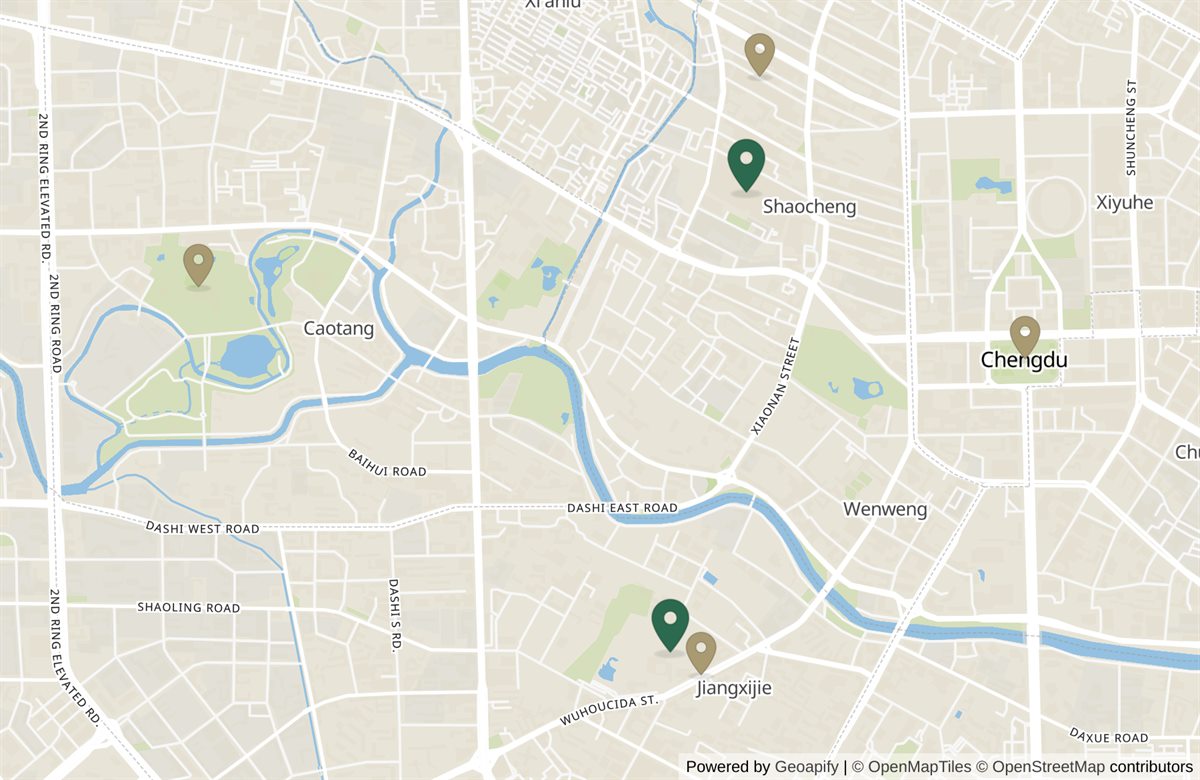 Wuhou Temple & JinliWuhou & Jinli武侯祠 station (Line 10)Kuanzhai AlleyKuanzhaiKuixinglou St — eat hereTianfu SquareDu Fu Thatched Cottage
Wuhou Temple — the Three Kingdoms shrine
Wuhou Temple (武侯祠 — “Marquis Wu’s Shrine,” referring to Zhuge Liang’s noble title) is the only Three Kingdoms (220–280 CE) memorial in China that combines a ruler’s mausoleum with his strategist’s shrine in a single complex. Liu Bei — founder of the Shu Han kingdom — and Zhuge Liang — his prime minister and military strategist — are both honored here. The original temple was built around 200 CE; the current architecture dates to a Qing-dynasty 1672 reconstruction.
The complex is divided into four zones:
| Zone | What it is |
|---|---|
| Liu Bei’s mausoleum 汉昭烈墓 (Han Zhao Lie Mu) | The actual burial mound of Shu Han’s founder, ringed by cypress trees over 1,000 years old. Contemplative, not crowded. |
| Zhuge Liang shrine 武侯祠 (Wuhou Hall) | Central hall with the seated statue of Zhuge Liang flanked by his ministers — the iconic image used in Three Kingdoms art. |
| Three Kingdoms exhibits | Covered galleries of general statues, narrative panels and historical artifacts. English signage on the major panels. |
| Red Wall corridor 红墙 | 50-meter passage, deep red-lacquer wall on one side, dense green bamboo on the other — the single most photographed spot at Wuhou. |
Allow 1.5–2 hours. The complex is mostly outdoor courtyards linked by covered walkways; bring an umbrella in summer rain. The cypress trees near Liu Bei’s mausoleum give shade year-round.
Wuhou ticket & practical info
| Detail | Info |
|---|---|
| Address | 231 Wuhouci Avenue, Wuhou District (武侯区武侯祠大街231号) |
| Metro | Line 10 to 武侯祠(锦里), exit A2 — ~220 m. On Line 3 / 5, Gaoshengqiao (高升桥站) exit A, ~1 km |
| Hours | 1 May–7 Oct: 8:30am–6:30pm, admission stops 5:30pm. Rest of year: 9:00am–6:00pm, admission stops 5:00pm |
| Ticket | ¥50. ¥25 ages 7–17 (foreign minors included) and full-time students 18–23; free under 7 or under 1.3 m. A foreign adult pays full |
| Booking | Real-name, released 14 days ahead at wuhouci.net.cn or WeChat — passport accepted, English interface |
| Entering | One entrance only: the south main gate, with every other gate exit-only. On a passport, collect a printed ticket from the counter beside it first |
| Du Fu Cottage | Separate ¥50 ticket — no official combo any more |
| Guides | Free Chinese/English audio guide via the museum’s WeChat account; ¥20 ten-language handset (¥100 deposit); live English guides inside the gate |
| Time on-site | 1.5–2 hours |
Book direct, and book with your passport. Wuhou is real-name and not walk-up, and tickets are released 14 days ahead rather than the day before. Book on the museum’s own site (wuhouci.net.cn) or its WeChat account: the ID selector takes a passport and the interface runs in English, Japanese and Korean, so the usual Chinese-only obstacle does not apply here. The museum states plainly that it has never authorised anyone to sell its tickets online, and its booking system adds that the risk from an unofficial channel is the buyer’s — though a ticket that is genuine and scans will still admit you. On the day, go to the south main gate, the only entrance; the turnstiles read mainland ID cards, so exchange your order QR and your physical passport for a paper ticket at the service window beside it. Anyone offering an “inside ticket” or to walk you past the queue is running a scam.
Jinli Ancient Street — the free snack & opera street
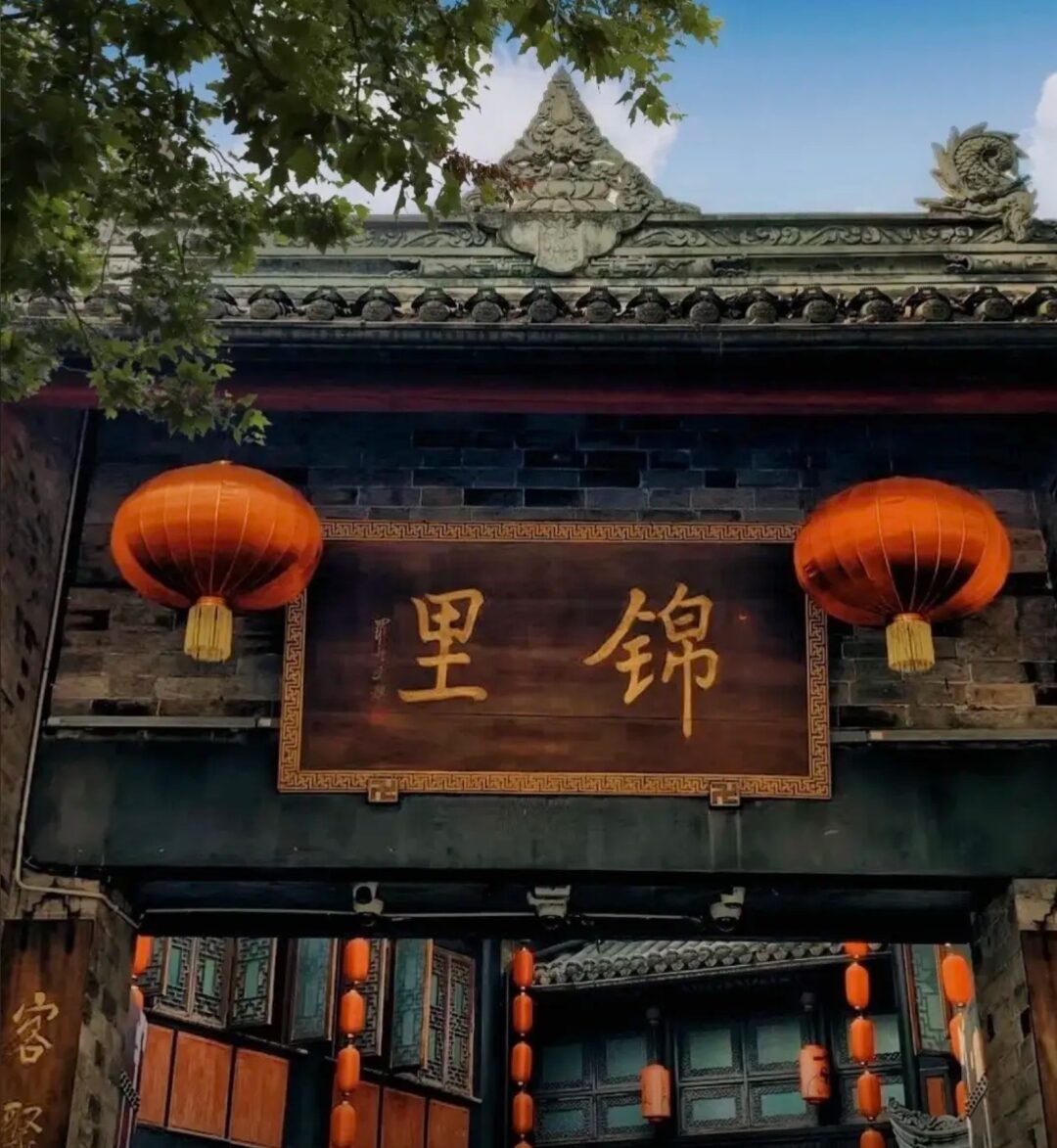
Jinli (锦里 — “Brocade Lane,” a nod to Chengdu’s historical silk-weaving trade) is a 350-meter Ming-style covered street built directly against Wuhou Temple’s north gate. The architecture is a 2004 reconstruction (the original Qing-era street was demolished decades earlier), but the layout and materials are historically accurate. Entry is free — walk straight in from Wuhou’s north gate, or from the dedicated Jinli entrance on Wuhouci Avenue. You only pay for snacks, opera tickets and restaurant meals.
The street itself never closes; the shops keep roughly 9am to 10pm and the bars run later. Which matters more than it sounds, because Jinli by day and Jinli after dark are close to two different places — in daylight it reads as a well-executed shopping street, and the thing everyone comes for only exists once the lanterns are lit. If your schedule can only fit an afternoon here, it is fair to give Jinli twenty minutes and spend the time in the shrine instead.
What you find walking through, north to south:
| Section | What’s there |
|---|---|
| Northern entrance | Lantern-lit gateway, the larger sit-down restaurants, and a courtyard Sichuan-opera tea-house theatre. |
| Middle section | Three-Kingdoms-themed shops, craft demos (paper cutting, sugar painting, calligraphy on rice paper) and small tea houses. |
| Southern snack alley | Denser snack stalls (sandapao, long chaoshou, tutou), smaller seating, and the best late-evening lantern photography. |
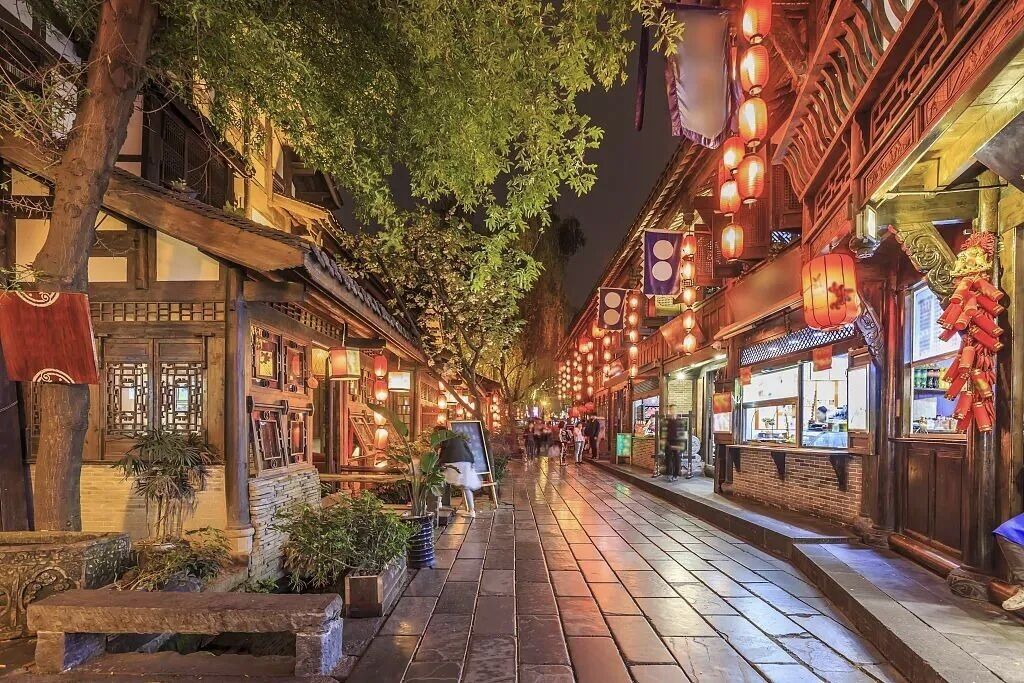
Jinli food: what to actually eat
Chengdu’s own verdict on this street is worth hearing before you plan a meal around it: the main run of stalls is priced and staged for photographs rather than for eating. That is not a reason to avoid it — a couple of things here are made in front of you and are part of the fun — but it is a reason not to arrive hungry and expect dinner. Two habits change the experience: buy in the lanes rather than at the main-street entrance, where the same snack costs noticeably less, and keep the eating to a graze.
What is worth the few yuan, and what each one actually is:
| Food | Price | What it’s like |
|---|---|---|
| 三大炮 sandapao | ¥10–15 | Three glutinous rice balls thrown onto a drum platform with a loud thump, then coated in brown sugar and roasted soybean powder. Showy and tasty. |
| 龙抄手 long chaoshou | ¥15–25 | Chengdu’s wonton in spicy red chili oil (or clear soup if you can’t take heat). The Jinli branch is convenient; the original Chunxi Road shop is more authentic. |
| 凉粉 liang fen | ¥10–15 | Cold mung-bean-jelly noodles in chili-vinegar dressing. Refreshing in summer. |
| 糖油果子 tangyouguozi | ¥10 | Fried syrup balls on a stick — a street-food classic. |
| 兔头 tutou | ¥15–25 | Spiced rabbit head, a Sichuan delicacy. Polarizing — order one to try before committing. |
| 担担面 dan dan mian | ¥20–30 | Sesame-paste noodles with chili oil and minced pork. Try the dry version. |
Most stalls take Alipay or WeChat Pay; foreign credit cards are rarely accepted. A graze of three or four snacks for two runs roughly ¥60–100, which is the right size for this street. Sit-down restaurants inside run Sichuan classics for ¥80–150 per person and are the part locals steer visitors away from.
Where Chengdu actually eats: Kuixinglou Street (奎星楼街). It is 3.6 km from Jinli, so it is not somewhere you nip out to mid-visit — but it sits about 535 m from Kuanzhai Alley, which is the other half of the day most visitors pair with this one. Put the shrine and the lanterns here, and put dinner there.
Avoid the common traps: skewered snacks can be over-portioned (a few bites split across many sticks) — check the per-stick or per-portion price first. Decline anyone offering a “free” fortune reading near the gates. For souvenir 张飞牛肉, the supermarket vacuum packs are about half the in-park price, and check the date on anything sold loose.
Sichuan opera & face-changing in Jinli
Jinli has small courtyard tea-house stages running Sichuan-opera variety shows — face-changing, long-spout tea pouring, hand shadows, fire-spitting. Travellers name Fanhua Xiyuan (繁花戏园) among them. These are convenient rather than accomplished, and the thing to get right is not which venue but which price model you are being sold, because two of them run side by side and only one of them is the price you were quoted.
| What you’re buying | Detail |
|---|---|
| The ~¥18 seat | Tea not included. Once you sit you are required to order a drink from about ¥18, so the real cost is nearer ¥36. This is the one that catches people |
| The ~¥28 seat | Includes a covered-cup tea, no minimum. Ask which model it is before you sit down |
| Schedule | No fixed timetable — roughly hourly through the afternoon and evening. Staff say “ten minutes” when it is thirty; ask for a specific start time |
| Length | 30 min to an hour over about four segments. At some venues the face-changing is only the last few minutes |
| Watch out | Boxed tea leaves pushed at several hundred yuan, and a calligraphy segment where the writing is free but mounting it costs around ¥200 |
| The alternative | A dedicated theatre runs a full professional programme for more money and no waiting — the better choice if the opera is the point rather than the convenience |
See our Sichuan opera guide for venue comparisons across Jinli, Shufeng Yayun, and the Wide-Narrow Alley courtyard shows.
Guided tours & opera tickets — 3 platforms
Sorted by what each is good for, not by commission · all take a foreign card with English checkout
- GetYourGuideSearch GetYourGuide
Private cars and small-group city tours — the pick if you want the shrine explained rather than just entered.
- ViatorSearch Viator
The deepest catalogue of join-in day tours that bundle Wuhou and Jinli with the panda base.
- Trip.comSearch Trip.com
Best for the Sichuan-opera show tickets and for building a custom private day.
Suggested half-day visit plan
Two hard edges shape this day and they pull in opposite directions: Wuhou stops admitting visitors an hour before it closes, and Jinli is not worth photographing until the lanterns come on at dusk. Between them sits a gap that most itineraries fill with dinner and a show — which is how people end up inside a tea house during the one half-hour the street is at its best. The order below protects the light instead.
High-summer timings below — June to August, when the sun sets around 8pm. In May and September sunset is 20–45 minutes earlier, so slide the evening forward to match; the sunset figures are in the photography section.
| Time | What |
|---|---|
| 3:00pm | Line 10 to 武侯祠(锦里), exit A2, ~220 m to the south main gate. Ticket booked ahead; exchange it at the window if you are on a passport. |
| 3:00–5:00pm | Wuhou Temple — Liu Bei’s mausoleum, the Zhuge Liang shrine, and the Red Wall corridor, which is at its best in the slanting afternoon light. |
| 5:00–6:00pm | Into Jinli through the shared wall. Craft lanes and shops while it is still light — this is the part that photographs poorly later. |
| 6:00–7:30pm | Eat. A graze of two or three snacks here, or leave now for Kuixinglou Street if you want a real dinner. |
| 7:45–8:20pm | Be on the lanes for the lanterns. They come on at dusk and the half-hour that follows is the blue hour — sky still coloured, lanterns lit. Miss this and you are shooting against black. |
| 8:30–9:30pm | Tea-house face-changing show, now that the light has gone and there is nothing left to lose outside. |
| Till 10:00pm | Shops shut at 10 but the lanterns stay lit, and the lanes empty out — the quietest, best walk of the evening. |
In winter, shift the whole thing about two hours earlier. Chengdu’s sunset moves from around 8:10pm at midsummer to around 6:05pm in December, and the lanterns follow it. Wuhou also reverts to its 9am–6pm hours with admission stopping at 5pm from 8 October, so a winter visit is roughly: gate by 2pm, shrine until 4, into Jinli by 4:30, lanterns around 6, show after.
Best photography times
| Subject | When · why |
|---|---|
| Red Wall at Wuhou | Mid to late afternoon, roughly 3–5pm, when the sun comes in low enough to throw bamboo shadows across the lacquer. Avoid the noon overhead sun. |
| Jinli lanterns | The half hour after they light — sky still blue behind warm lanterns. That is roughly 8:10–8:40pm in late June, 7:50–8:20pm in mid-August and 6:05–6:35pm around the winter solstice; see the note below for why it runs so late. Later shots are pure black behind the lanterns and lose the roofline. |
| Empty lanes | After 10pm, once the shops close. The lanterns stay on until then and the crowds have gone. |
Why dusk here is so much later than the clock suggests. All of China runs on Beijing time, but Chengdu sits about 16 degrees of longitude west of the meridian that clock is set to — so the sun here reaches its highest point around 1:04pm, not noon, and everything solar runs correspondingly late. Sunset over Jinli is about 8:10pm in late June, 7:50pm in mid-August, and 6:05pm around the winter solstice. Guides that give a single evening time for the lanterns are quoting one season and will send you out an hour or two wrong in the other.
Combining with other Chengdu attractions
Wuhou + Jinli is a half-day; most travellers pair it with one of these:
- Giant Panda Breeding Base (morning) → Wuhou + Jinli (afternoon–evening). Pandas are active 8–11am only, leaving the afternoon free for the shrine.
- Wide-Narrow Alley (Kuanzhai) (afternoon) → Jinli (evening). This is the pairing to make if you want to eat well: Kuixinglou Street, Chengdu’s own food strip, is ~535 m from Kuanzhai, so have the real meal there and keep Jinli for the lanterns. Take a taxi between the two — they are 2.3 km apart in a straight line but no single metro line joins them, so the train takes about 37 minutes with two changes against roughly 13 by car.
- Du Fu Thatched Cottage (morning) → Wuhou + Jinli (afternoon) — buy each ticket separately (¥50; the old combo no longer sells). Worth saying plainly: this is the pairing we would only make if Tang poetry is a reason you came to China. The cottage is a reconstruction of 1997 in a memorial garden, the poems are the exhibit, and without them the ¥50 buys a walk in a park. Wuhou rewards a visitor who knows nothing about the Three Kingdoms far more readily.
One option that rarely makes English guides: the museum sits on Chengdu’s 景区直通车 tourist-shuttle network, with direct coaches to Wuhou from Shuangliu Airport, the Chengdu East bus station distribution centre, Kuanzhai Alley, Du Fu Thatched Cottage, the Jinsha Site, Chengdu IFS, Chunxi Road, Taikoo Li, Dujiangyan and Sanxingdui. For most of those the metro is quicker; the useful ones are the long-haul pair — Dujiangyan and Sanxingdui — where a direct coach saves an awkward transfer, and the airport run if you are arriving with luggage and heading straight for a Wuhou-area hotel.
Skip it if: you’ve already done 2–3 ancient-street complexes in China and you’re not a Three Kingdoms history fan — Jinli’s street format repeats a pattern you will have seen, and Wuhou rewards an interest in the history most. If you have an afternoon and no evening, that is also the case for giving Jinli twenty minutes rather than an hour.
Where to stay for a Jinli + Wuhou visit
Staying beside the gate buys you very little here. This is a half-day stop in a well-connected part of the city, and the one thing worth optimising for is a fast ride back out at the end of a late evening — which the metro handles from almost anywhere central.
Frequently asked questions
Are Jinli Ancient Street and Wuhou Temple worth visiting together?
Yes — they share a perimeter wall, so doing both in one half-day is the standard format and needs no planning beyond the order. Wuhou Temple (武侯祠) is the historical attraction: a Three Kingdoms shrine holding both Liu Bei's mausoleum and Zhuge Liang's temple. Jinli (锦里) is the covered lantern street built against its north side. Do the shrine first because it closes in the early evening, and stay in Jinli for the lanterns, which are the reason to be there at all. Budget three to four hours for the pair. Skip both if you have already walked two or three reconstructed ancient streets in China and have no particular interest in the Three Kingdoms period.
How do I get to Jinli Ancient Street + Wuhou Temple?
Metro Line 10 to 武侯祠(锦里)Station and out of exit A2 — about 220 metres to the heritage-area main gate, which the museum quotes as a three-minute walk. That station opened with Line 10's third phase on 17 September 2025, so any guide that routes you to Gaoshengqiao Station (高升桥站) for a ten-minute walk was written before it existed; Gaoshengqiao is still the right stop if you are already riding Line 3 or Line 5, and the walk from there is about a kilometre. Line 10 also runs directly from Shuangliu Airport (CTU) to the temple without a change — roughly 37 minutes, seven stops — which makes this one of the few major Chinese sights you can reach from an airport on a single train. There is a no-stopping zone along the Wuhouci Avenue frontage, so taxis and shared bikes set down some way from the gate; the metro is the reliable arrival. Wuhou Temple and Jinli share a wall, so you walk from one into the other.
What's the Wuhou Temple ticket price and what does it include?
Wuhou Temple entry is ¥50. It is a real-name, online-reservation museum and tickets are released 14 days ahead — one per document per visiting day, up to eight people per account. Book direct at wuhouci.net.cn or through the museum's WeChat account; the ID selector takes a passport and the interface runs in English, Japanese and Korean as well as Chinese. Concessions are narrower than most visitors expect: ¥25 covers ages 7 to under 18, foreign minors explicitly included, and full-time students aged 18–23 on mainland, Hong Kong, Macau, Taiwan or permanent-residence documents; under-7s and children under 1.3 m are free; over-60s are free on a mainland ID card or a Chinese permanent-residence card. A foreign adult on an ordinary passport pays the full ¥50. Entry covers Liu Bei's mausoleum (Han Zhao Lie Mu), the Zhuge Liang shrine, the Three Kingdoms exhibits and the Red Wall corridor. Guide options run from a free Chinese/English audio guide on the museum's WeChat account up to a ¥20 ten-language handset (¥100 deposit) and live English guides booked inside the gate. Du Fu Thatched Cottage is a separate ¥50 ticket — no combo. Jinli next door is free; you pay only for food, tea-house shows and shops.
Can foreign visitors scan a passport at the Wuhou Temple gate?
No — the turnstiles read mainland Chinese ID cards only, and this is set per site rather than nationally, so do not assume it from another Sichuan attraction. The exchange counter beside the main gate handles it: hand over your order QR and the physical passport, collect a printed ticket, scan that. Bring the passport itself; a photocopy or a phone photo is refused. Allow 5–10 minutes at the counter on a weekday and 20–30 at weekends, on public holidays or through the summer peak. One more thing worth knowing at the door: the heritage area has a single entrance, the south main gate on Wuhouci Avenue, and every other gate is exit-only.
Why is Wuhou Temple important?
Wuhou Temple is the only Three Kingdoms (220-280 CE) memorial in China that combines a ruler's mausoleum with his strategist's shrine in the same complex — Liu Bei (founder of Shu Han kingdom) and Zhuge Liang (his prime minister and military strategist) are both honored here. The original temple was built around 200 CE; the current architecture dates to a Qing-dynasty 1672 reconstruction. For Chinese visitors, it's a pilgrimage site for fans of the Romance of the Three Kingdoms novel; for Western visitors, it's the most accessible window into a period most Westerners only know through video games (Dynasty Warriors, Total War: Three Kingdoms).
What's the Red Wall corridor at Wuhou Temple?
The Red Wall (红墙) corridor is a 50-meter passageway between two parts of the Wuhou Temple complex, with a deep red-lacquer wall on one side and dense green bamboo on the other. The color contrast plus traditional curved wall-cap roof makes it one of Chengdu's most photographed spots — particularly popular with Hanfu (汉服) photoshoot tourists. Photography during 9-10am or 4-5pm gets the best light. Expect short queues for a clean photo on weekends; weekdays usually no wait.
What food should I try at Jinli Ancient Street?
Try one or two things for the novelty and eat properly elsewhere. Chengdu's own verdict on the main street is that it is priced and staged for photographs: 三大炮 (sandapao — glutinous rice balls thrown onto a drum) and 糖油果子 (tangyouguozi — fried syrup balls) are made in front of you and worth the few yuan; the rest is ordinary at tourist prices. Prices fall the further you walk from the main-street entrance, so buy in the lanes rather than at the first stall. If you want to eat properly, go to Kuixinglou Street (奎星楼街) — 3.6 km from Jinli, but only about 535 m from Kuanzhai Alley, so it belongs to that half of your day rather than this one. For souvenir 张飞牛肉, the supermarket vacuum packs cost roughly half the in-park price; be wary of snacks and beef sliced and sold by weight, which is where visitors most often report being over-charged.
Can I see Sichuan opera at Jinli?
Yes, at the small courtyard tea-house stages inside the street — travellers name Fanhua Xiyuan (繁花戏园) among them — but understand what you are buying. Two pricing models run side by side: around ¥18 a head that does NOT include tea, where you are required to order a further drink once seated and the real cost lands near ¥36; and around ¥28 that includes a covered-cup tea with no minimum. Ask which one it is before you sit. There is no fixed timetable — roughly hourly through the afternoon and evening — and staff routinely say the next show starts in ten minutes when it is half an hour, so pin them to a clock time before you pay. Shows run 30 minutes to an hour across four or so segments (face-changing, long-spout tea pouring, hand shadows), though at some venues the face-changing is only the last few minutes. Watch for the up-sells: boxed tea leaves, and a calligraphy segment where the writing is free but mounting it costs around ¥200. For a full professional programme, go to a dedicated theatre instead — see our Sichuan opera guide for the venue comparison.
What's the difference between Jinli and Wide-Narrow Alley (Kuanzhai)?
Jinli is a Three-Kingdoms-themed covered street next to Wuhou Temple — denser snack stalls, more lanterns, louder evening atmosphere, more spectacle-driven, often more crowded. Wide-Narrow Alley (Kuanzhai) is restored Qing-dynasty residential alleys — three parallel lanes, tea-house culture, opera courtyards, ear cleaning, more relaxed. Most foreigners visit both. They sit 2.3 km apart, but take a taxi rather than the metro: no single line joins them, so the train is about 37 minutes with two changes against roughly 13 minutes by car. If you only have time for one and you like history + Three Kingdoms, pick Jinli + Wuhou. If you prefer slow-life tea atmosphere, pick Kuanzhai.
Related Chengdu guides
- Wide-Narrow Alley (Kuanzhai) — the Qing-dynasty alley complex, 15 min from Jinli
- Sichuan opera face-changing — venue comparison including the Jinli courtyard shows
- 17 things to do in Chengdu
- Chengdu 3, 5, or 7-day itinerary
- Chengdu city overview
Sources
Checked August 2026 · Written from our own first-hand travel in China.
Corrected since publication: Earlier versions described the metro station here as unbuilt. Line 10's third phase opened on 17 September 2025.