Key takeaways
- It is free and always open — a working city-centre street, not a ticketed sight. Half an hour covers the monument itself.
- The reason to give it an afternoon is what surrounds it: Shancheng Lane, Kuixinglou and Baixiangju are all free and all within a 25-minute walk.
- ⭐ Enter Shancheng Lane at the Lingshi Lane (领事巷) end and it runs downhill the whole way. The Zhongxing Road entrance is the same lane as a climb of steep steps.
- Kuixinglou is the terrain in one building: you walk in at what looks like street level and you are 22 floors up. Free, open all hours, Line 2 to Linjiangmen exit 2.
- The tout layer is real but harmless: anyone steering you somewhere whose price you learn after sitting down is running the same trick, whether it is tea, a bar or a fortune.
What Jiefangbei actually is
For most foreign visitors Jiefangbei is not an attraction you visit so much as the place you cannot avoid. Book a four- or five-star hotel in central Chongqing and you have almost certainly booked one within a twelve-minute walk of the plaza; you will cross it on the way to Hongyadong, on the way to dinner, and on the way home most nights.
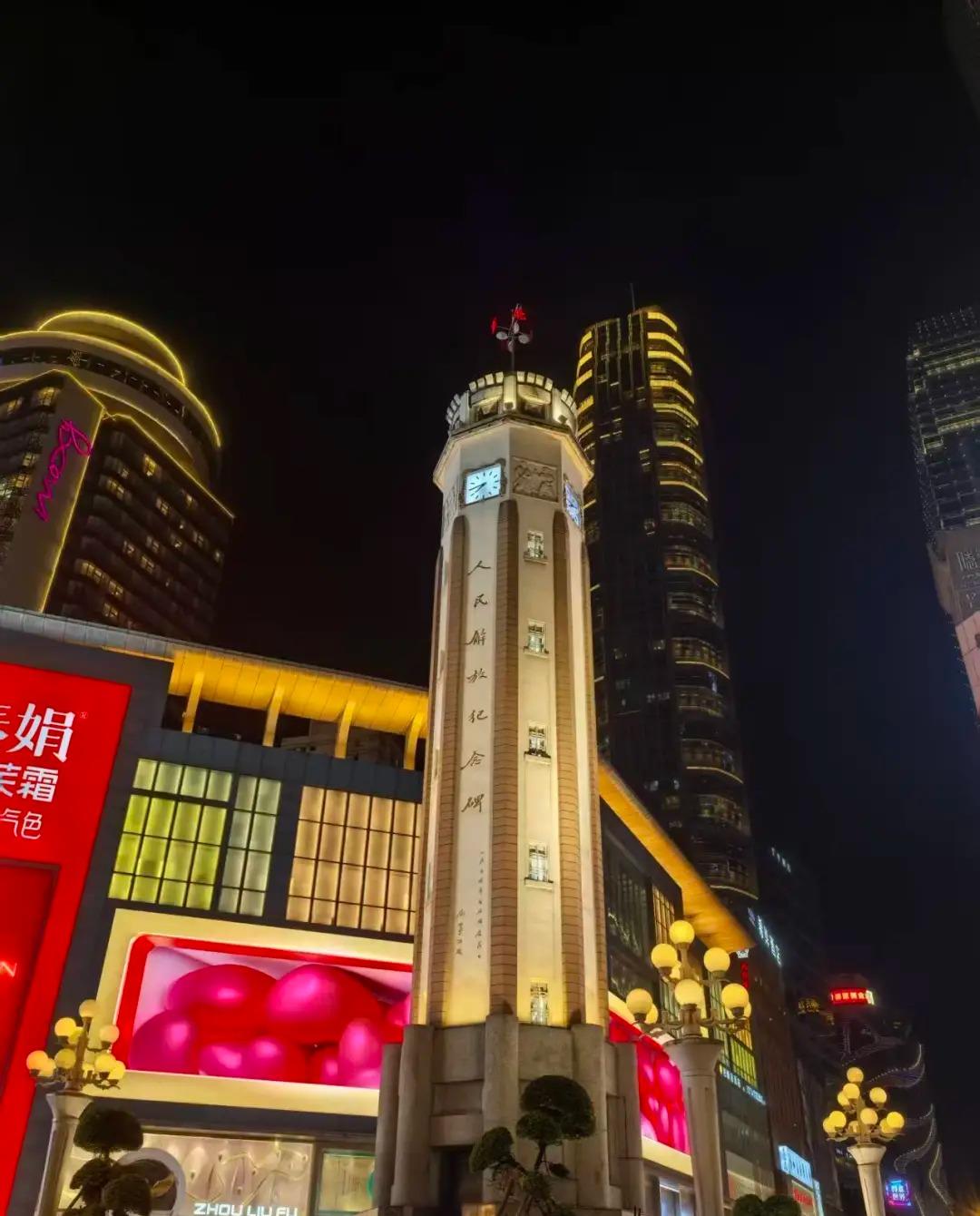
The clock tower at the centre is the city’s most recognisable civic landmark and also a short look: one lap of the base, the inscription, the clock face, and you have seen it. That is not a criticism of the monument — it is a scheduling fact, and it is the single most useful thing to know before you set aside a morning for it.
Where Jiefangbei sits in Chongqing
18 km across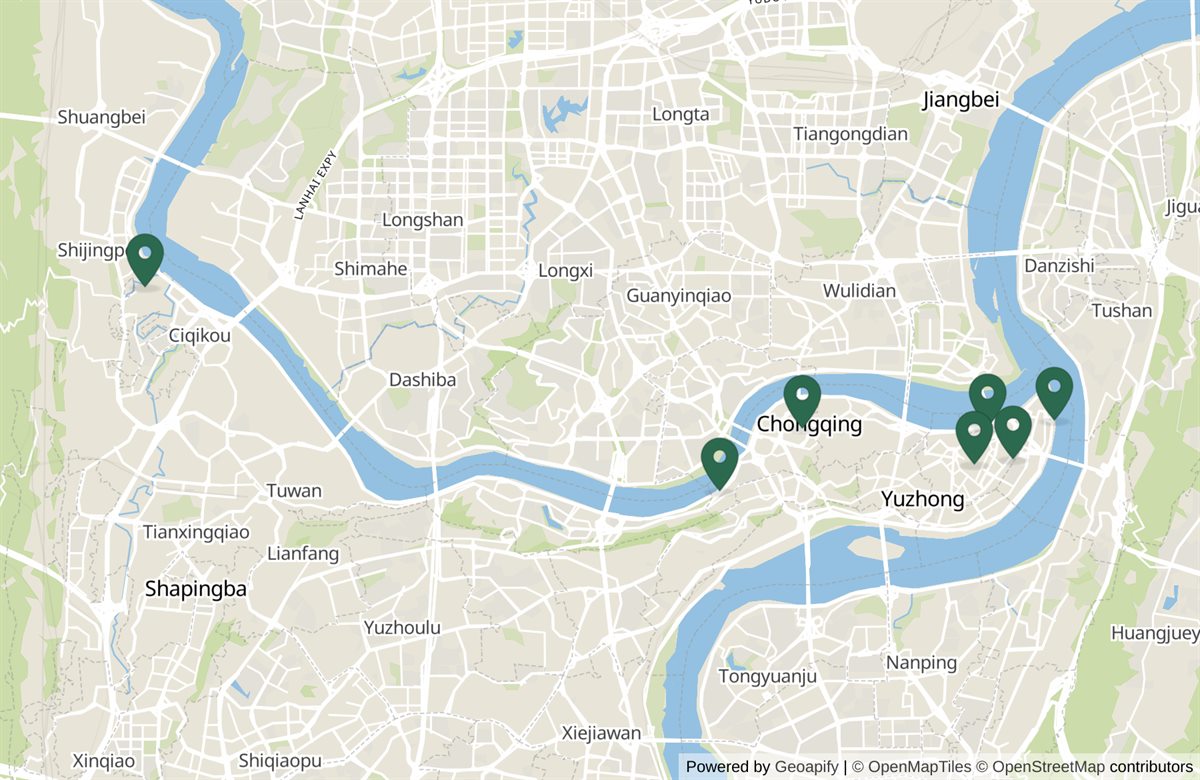 Ciqikou Ancient TownCiqikouLizibaJiefangbeiThree Gorges Museum3 Gorges Museum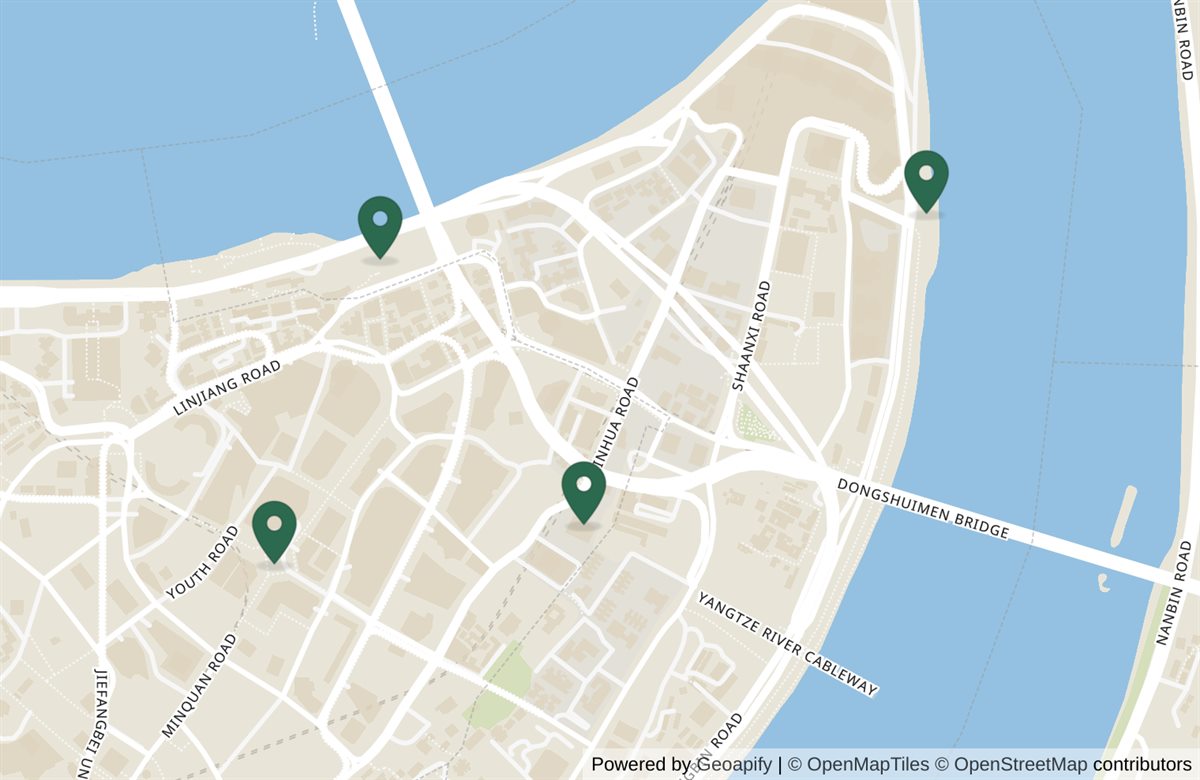
The monument itself, in numbers
It carries two names because it stacks two histories on one tower. It went up as the Monument to the Victory of the War of Resistance — Chongqing was the Republic of China’s wartime capital after Nanjing fell, and was bombed from the air between 1938 and 1943. On 20 September 1950 it was renamed the People’s Liberation Monument, the new name inscribed by Liu Bocheng. Same tower, recontextualised.
| Fact | Detail |
|---|---|
| Height | 27.5 m overall · 24 m shaft |
| Shape | Octagonal outside, faces of 2.55 m; circular inside, 4 m across |
| Built | Foundation stone October 1946 · completed August 1947 |
| Renamed | 20 September 1950, inscription by Liu Bocheng |
| Inside | Eight floors and a 140-step spiral stair to the clock tower |
That last line is worth a sentence, because it is the one thing people are surprised by: the shaft is not solid. Municipal records describe eight internal floors and a cantilevered spiral stair running up to the clock. Whether any of it is open to visitors we could not establish — every account of a visit here is of the outside — so plan on photographing the exterior and treat the interior as a piece of trivia rather than an itinerary item.
By the late 1990s the streets around it had become Chongqing’s main retail district, which is why locals say 解放碑那一片 — “the Jiefangbei area” — to mean the whole walking district rather than the tower. It is also why a hotel advertised as “at Jiefangbei” may be several streets away.
The plaza — when to walk it
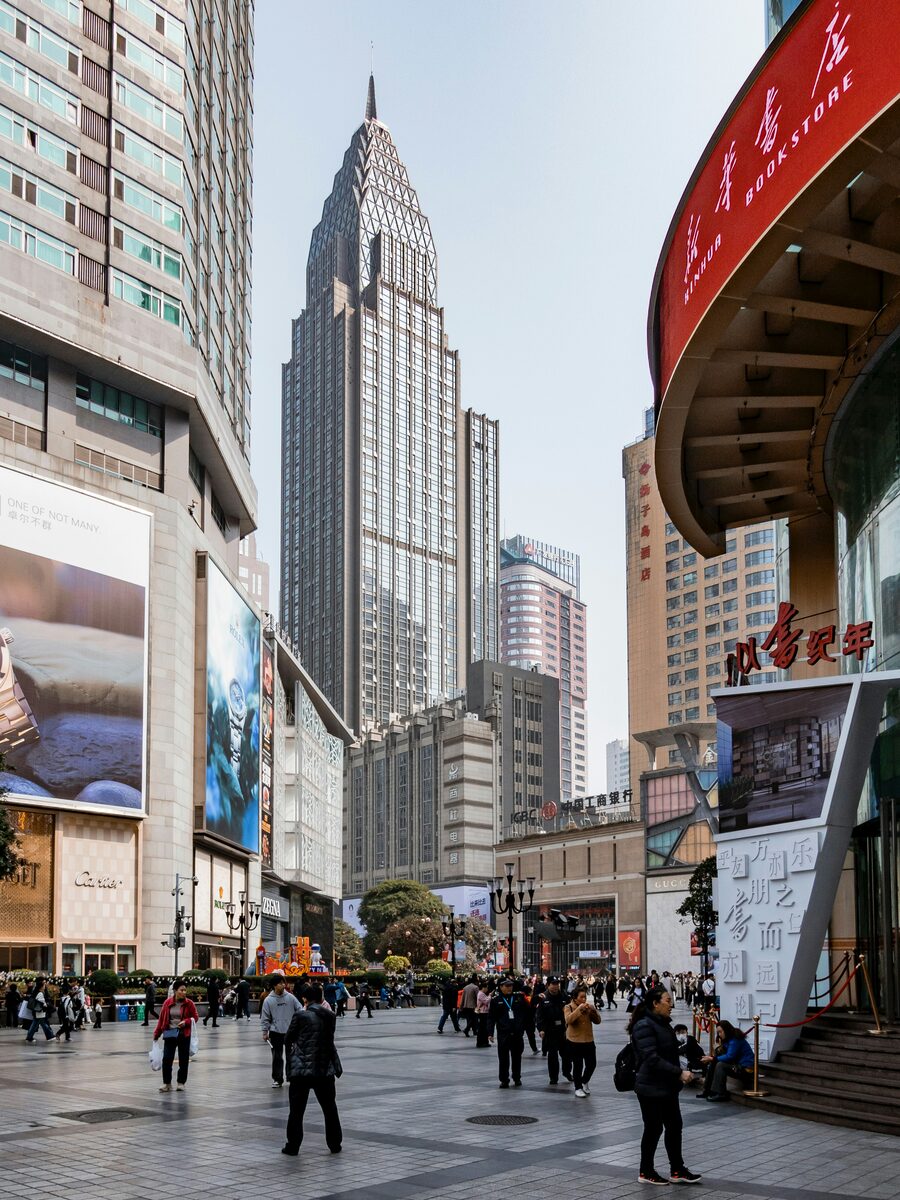
The plaza ring is roughly a square kilometre of pedestrianised streets bounded by Cangbai Road to the north (toward Hongyadong), Zourong Road south, Minquan Road east and Linjiang Road west. Worth your attention:
- The monument at the central crossroads — best after dark, when the clock face is lit and the LED walls on the surrounding malls produce the neon effect the city is sold on. Shoot from any corner about 30 m back; phone night mode handles it.
- The four-corner department stores — useful for air conditioning, toilets and the basement food courts, which are cheaper and more local than the street-level restaurants. The World Financial Center has the Huixianlou (会仙楼) observation deck on floors 73–75, ¥118, daily 9am–10pm.
- The neon itself. The big screens run from late morning; the skyline lighting comes on around 7:30–8pm and the plaza is busiest 8–9:30pm. Because of the terrain you see neon stacked three or four building-tiers above plaza level, which is the part that does not happen in a flat city. Arrive around 7pm for the blue hour.
The shopping is unremarkable — the same global brands as anywhere. Buy jade or watches inside the named malls with published prices and receipts, never from the street vendors described further down.
Shancheng Lane — which end you enter decides the walk
山城巷 is the restored old lane that clings to the cliff just west of the plaza: stone steps, surviving stilt houses, a cliff boardwalk with a river view, and small cafés in among the residences. English write-ups call it Shancheng Lane, but the lane’s own lanterns render it “Mountain City Alley” — worth knowing, because that is the wording you will actually see hanging over the boardwalk. It sits inside the wider Shancheng Third Trail (山城第三步道) — roughly 3 km of routes with about 80 m of height between top and bottom, threading past the Tongyuanmen city wall, the old Renaitang hospital and the Puti Jingang pagoda. It is free, and there is no ticket at any entrance.
The lane has five entrances and they are not equivalent. Enter at the Lingshi Lane end (领事巷) — metro Line 1 to Qixinggang (七星岗) exit 1, then about fifteen minutes on foot — and the whole route runs downhill, coming out at Jiaochangkou. Enter at Zhongxing Road no. 234, beside the district court, and it is the same lane as a climb of steep steps. Navigation apps will happily take you to either.
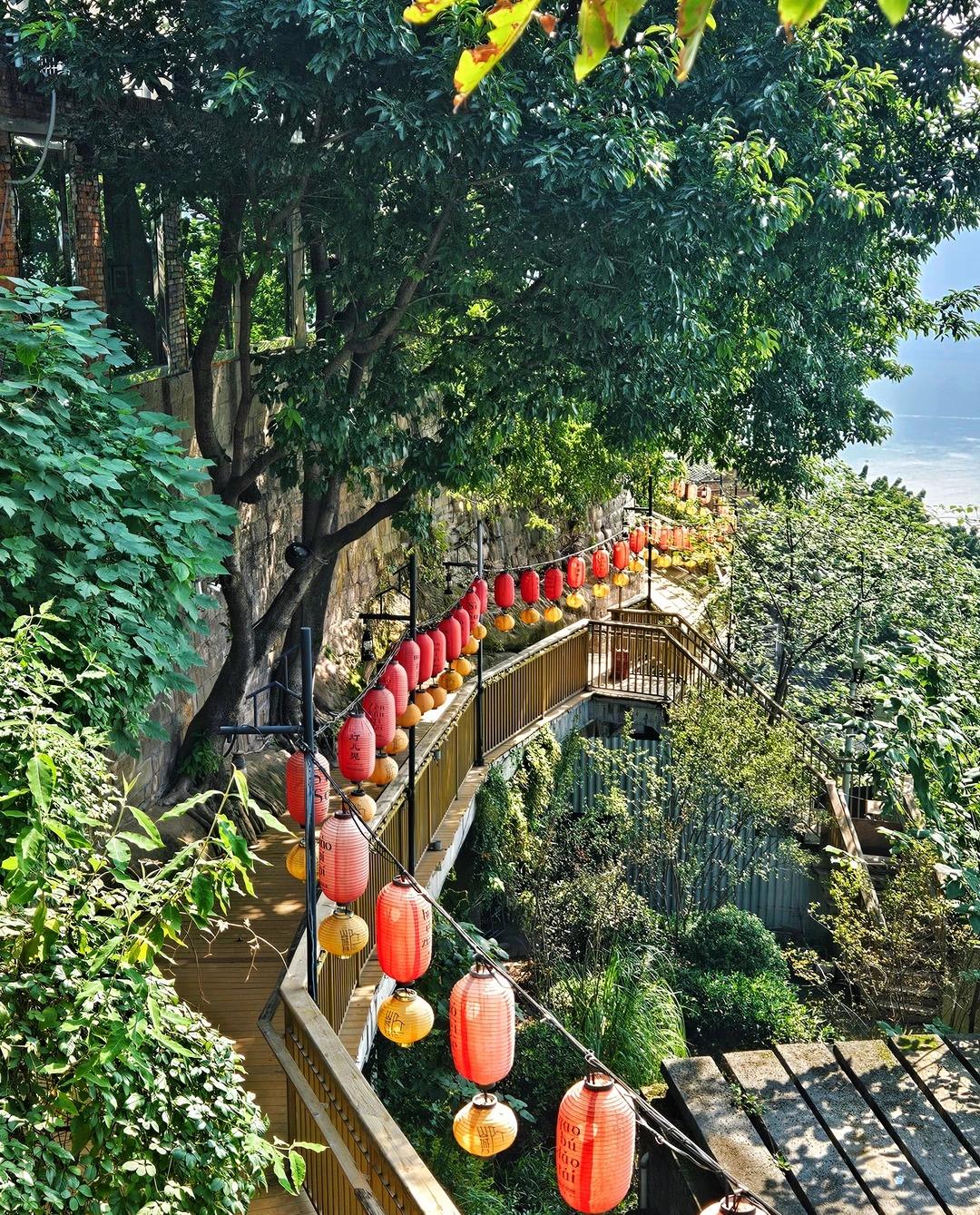
Coming out at Jiaochangkou is the other half of the argument: it puts you at the top of Shibati (十八梯), the rebuilt stair-street quarter, and from there it is a short walk back to the plaza. So the whole thing is one downhill line rather than an out-and-back — which matters more here than it would in a flat city.
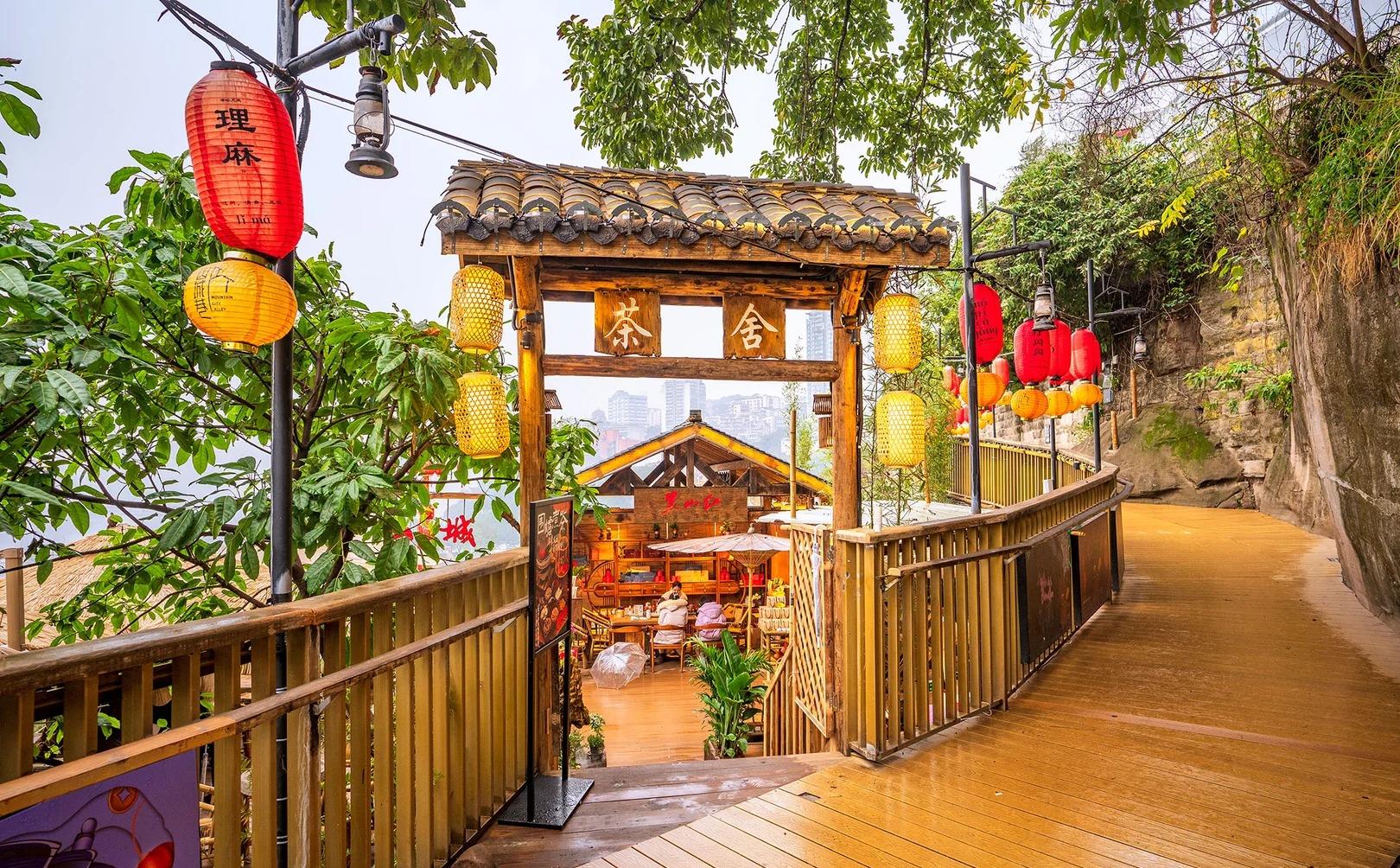
Allow an hour and a half to two hours if you stop, and wear shoes with grip: the stone is smoothed and Chongqing’s humidity keeps it damp more often than the sky suggests. The main route is lit in the evening, but the side lanes are not — stay on the main path after dark and do not take a shortcut.
The 22nd floor that is also the ground floor
If you only have an hour to understand why Chongqing is described the way it is, spend it at Kuixinglou (魁星楼) rather than at the monument. It is an office complex at Linjiangmen Datang Plaza no. 17, and its plaza-level entrance is twenty-two floors above the ground. You walk in off what reads as a street and you are standing on a roof. Two sky bridges of about 23 m span the gap between buildings, 68.5 m above the road below.
| Fact | Detail |
|---|---|
| Entry | Free, open around the clock |
| Getting there | Metro Line 2 to Linjiangmen (临江门) exit 2 — the exit opens onto the viewing level, ~220 m |
| From Jiefangbei | ~800 m, 10–15 minutes on foot |
| Watch for | A hospital outpatient building in the same complex shares the name — follow signs for the deck, not the address |
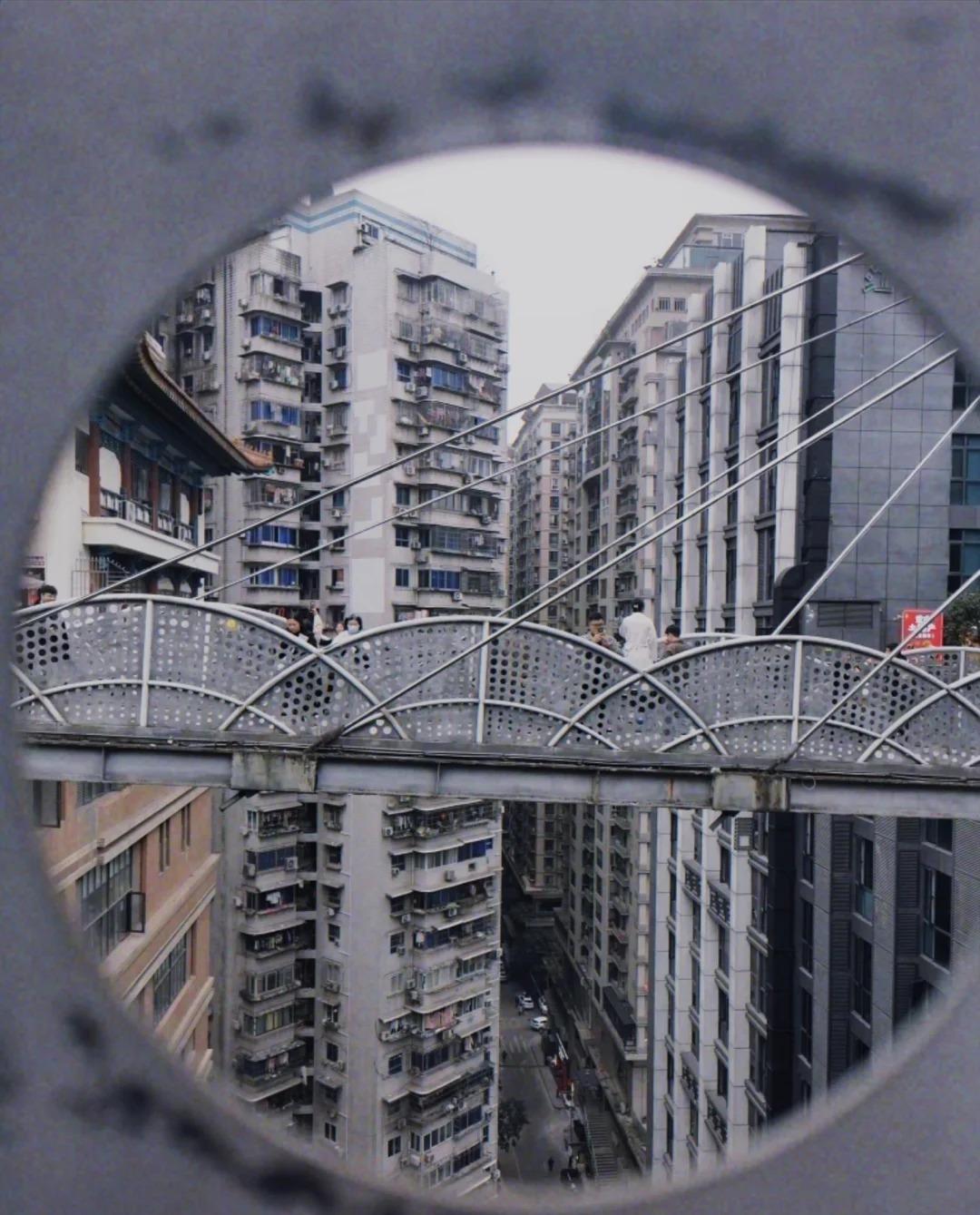
The vertigo is the point, and it is worth knowing in advance if you do not like heights: the bridges are solid underfoot and fully railed, but the drop beside them is unobstructed and the buildings below are ordinary residential blocks, which somehow makes it worse than a purpose-built viewpoint.
Baixiangju, ten minutes away
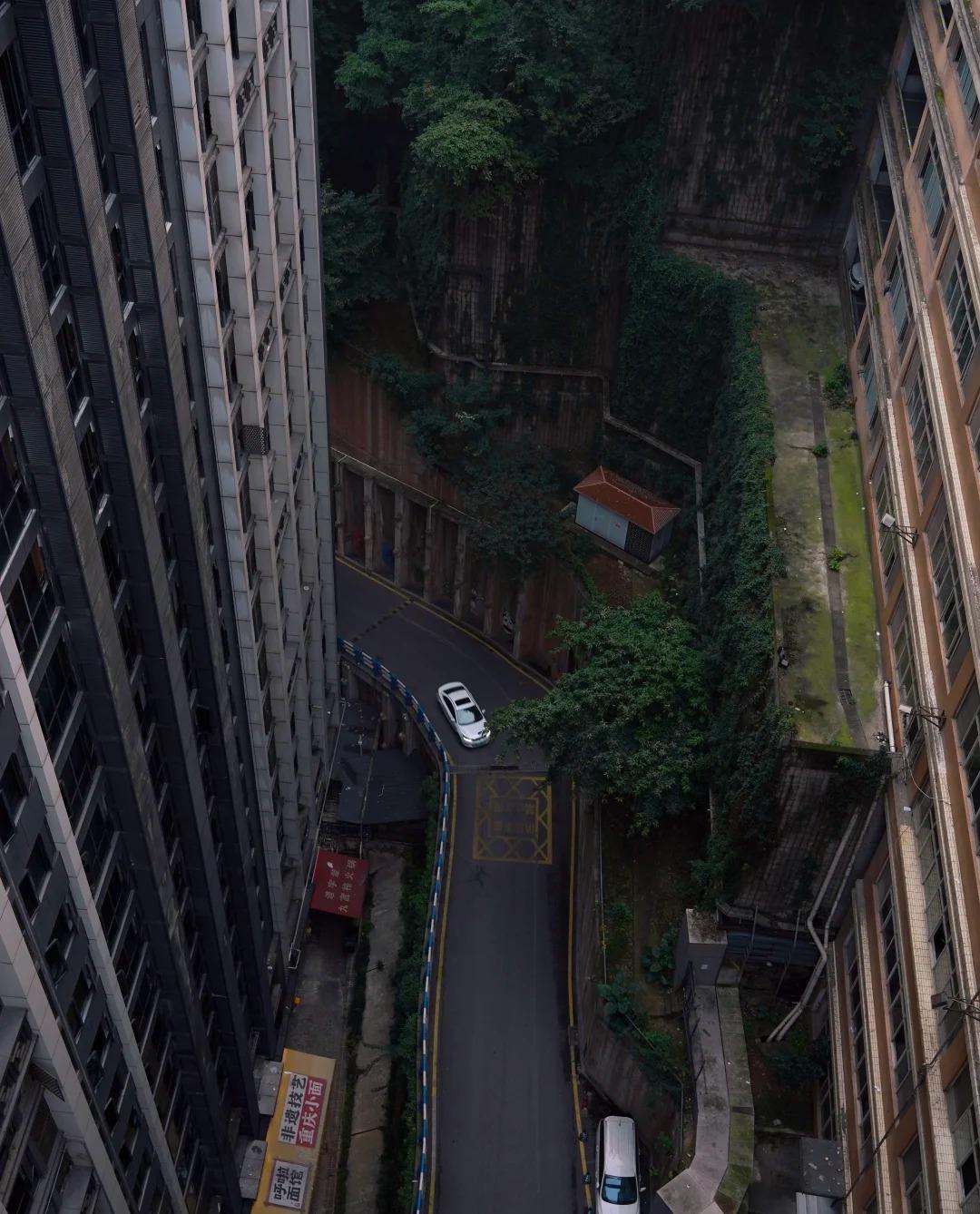
Baixiangju (白象居) is the other free one, a little under a kilometre east of the plaza in a straight line and nearer fifteen minutes on foot once the terrain has its say. It is a 24-storey residential block with three exits onto streets at different heights, so which floor counts as the ground floor depends on which door you use — and it is the frame most of the Chongqing photographs you have seen were taken in or from.
Two things before you go. There is no lift: inside is stairs the whole way, and navigating to the west gate lets you walk down rather than up. And people live there — the guidance travellers give each other is to keep your voice down, and if you are with elderly companions or small children, to photograph it from outside rather than going in at all.
A half-day that runs downhill and ends at the metro
One dedicated afternoon covers everything above, in an order that goes downhill, does not double back, and finishes at the lights rather than starting with them. Distances are the walking ones:
| When | Where | What |
|---|---|---|
| Early afternoon | Shancheng Lane 山城巷 | Start at the top, per the section above, so the lane runs downhill; come out at Jiaochangkou. Allow 1.5–2 hours. |
| Late afternoon | The plaza ~1.1 km on from Jiaochangkou | Back up to the monument for the half-hour lap while it is still light, and the mall basements if you need a break from the heat. |
| Dusk | Kuixinglou 魁星楼 · 10–15 min | The sky bridges as the lights come on, then follow the signs down toward the Jialing riverside. |
| After dark | Hongyadong ~600 m on from Kuixinglou | The lights come on around 7:30pm; the photograph everyone wants is from the Qiansimen bridge, not from inside. |
That is about 2.5 km of forward movement across an afternoon, in one direction, with no leg walked twice. Dinner slots in wherever you are hungry rather than at a fixed point — the eating section below is arranged that way.
Baixiangju is deliberately not on this line. It sits on the Yangtze side, the opposite way from Kuixinglou and Hongyadong — plotting the four together puts a 1.3 km doubling-back in the middle of your evening. It pairs far better with the Yangtze Cable Car, whose north station is a few hundred metres from it, so do the two of them together on a different half-day.
For the bridge vantage and the light-on timing, see the Hongyadong night-view guide.
Book a Chongqing day tour — 3 platforms compared
Sorted by format, not commission · all take a foreign card & English checkout
- GetYourGuide★ Editor’s pick
Chongqing Deep Explore — Private Car Service (incl. meals)
★ 4.9(118 reviews)Private carFull day · mealsFree cancellation
Verified Aug 2026 · re-checked quarterly
Book on GetYourGuide$189from · per person - Viator
Chongqing 8D Mountain-City Full-Day Join-In Tour
★ 4.8(43 reviews)Group join-in7–8 hoursPickupFree cancellation
Verified Aug 2026 · option pre-selected on landing
Book on Viator$49from · per person 
Chongqing 10-Hour Customized Tour (optional English guide)
Custom privateBuild your own route10 hours
Verified Aug 2026 · re-checked quarterly
Book on Trip.comCustomprice varies by configuration
Editor’s note: private car (GetYourGuide) for comfort and meals · group join-in (Viator) for value · fully custom (Trip.com) to pick the stops. We sort by format, not commission.
Eating here — how to order, and what to skip
Hot pot is the obligatory Chongqing dinner and Jiefangbei is surrounded by it. Where matters less than how you choose:
| Where | Style · price | Notes |
|---|---|---|
| Bayi Lu 八一路 | Midrange · ¥70–120pp | Five blocks immediately east of the plaza; the most foreigner-friendly strip. Walk 200 m into the side lanes and prices drop by about a third. |
| Hongqi He Gou 红旗河沟 | Local · ¥60–100pp | Ten minutes north of Bayi Lu; louder than it, a little cheaper than it, and far fewer visitors. |
| Air-raid-shelter hot pot 防空洞火锅 | Varies | The format worth seeking out rather than a single restaurant: hot pot served inside a genuine wartime shelter, cool in summer and warm in winter. |
| Nanbin Road 南滨路 | Upscale · ¥150–300pp | Across the Yangtze, 15-minute taxi. Big riverside operations with the skyline as the view back. |
The one rule everyone repeats: do not go into a restaurant whose staff tout you in from the street front. The good cheap places are in what locals call 卡卡角角 — the awkward corners — and being hard to find is most of the point.
Five words that change what arrives
- 鸳鸯锅 (yuānyāng guō) — the split pot, one spicy side and one clear. The default order for anyone who has not done this before.
- 微辣 (wēi là) — mild. Ask for it on a first visit and understand that mild here is still hot; 唯怡 soy milk is the local antidote, not water.
- 干溜 (gān liū) — at a noodle counter, gets your 小面 or 豌杂面 dry-mixed rather than in soup, so the sauce coats instead of floating.
- 数签签 (shǔ qiān qiān) — at a skewer place the bill is counted off the sticks you have eaten, so this is how you ask for it.
- 海椒 (hǎi jiāo) — the local word for chilli, in place of 辣椒.
For the wider argument about which city’s hot pot you are actually eating, see our Chongqing vs Chengdu hot pot guide.
The touts — one pattern, many costumes
Chongqing is safe: petty crime is low and walking here late is routine. What the plaza has is a tout layer, and it is worth recognising because it is all one trick.
The tell is always the same: a stranger is steering you somewhere whose price you will only learn after you sit down. Tea ceremony, a bar, a foot massage, a fortune — the costume changes, the mechanism does not.
- The tea-house approach. A well-dressed stranger opens a friendly conversation in English and invites you to a “traditional Sichuan tea ceremony” nearby. The bill arrives at ¥1,000–3,000 for tea worth ¥30 (observed at the plaza’s south-west corner, 15 April 2026, 22:30). Real tea and opera venues publish prices of ¥80–150 and do not approach people in the street.
- People in uniform who are not staff, and over-helpful strangers offering directions — both usually end at a restaurant paying commission.
- Costumed “bronze statues” who want paying once you have taken the photograph, and shoulder-pole fruit sellers who price by weight after you have accepted the bag.
- Jade, watches and the “¥10 bracelet” at intersections after 9pm: the goods are fake and the bracelet bills out at several hundred once it is strung. Buy inside the malls, where prices are posted and you get a receipt.
- Two queues to walk past. The lines at 鬼包子 and 鬼酥肉 are widely described by locals as marketing rather than quality.
“不了,谢谢” (bù le, xiè xie — no thanks), keep eye contact, keep walking. If someone follows, step into a department store; security is at the door. Taxi-meter scams are rare here — Didi dominates and taxis are metered. Where genuine tea houses exist with posted prices: Ciqikou Old Town.
Where to stay walking-distance to Jiefangbei
Jiefangbei is the central base, which is why almost every hotel recommendation for Chongqing points here. One caution specific to this city, though: it is vertical. A hotel five minutes away in a straight line can be fifteen minutes of stairways, so check the walking route rather than the distance.
Frequently asked questions
Is there an entry fee for Jiefangbei, and what are the opening hours?
No fee and no hours — it is a public pedestrian plaza in the middle of a working city centre, open around the clock, with nothing to buy and nothing to book. You do not 'visit' it the way you visit a ticketed scenic area; you walk into it. The surrounding department stores run roughly 10am–10pm, restaurants later, and the hot-pot strips go to 1–2am. The neon and the crowds peak between 7 and 10pm, hardest on Friday and Saturday.
How do you pronounce Jiefangbei, and what does it mean?
[jyeh-fahng-bay] — three syllables. 解放碑 means 'Liberation Monument': 解放 (jiěfàng) is liberation and 碑 (bēi) is a stele or monument. Its full name is 人民解放纪念碑, the People's Liberation Monument. In everyday use locals say 解放碑那一片 — 'the Jiefangbei area' — meaning the whole CBD walking district rather than the tower itself, which is why a hotel advertised as 'at Jiefangbei' may be several streets from the monument.
How tall is the monument, when was it built, and can you go inside?
Municipal records give it as 27.5 m overall with a 24 m shaft, octagonal outside with faces of 2.55 m and circular inside at 4 m across. The foundation stone was laid in October 1946 and it was completed in August 1947, as the Monument to the Victory of the War of Resistance; it was renamed the People's Liberation Monument on 20 September 1950, the new name inscribed by Liu Bocheng. The shaft is not solid — the same records describe eight internal floors and a 140-step cantilevered spiral stair up to the clock tower. Whether any of that is open to visitors is something we could not establish, and every account of a visit here is of the outside, so plan on photographing the exterior.
How long should I spend at Jiefangbei?
About half an hour covers the monument: a lap of the base, the inscription, the clock tower, and the four-corner neon if you are there after dark. The reason to give the area an afternoon is not the tower but what surrounds it — Shancheng Lane, Kuixinglou and Baixiangju are all free, all within a 25-minute walk, and all better demonstrations of what makes Chongqing strange than the plaza is. If your hotel is anywhere in the Yuzhong core you will cross the plaza daily anyway without scheduling it.
Which end of Shancheng Lane should I enter from?
The Lingshi Lane end (领事巷), which is the top. Shancheng Lane is the restored lane inside the wider Shancheng Third Trail (山城第三步道), and it has five entrances — which one you pick decides whether the walk is a stroll or a stair climb. From Qixinggang (七星岗) metro exit 1 it is about 15 minutes to the Lingshi Lane end, and from there the whole route runs downhill, coming out at Jiaochangkou, which leads on to Shibati and back to Jiefangbei. The Zhongxing Road entrance at no. 234, beside the district court, is the uphill one: the same lane, done as a climb of steep steps. It is free and there is no ticket at either end.
What is Kuixinglou and is it really free?
Kuixinglou (魁星楼) is an office complex at Linjiangmen Datang Plaza no. 17 whose plaza-level entrance is, in fact, twenty-two floors above the ground — you arrive at what reads as a street, and it is a rooftop. Two sky bridges of about 23 m hang 68.5 m above the street below. It is free and open around the clock, and metro Line 2 to Linjiangmen exit 2 puts you out at the viewing level, about 220 m away. One warning: part of the same complex is a hospital outpatient building that shares the name, so follow signs for the viewing deck rather than the address alone.
Is Baixiangju worth the walk, and can I go inside?
It is about 600 m from the plaza, ten to twelve minutes and mostly downhill or flat, and it is the photograph people come to Chongqing for: a 24-storey residential block with three exits onto streets at different heights, so the 'ground floor' depends which door you use. Two things to know before you go. There is no lift, so the inside is stairs the whole way — navigating to the west gate lets you walk down rather than up. And people live there: the guidance travellers give each other is to keep quiet, and with elderly companions or small children to photograph it from outside rather than going in.
Where should I eat hot pot near Jiefangbei, and how do I order?
The densest strip is Bayi Lu immediately east of the plaza (¥70–120 a head), and walking 200 m into the side lanes drops that by roughly a third. Local advice is consistent on two points: avoid any restaurant whose staff tout you in from the street front, and the good cheap places are in what locals call 卡卡角角, the awkward corners. Order a split pot (鸳鸯锅), one spicy side and one clear, and ask for 微辣 (mild) on a first visit — mild here is still hot by most standards, and 唯怡 soy milk is the local antidote. Two words worth carrying: 干溜 gets noodles dry-mixed rather than in soup, and at a skewer place the bill is counted off the sticks, which is why you will hear 数签签. If you want the distinctive local format rather than the best-known brand, look for 防空洞火锅 — hot pot served inside a genuine air-raid shelter.
What scams should I watch for at Jiefangbei?
Chongqing is safe and this is nuisance rather than danger, but the plaza has a persistent tout layer. The long-running one is the tea-house approach: a well-dressed stranger opens a friendly English conversation and steers you to a 'traditional tea ceremony' whose price you only learn after you sit down, ending at ¥1,000–3,000 for tea that should cost ¥30 (observed at the plaza's south-west corner, 15 April 2026, 22:30). The same approach now also fronts bars, foot massage and fortune-telling — the tell is always a stranger steering you somewhere unpriced. Alongside it: people in uniform who are not staff, over-helpful strangers offering directions, shoulder-pole fruit sellers, costumed 'bronze statues' who want paying after the photo, and jade or watch vendors after 9pm whose goods are fake. Two food traps by name — the queues at 鬼包子 and 鬼酥肉 are widely described as marketing rather than quality. '不了,谢谢' and keep walking works on all of it.
Where should I stay if I want to be walking distance to Jiefangbei?
The Yuzhong downtown core, which is what 'Jiefangbei' means in a hotel listing: Hongyadong about ten minutes north, Liziba about fifteen on Line 2, the Yangtze Cableway a short walk east. Best value for most visitors is a home-grown mid-range chain in the plaza ring — JI Hotel (全季) or Atour (亚朵) — with the JW Marriott and the Westin as the two international five-stars at the plaza itself. One caution specific to this city: Chongqing is vertical, so a hotel five minutes away in a straight line can be fifteen minutes of stairs. Check the walking route, not the distance.
Sources
Checked August 2026 · Written from our own first-hand travel in China.
Corrected since publication: Five things were corrected in that round, including a hero photograph that was not Chongqing.