Key takeaways
- Free and open 24/7 — it’s a public street network, not a ticketed park.
- Metro Line 1 → Ciqikou, exit 1: 35–55 min from downtown, ¥4–5. Enter by the couplet archway (黄桷坪牌坊), leave through the back street.
- Order matters: the courtyard and temple shut 5:30–6pm, and the lanterns only come on ~7:30pm winter / ~8pm summer — interiors first, dusk food, lights last.
- Eat: dragon’s beard candy, Chen mahua twists, sugar painting, mao xue wang by the river — skip the dyed 金西梅 fruit and anywhere without posted prices.
- Allow 2–4 hours; face-changing in the old town is casual tea-house style (¥28–30) — the full pro show is downtown (¥88).
What Ciqikou is
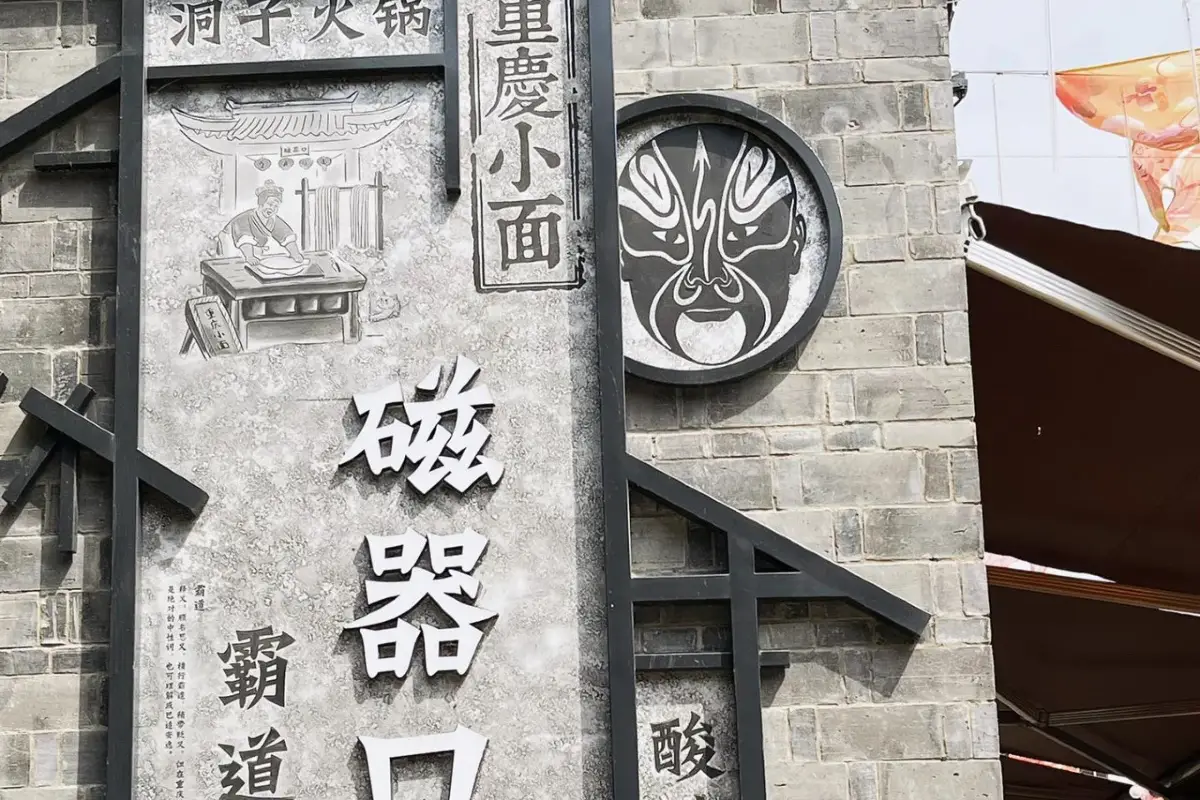
Ciqikou is the surviving fragment of Ming-Qing-era Chongqing — a warren of flagstone alleys, courtyard houses, and shop-fronts that historically served as the porcelain shipping port for the city. The Jialing River runs along its north-eastern edge; up the slope are 100+ small shops, restored merchant courtyards (the Zhong Family Courtyard 钟家院 is the one that charges), a porcelain-history hall in the former 宝善宫 temple, and a working Buddhist temple. Before the porcelain trade named it, the town was called 龙隐镇 — “the town where the dragon hid” — after the legend that the deposed Jianwen Emperor took monastic vows here. UNESCO doesn't list Ciqikou, but it is one of the few intact Ming-Qing trading-town footprints in southwest China, and among the city's most visited sights.
Where Ciqikou sits in Chongqing
18 km across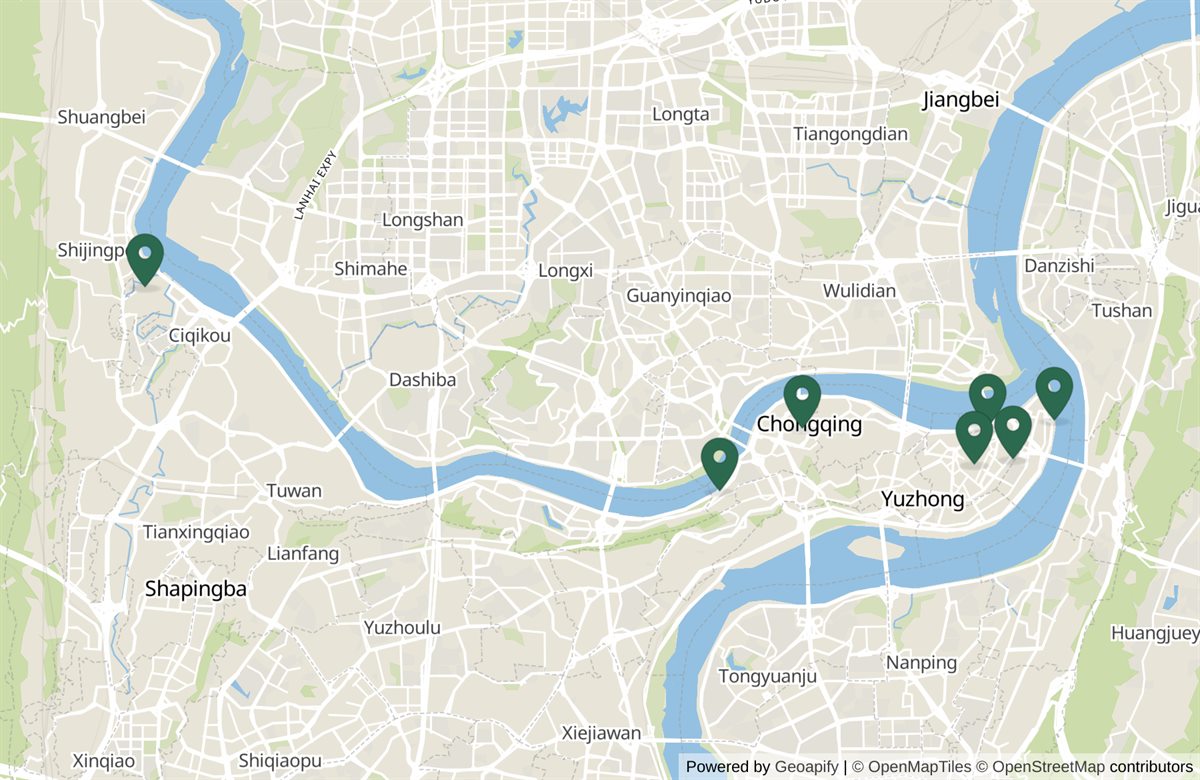 Ciqikou Ancient TownCiqikouLizibaThree Gorges Museum3 Gorges Museum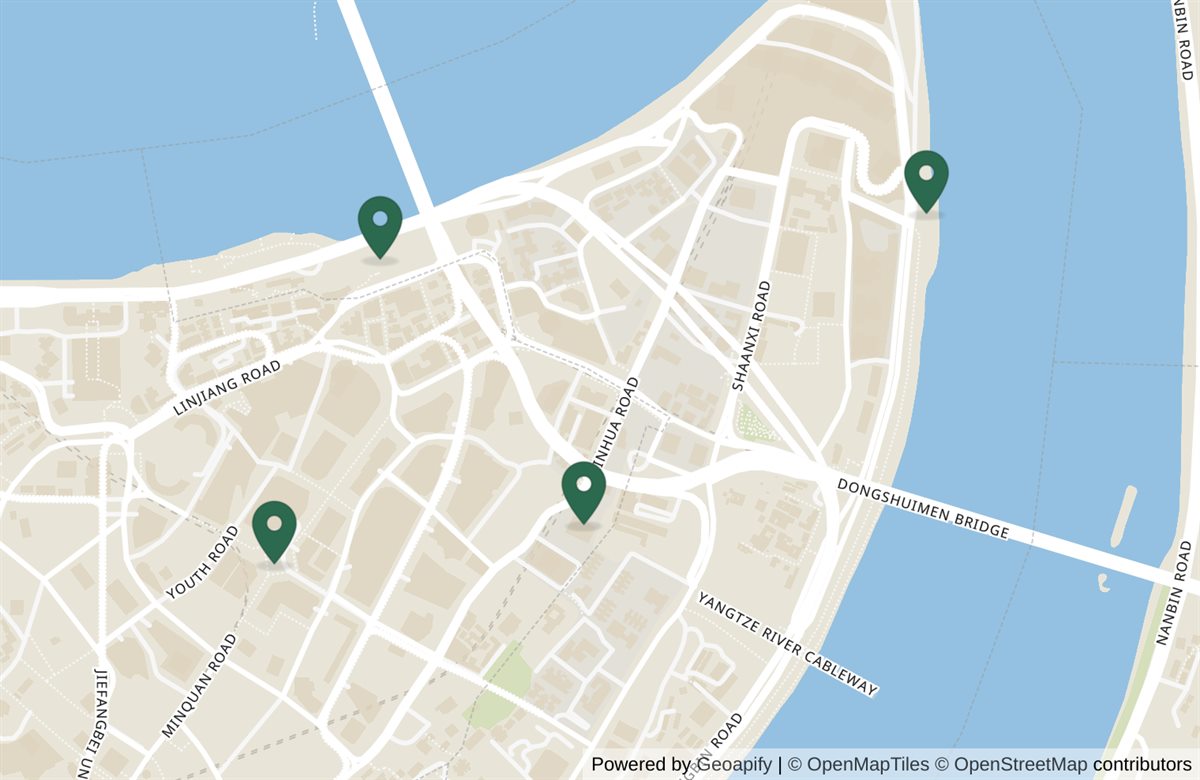
Pronunciation & what the name means
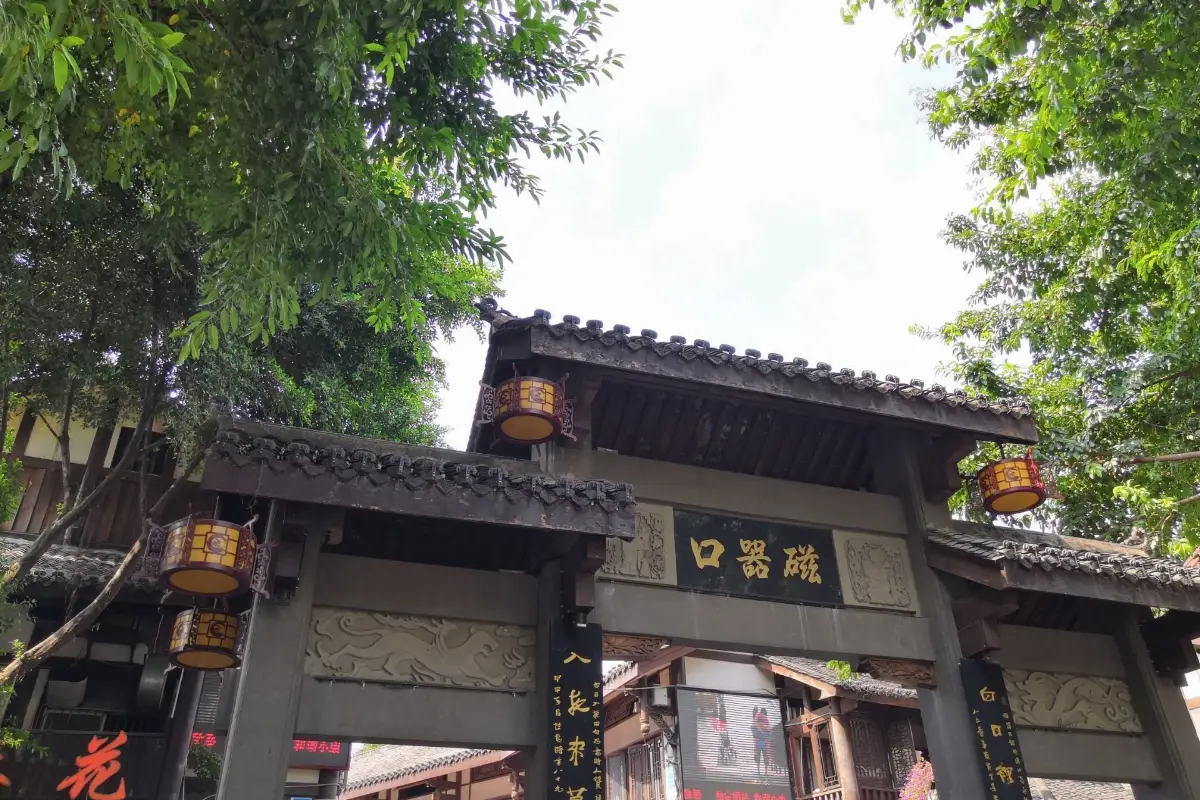
Say it [chee-chee-koh] — three quick syllables, with the “ci” closer to “ts” than “sai.” The name means “Porcelain Port”: 磁器 (cíqì) is an old word for porcelain and 口 (kǒu) means port — this was the Jialing River wharf where locally-fired porcelain was loaded onto boats for shipment downstream. (Tones and common mispronunciations are in the FAQ.)
How to get there from downtown
Metro Line 1 is the only sensible way in — three common starting points:
| From | Metro route | Time |
|---|---|---|
| Jiefangbei 解放碑 | Line 1 direct from Xiaoshizi (小什字) | 35–40 min |
| Hongyadong 洪崖洞 | Line 2 from Linjiangmen (临江门) → Line 1 at Jiaochangkou (较场口) | 35–40 min |
| Raffles City 来福士 · 朝天门 | Line 1 direct from Chaotianmen (朝天门) — the line’s terminus, so the train starts empty and you get a seat for the whole ride | ~55–60 min · ¥6 |
| Chongqing North 重庆北 (HSR) | Loop line → Line 1 at Shapingba (沙坪坝) | ~55 min |
¥4–6 depending on where you board — tap in with Alipay or WeChat Pay. Take exit 1. From there you have two ways in: the nearest archway (金蓉门, ~230 m) drops you straight into the rebuilt back street (磁器口后街) — wide, modern, chain-brand shops — while the old core's own entrance, the couplet archway 黄桷坪牌坊, is 720 m and about ten minutes east, most of it along Ciqikou Pedestrian Street (磁器口步行街). Enter by the couplet archway and keep the back street for the way out; that is where the night lanterns are. Taxi or Didi from Jiefangbei runs ¥30–40 — worth it with luggage or after the metro stops (~11pm), though slower in the 5–7pm rush — and skip the pedicabs and unlicensed cars at the gates (arbitrary prices, souvenir-shop detours). Our Chongqing city guide has the metro-line and pairing detail.
The walk — six stops, in order
Chinese guides all recommend roughly the same loop, and plotted against map coordinates it holds up: in by the couplet archway, up the main street to the river, out through the back street — about 2.9 km on foot. It is a loop rather than an out-and-back, because you come home along the other side of the town. One thing the guides never mention, though: the town dead-ends at the river, so the last stretch to the river gate is walked twice, and the way to the temple leaves the main street about 290 m back down it. Everything on the walk is free except one ¥15 courtyard.
Arrive 3–5pm. In by the couplet archway, because the two interiors close first and they are both at this end. Then the flagstone spine as far as the water, back down as far as the turn-off, and the temple on your way to the back street, which is lighting up by the time you reach it.
| Stop | Time · cost | What it is |
|---|---|---|
| 1 · Couplet archway 黄桷坪牌坊 | 5 min · free | The old core’s entrance at the main street’s south end. The carved couplet on its pillars (pictured above) is the town’s own advice on timing — day for the crowds, night for the lamps. |
| 2 · Zhong Family Courtyard 钟家院 | 30 min · ¥15 · 9am–5:30pm | Courtyard house of Zhong Yunting, a procurement officer to Empress Dowager Cixi — a northern-style courtyard built in southern materials. First on the route because it shuts first. |
| 3 · The academy cluster 翰林院 · 宝善宫 | 20 min · free | The lanes just inside the archway: the old Hanlin academy site (this river port schooled real imperial scholars) and the former 宝善宫 temple hall, which now houses the porcelain-history exhibition. Ignore anyone offering fortune-telling here — “donation” pressure is the reported trap on this stretch. |
| 4 · Main street to the river gate 磁器口正街 → 龙隐门 | 45 min · free | The flagstone spine runs north-east up to the Jialing and stops there — the river gate is a dead end, so you come back down it. Hengjie (磁器口横街) branches off with the same mahua shops and no queue; 望江楼 at the river end (正街1号) is the sit-down stop for mao xue wang. Stone steps drop to the water at the old wharf (磁器口码头), where the porcelain boats once loaded. |
| 5 · Bao Lun Temple 宝轮寺 | 30 min · free · 7:30am–6pm | A working Buddhist temple a short climb off the north stretch — incense, weathered timber, a terrace over the rooflines. Its other name is 龙隐寺, “temple of the hidden dragon”: the legend says the deposed Jianwen Emperor hid here as a monk, which named the whole town. |
| 6 · Out through the back street 磁器口后街 | 30 min · free | The rebuilt west side, at its best after dark: the fish-lantern alley (千灯醉巷) glows ~7–10pm, a Hanfu costume show has run nightly on the stilt-house plaza (吊脚楼广场) since late 2025, and the exit archway is ~3 min from the metro. |
The order rule: walked in the evening, this route reaches the temple after it shuts. The interiors close first (courtyard 5:30pm, temple 6pm) and the lanterns come on last (~7:30pm Oct–Apr / ~8pm May–Sep) — so arriving mid-afternoon, do stops 2, 3 and 5 before 5:30pm, eat along stop 4 at dusk, and finish with 6 after the lights are up.
Two additions worth knowing about. For the classic overhead photo of the grey-tiled rooflines, the new Phoenix skywalk (凤凰云槃空中栈道) opened in July 2026 on Phoenix Hill, about 380 m south-east of the couplet archway: free, ~300 m long with a 69 m drop and a 360° platform over the roofs and the river. And for a tea-house opera turn, sit down only where prices are posted — the reliable posted-price venue is the Zhuanyun Lou tea-house theatre (禧来转运楼, 磁器口正街110号). For a proper, full-length face-changing show, the better venues are downtown (Huguang Guild Hall, the Shibati district) or Chengdu’s Shufeng Yayun or Jinli; the old-town tea houses are a casual, hit-or-miss taster rather than the real thing.
Four foods foreigners should actually eat
The four specialties worth seeking out:
| Food | Price | What it’s like |
|---|---|---|
| Dragon’s beard candy 龙须糖 | ¥15 | Hand-pulled maltose floss (folded 16× into 65,536 threads) round a peanut-sesame core — China’s most photogenic street snack, and the pulling is the show. |
| Chen mahua twists 陈麻花 | ¥20–50/box | Sesame-honey fried braids, the town’s signature souvenir. Several shops legitimately trade as 陈麻花 (courts ruled the name generic); Chen Changyin (陈昌银) is the biggest brand — and its branches taste the same as the flagship, so skip the queue at the first shop on the main street and buy at a quiet branch or on Hengjie (横街). |
| Sugar painting 糖画 | ¥10–15 | Molten sugar drawn into a zodiac animal on a marble slab. Pick a stall doing detailed dragon scales rather than blobs; agree the price first — stalls set up most reliably 4–9pm. |
| Mao xue wang 毛血旺 | a shared main | The numbing-spicy boil of duck blood, tripe and sausage in chili broth that Ciqikou claims as its birthplace. Eat the real 江湖菜 version at a riverside restaurant — 望江楼 by the river gate (正街1号) is the standing name — not the snack-stall cup. Ask for wei la (微辣) if you’re not spice-ready. |
Skip the neon-bright 金西梅 preserved fruit (dyed — the snack locals warn each other about), the priced-by-weight fruit cups, chain bubble teas, shouting dried-meat-jerky stalls, and non-Chen “Ciqikou specialty” gift boxes — mostly factory mass-production. On anything sold loose, check the unit price and watch the scale: a “free taste” is the standard lead-in to a hard sell.
Best time to visit — day vs night
Year-round destination at low elevation. There is no single window that has everything — the interiors, the food and the lanterns close and open in sequence — so plan an arc from about 3pm to 9pm, or come on a weekday morning for the quiet version:
| Time | What it's like |
|---|---|
| Weekday 9–11am | The calm window: shops opening, clean light on the architecture, no queues. Weekend middays (12–2pm) are the opposite — barely moving on the main street. |
| 3–5:30pm | Do the interiors while they’re open — the Zhong Family Courtyard shuts 5:30pm, Bao Lun Temple 6pm — with golden hour arriving on the rooflines. |
| 5:30–7:30pm | Dusk: food stalls at peak, blue-hour photos, tea-house opera turns starting. Eat now — the lights are still to come. |
| ~7:30/8–9pm | Lanterns on — ~7:30pm October–April, ~8pm May–September; the back-street fish-lantern alley glows from ~7pm and the plaza Hanfu show runs after dark. This is the photo hour, and the crowd peak. |
| After 9pm | Thins out fast: alleys dim, most shops shut by 10pm, lights off ~9:30pm in winter / ~10:30pm in summer. |
Season: April–May and September–October are best (18–25°C, dry). July–August is hot and humid (visit after 5pm only). December–February is mild (8–15°C) with atmospheric river mist and lower crowds. Avoid the Spring Festival, May 1 and October 1 Golden Weeks, when the main alley is near-impassable. See our best time to visit China guide for the broader picture.
Practical for foreigners
Hours, fees, accessibility
- Old town entry: free, 24/7 (a public street network)
- Bao Lun Temple: free, 7:30am-6pm
- Zhong Family Courtyard (钟家院): ¥15, 9am-5:30pm — the one paid courtyard
- Face-changing: old-town tea houses ~¥28–30 incl. tea (quality varies); full professional show downtown ~¥88
- Drones: flying is banned inside the scenic area
- Footwear & weather: flagstone underfoot with frequent stair runs — wear flat, grippy shoes. In July-August the exposed stretches are punishing before ~4pm; in winter the river wind bites after dark, so bring a layer for the lantern hour.
- Accessibility: stone alleys are uneven with short stair sections. Wheelchair access is partial — the main alley is mostly walkable but the side courtyards and Bao Lun Temple have steps.
Touts & the trap list
Ciqikou’s traps are low-stakes but dense. The set travellers report, in one place: pedicabs and unlicensed cars waiting at the gates; “free gift” handouts that end at a sales table; spin-the-wheel game stalls; fortune-tellers pressing “donations” in the temple lanes; tea houses with no posted prices, where a simple sitting can be billed in the hundreds; and loose snacks weighed before you’ve heard the unit price. None of it is dangerous — a firm no and walking on settles all of it, and the city complaint line is 12345 (Chinese-language) if something escalates.
Payment & English
Alipay and WeChat Pay are universal. Most foreign-card POS at tea houses and shops works (Visa/Mastercard); smaller food stalls are cash-only — carry RMB 200 in cash for street food. English is limited: most stallholders speak Mandarin only, a few owners basic English. Tea-house opera dialogue is Mandarin; Bao Lun Temple has no English signage. Bring Baidu Translate for menus.
How Ciqikou fits a Chongqing trip
The distance shown on the map at the top is what should shape your day: give Ciqikou its own half-day rather than bolting it onto the peninsula. Everything else worth seeing in Chongqing is walkable from everything else; this is the one that costs you a Line 1 ride each way, so it pairs with exactly one other thing, not three.
Most foreigners pair Ciqikou with one other half-day attraction:
- Ciqikou + the Geleshan wartime sites — Baigongguan (白公馆) and the Zhazidong Prison museum (渣滓洞) are a short bus hop up the hill (both 9am-5pm, last entry 4:30pm — go there first), the standard way locals turn the old town into a fuller day.
- Ciqikou afternoon + Hongyadong evening — the classic combination; Line 1 to Jiaochangkou (较场口), one stop on Line 2 to Linjiangmen (临江门), 35–40 min between.
- Ciqikou + Liziba metro-through-the-building — Line 1 (Ciqikou) + Line 2 (Liziba) via one transfer, ~1 hour total transit.
- Ciqikou + hot pot dinner — stay through the lantern hour, then taxi ~25 min to a Yuzhong Peninsula hot pot restaurant. The Chongqing city guide has venue suggestions.
When NOT to go: the three Golden Weeks (domestic crowds), Sat/Sun lunch 12–2pm (the main alley at a standstill), or hot midday in July–August (little shade before ~4pm). And don’t force it into a packed day: if Hongyadong and the Mountain City Trail are already on your list, the archway and a short stretch of the main street is a legitimate visit.
Book a Chongqing face-changing showNASDAQ: TCOM
Ciqikou’s own opera is casual tea-house style (¥28–30); for the full professional face-changing show, Trip.com lists the downtown Chongqing venues (~¥88) — plus same-day Ciqikou + Hongyadong combo tours — booked in English on a foreign card.
Where to stay for a Ciqikou visit
You don't base at Ciqikou. It's about 18 km by road (~40 minutes) out from the city centre in Shapingba district, and there's no foreigner-friendly chain hotel right at the old-town gate. The sensible call for a first China trip is to stay in the Jiefangbei downtown core — walkable to Hongyadong, on Metro Line 1 straight out to Ciqikou (~35 min) — and treat Ciqikou as a half-day trip.
Frequently asked questions
How do you pronounce Ciqikou?
[chee-chee-koh] — three roughly equal syllables, soft 'ch' (closer to 'chee' than 'tsi'), short final 'oh'. The Mandarin tones are 2-4-3 (rising, falling, dipping) but you'll be understood without them. The name 磁器口 literally means 'magnetic-vessel port' — 'magnetic vessel' (磁器) is an old word for porcelain (the iron-rich kaolin clay rang when fired), and 'port' (口) refers to the Jialing River wharf where porcelain was loaded for shipment downstream during the Ming-Qing dynasties.
Is Ciqikou worth visiting?
Yes — with honest framing. This is what Chinese travellers debate most about Ciqikou, and the local consensus is that it's a short-stop old street, not a destination: the main spine is heavily commercialised (machine-made 'handmade' snacks, chain gift shops), but the bones are genuinely Ming-Qing, Bao Lun Temple is a real working temple, and the lanes off the spine still feel like the old river port. Give it 2-4 hours, not half a day: enter by the couplet archway (黄桷坪牌坊), see the courtyards before they shut (~5:30pm), eat at the river end rather than on the spine, and pair it with the Baigongguan-Zhazidong wartime sites or a Hongyadong evening rather than building a whole day on it.
How do I get to Ciqikou from downtown Chongqing?
Metro Line 1 (orange line) to Ciqikou station (磁器口站). From Jiefangbei (Liberation Monument) it's about 35-40 minutes; from Hongyadong about 35-40 minutes (Line 2 from Linjiangmen, change to Line 1 at Jiaochangkou); from Chongqing North Station (where HSR arrives) about 55 minutes — ride the Loop line and change to Line 1 at Shapingba (沙坪坝). If you are staying at Raffles City on the peninsula tip, you are at Chaotianmen (朝天门), which is Line 1's own terminus: no change at all, about 55-60 minutes door to door, and the train starts empty so you get a seat. Fares are ¥4–6 depending on where you board, with Alipay or WeChat Pay tap-in (no card needed). Take exit 1. The nearest archway (金蓉门, ~230 m) puts you into the rebuilt back street — wide, modern, chain brands; the old core's own entrance is the couplet archway 黄桷坪牌坊, about 720 m and ten minutes east, most of it along Ciqikou Pedestrian Street (磁器口步行街). Enter there and save the back street for the way out. Taxis/Didi from downtown run ¥30-40 but are slower than the metro in evening traffic — and skip the pedicabs and unlicensed cars waiting at the gates, which charge arbitrary prices and detour past souvenir shops.
What are Ciqikou opening hours and is there an entry fee?
The old town itself is open 24/7 with no entry fee — it's a public street network, not a ticketed scenic area. Most shops open 9-10am and shut by 10pm, many earlier. The two interiors keep shorter hours: Bao Lun Buddhist Temple is free, 7:30am-6pm; the Zhong Family Courtyard (钟家院), the one paid courtyard, is ¥15, 9am-5:30pm. The lanterns are later than most write-ups claim: the back-street fish-lantern alley lights at ~7pm, and the old town's own lanterns come on around 7:30pm from October to April and around 8pm from May to September, going off from about 9:30pm (winter) / 10:30pm (summer).
What is the best walking route through Ciqikou?
Chinese guides all recommend roughly the same loop, and plotted against map coordinates it holds up. From metro exit 1, walk east along Ciqikou Pedestrian Street (磁器口步行街) to the couplet archway (黄桷坪牌坊); take the Zhong Family Courtyard (钟家院) and the academy lanes (翰林院, with the porcelain hall in the former 宝善宫) just inside; walk the flagstone main street (磁器口正街) north-east up to the river gate (龙隐门) and the old wharf on the Jialing; come back down the main street and cut west to Bao Lun Temple; then leave through the back street (磁器口后街) past the fish-lantern alley, which drops you near the metro. About 2.9 km on foot. Two things the guides leave out. The town dead-ends at the river, so the top of the main street is walked twice and the temple turn-off is about 290 m back down it — it is a loop, not a route that never repeats a step. And walked in that order in the evening you reach the temple after it shuts at 6pm, so from mid-afternoon do the courtyard and temple first, then the streets at dusk, then the lanterns.
When is the best time to visit Ciqikou — day or night?
The mistake to avoid is timing the visit around a single window, because the three things worth doing close in sequence: the interiors shut first (Zhong Family Courtyard 5:30pm, Bao Lun Temple 6pm), street food peaks at dusk, and the lanterns only come on around 7:30pm (October-April) or 8pm (May-September) — there is no time of day when you can have all three at once. The best plan is an arc: arrive 3-4pm, do the courtyard and temple, eat as the light goes, then walk the lantern-lit back street before crowds thin and shops shut from about 9pm. If you'd rather have the place quiet, a weekday morning is the calm window; weekend afternoons (especially 12-2pm) are shoulder-to-shoulder on the main street.
What food should I eat at Ciqikou?
Four genuine specialties worth seeking out: (1) Dragon's beard candy (龙须糖) — maltose pulled by hand into thousands of silk-fine threads around a peanut-sesame core; the pulling is the show. (2) Mahua fried twists (麻花) — sesame-honey braided dough. Several shops legitimately trade under the 陈麻花 name (courts ruled it generic); Chen Changyin (陈昌银) is the biggest brand, and branches taste the same as the flagship — so skip the queue at the first shop on the main street and buy at a quiet branch, including on Hengjie (磁器口横街). (3) Sugar painting (糖画) — molten sugar drawn into animals on a marble slab (agree the price first). (4) Mao xue wang (毛血旺) — the numbing-spicy boil of duck blood, tripe and sausage that Ciqikou claims as its birthplace; eat it as a shared main at a riverside restaurant such as 望江楼 by the river gate (磁器口正街1号), not as a snack-stall cup. Skip the neon-bright 金西梅 preserved fruit (dyed — the local avoid-word), priced-by-weight fruit cups, chain bubble teas and 'specialty' gift boxes, and watch the scale on anything sold loose.
Is the Sichuan Opera face-changing show worth seeing at Ciqikou?
Bian lian (变脸) face-changing is a 300-year-old Sichuan opera technique where performers change painted silk masks in fractions of a second, often without obvious hand movements. One thing to set straight: Ciqikou has no dedicated face-changing theatre. Inside the old town you'll only find tea houses that fold a short opera turn into a tea sitting (about ¥28–30 with tea, quality varies — read the on-the-spot reviews before paying). Sit down only where prices are posted at the door: tea houses without a posted price list are the town's classic overcharge, sometimes with time limits on the seat. The long-standing posted-price venue is the Zhuanyun Lou tea-house theatre (禧来转运楼, 磁器口正街110号). For a proper, full-length professional show, see it downtown (Huguang Guild Hall or the Shibati district, about ¥88) or in Chengdu (Shufeng Yayun). Ignore anyone on the street handing out 'free' opera tickets — that's a touts' lead-in to a shopping stop or an overpriced tea house.
How long do I need at Ciqikou?
Chinese travellers' consensus: 2-4 hours, not half a day. A 90-minute speed run covers the main street + Bao Lun Temple + one street snack; 3-4 hours adds the courtyard, a proper meal and the lantern hour; only a serious shopper or a tea-house sitting stretches it past that. Most visitors pair Ciqikou with something else — the Baigongguan-Zhazidong wartime sites up the hill, a Hongyadong evening, or Liziba on the way back in — rather than spending a full day. And if you're already doing Hongyadong and the Mountain City Trail on the same trip, locals' honest advice is that the archway and a short stretch of the main street may be all you need here.
What should I buy in Ciqikou, and what should I skip?
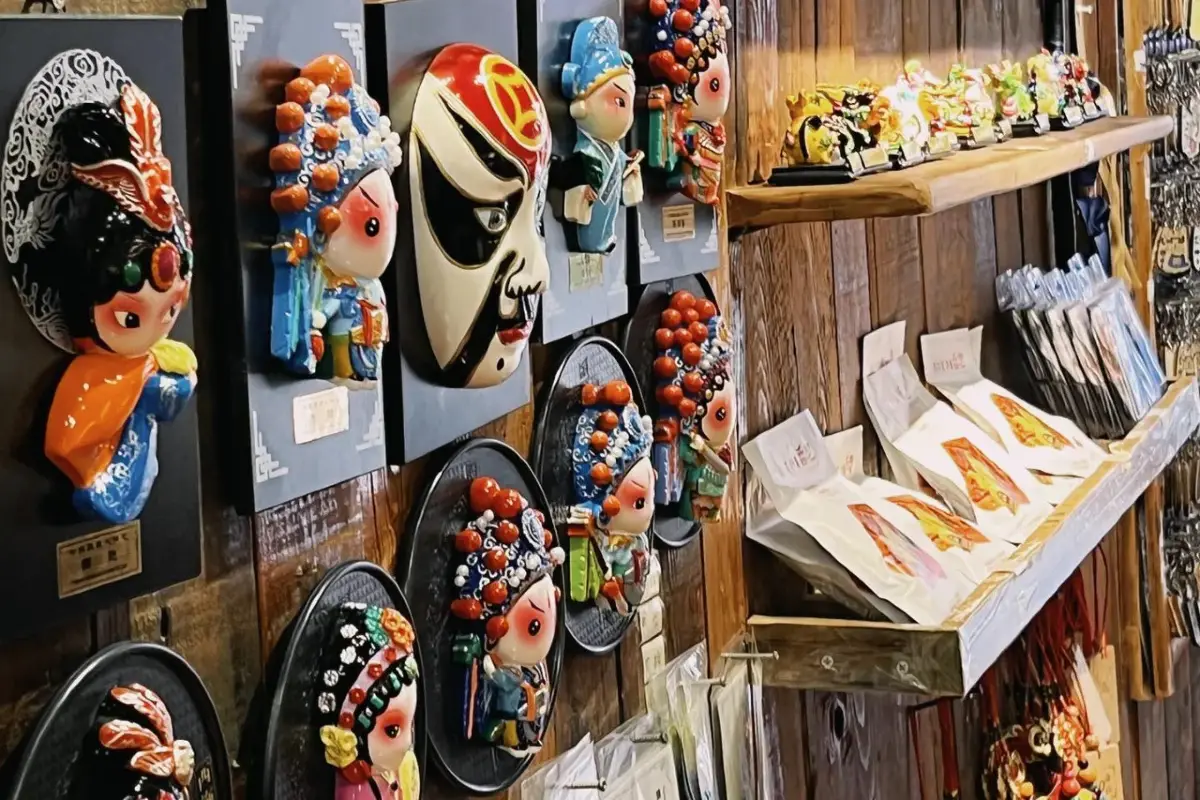
Buy the mahua twists (麻花) and, if you want one object rather than food, a painted Sichuan-opera face mask — those are the two things genuinely of this place. On the mahua: several shops legitimately trade under the 陈麻花 name because the courts ruled it generic, Chen Changyin (陈昌银) is the biggest brand, and its branches taste the same as the flagship — so walk past the queue at the first shop on the main street and buy at a quiet branch or on Hengjie (磁器口横街), ¥20–50 a box. Skip the generic "Ciqikou specialty" gift boxes that are not a named brand (mostly factory mass-production), the neon-bright 金西梅 preserved fruit (dyed, and the snack locals warn each other about), and the priced-by-weight fruit cups. On anything sold loose, ask the unit price before it goes on the scale and watch the scale — a free taste is the standard opening to a hard sell. Dragon's beard candy (龙须糖, ¥15) is worth buying but eat it there; it does not travel. Alipay and WeChat Pay work everywhere, most shop card machines take Visa/Mastercard, and small stalls are cash-only.
Sources
Checked August 2026 · Written from our own first-hand travel in China.