Key takeaways
- “Wuzhen” is two separately-ticketed scenic areas ~2 km apart — Xizha (¥150) and Dongzha (¥110) — plus two free, ungated streets most guides never mention.
- Every ticket is single-entry, valid the day you buy it. Leave the gate and it is spent — which is why a cheap room “near Xizha” that turns out to be outside is the classic Wuzhen mistake.
- Sleep inside Xizha if you can. Guests can get a temporary pass that ends the single-entry rule, plus the empty lanes after the 22:00 close and before the 09:00 open, and the 07:00–09:00 market on the water.
- Lights come on ~17:30 in summer, ~17:00 in winter. Be inside by about 16:00 so the daytime houses, the sunset and the lit canals all land on one ticket.
- Its reputation as a “managed resort” is accurate and is the reason it works for a first visit: fixed posted prices, no touts inside the gate. The touts are all outside it.
What Wuzhen is
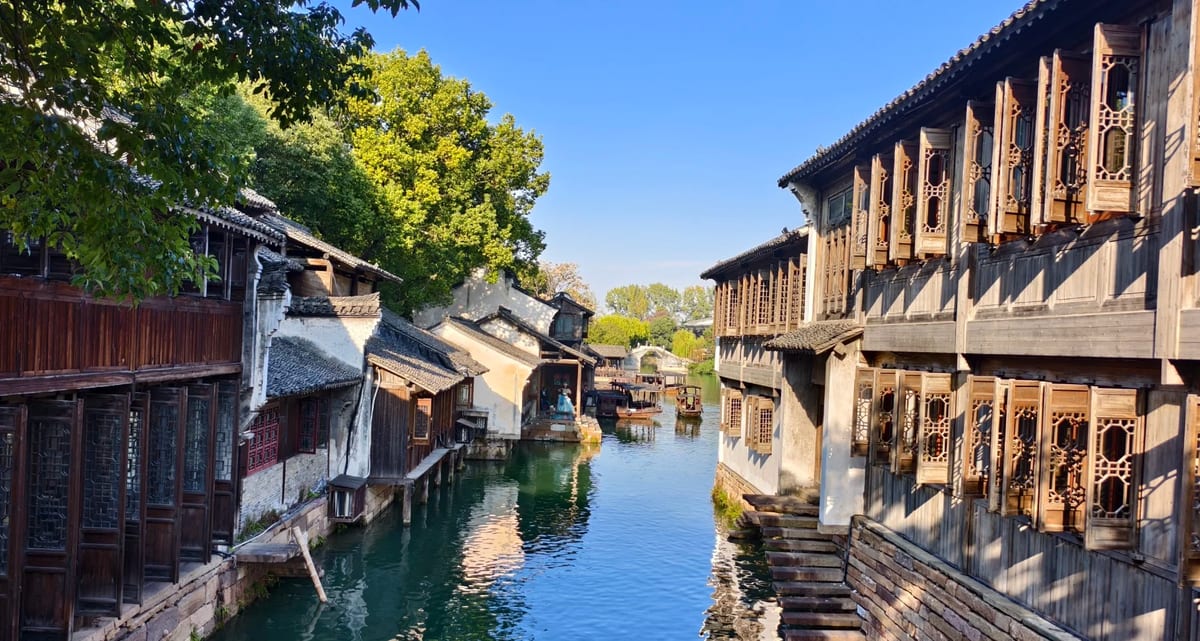
Wuzhen sits on the Grand Canal in Tongxiang, Zhejiang, between Hangzhou and Shanghai and rather closer to Hangzhou. It is the most restored and by some distance the most tightly managed of the Yangtze-delta water towns, and it carries a cultural weight the others do not: it is the birthplace of the novelist Mao Dun, the home town of the painter and essayist Mu Xin — who spent two decades in New York and has a museum here built for his work — the venue of the annual Wuzhen Theatre Festival, and the permanent host of China’s World Internet Conference.
The thing to understand before you book anything is that Wuzhen is not one entrance. The town has four quarters. Two of them are gated scenic areas with their own tickets — Xizha (西栅), the West Scenic Zone, and Dongzha (东栅), the East Scenic Zone — and two are ordinary streets you can walk into for nothing: Nanzha (南栅), where a good deal of the town’s actual daily life happens, and Beizha (北栅), built around a converted silk factory that now holds art spaces. English guides almost universally describe only the two ticketed halves, which is how people end up at the wrong gate.
Where Wuzhen sits between Shanghai and Hangzhou
No station in Wuzhen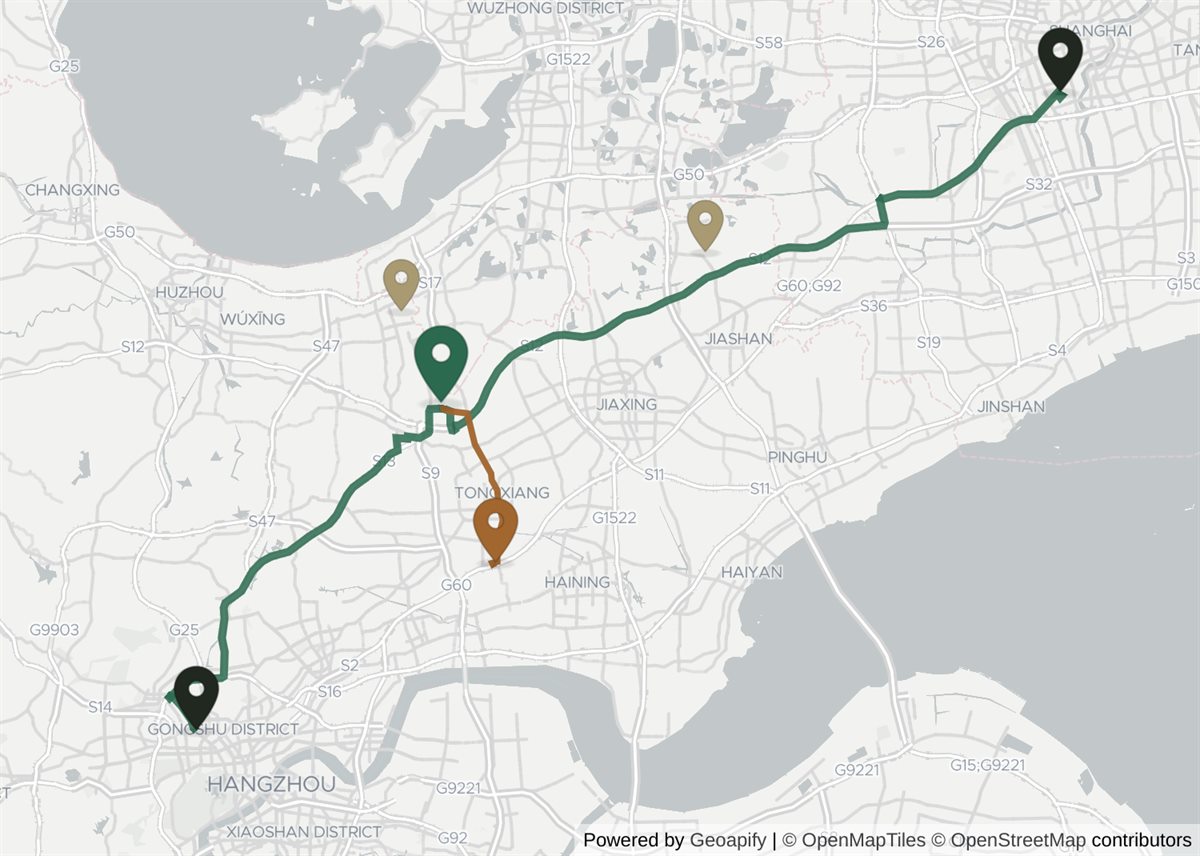 WuzhenWuzhenShanghaiShanghaiHangzhouHangzhouTongxiang stationTongxiang stationXitangXitangNanxunNanxun
One town, four quarters — two of them ticketed
Separate gatesSeparate ticketsFour quarters, two gates, one name. The two ticketed zones are drawn to scale and to their real separation — that gap is a taxi or a local bus, not a walk between halves of one town, and it is the reason the gate you pick decides your day. The two pale, dashed quarters have no gate at all.
Which gate — Dongzha or Xizha
This is the decision the whole trip turns on, and it is not close. If you are going once, go to Xizha. It is far larger, it holds the canal-side night lighting, the boats, the museums and every bed inside a gate, and it stays open until 22:00. Dongzha is a compact morning walk through house-museums that shuts in the late afternoon and has no evening at all.
| Xizha 西栅 (West) | Dongzha 东栅 (East) | |
|---|---|---|
| Ticket | ¥150 | ¥110 |
| Open | 09:00–22:00, last entry 22:00 | 07:00–18:00 (Jun–Sep), 07:00–17:30 otherwise |
| Night lighting | ⭐ Yes — the reason to come | None |
| Size / time | Large — half a day to a full day | Small — 2–3 hours |
| Sleeping inside | Yes — guesthouses, a dozen hotels and one hostel | No |
| Feel | A managed estate: immaculate, almost no residents | More lived-in and domestic, more worn |
| What it is for | The evening, the boats, the photographs, staying over | Mao Dun, the beds museum, the old dye yard — and the daytime folk performances |
| Free performances | Afternoon into the evening — opera, storytelling, open-air films, the night watchman | Morning to mid-afternoon — martial-arts boat, pole acrobatics, opera, shadow puppets |
The ¥190 combo covers both and saves against buying them separately — but it is a same-day pass, and that is where it goes wrong. The regret people report is consistent: two hours spent in Dongzha in the morning, then arriving in Xizha with the light going and the better half of the trip rushed. Buy the combo only if you have a genuinely full day and good legs, or if your room is inside the west gate — in which case you can buy a two-day version at check-in instead and split the zones across two mornings.
Tickets, and the single-entry rule
Wuzhen’s prices are simple; its rule is the part that catches people. A ticket is valid for one entry on the day you buy it. Step back out through the turnstile — for lunch, for your bags, to move a car — and it is finished. There is no re-entry stamp and no grace period.
| Ticket | Price | What to know |
|---|---|---|
| Xizha (West Scenic Zone) | ¥150 | The one to buy if you buy one. Concession ¥75. |
| Dongzha (East Scenic Zone) | ¥110 | Daytime only. Concession ¥55. Ticket is checked again at each house inside. |
| East + West combo | ¥190 | Same day, one entry each. Concession ¥130. A two-day version exists for guests staying inside Xizha, bought at check-in. |
| Xizha evening ticket | ¥80 | ⚠️ Most people should not buy this — a normal Xizha ticket already covers the evening. Only worth it if you arrive late. Why, and when it opens. |
Children under 1.2 m or aged six and under go free; over-70s go free on production of ID at the No. 2 visitor centre. The concession rates above are posted for full-time students, ages 6–18 and 60–69.
One thing that changes which ticket you need: if you are sleeping inside Xizha, the room rate normally includes admission for two adults and lets you come and go until noon on the day you leave — so the combo, the evening ticket and the day rate are not the only options on the table. How that sum works, and which beds are excluded.
Booking, honestly: on an ordinary day there is no capacity cap to beat, and the staffed windows do sell walk-up tickets. Two things still change that answer. The first is the room rate above — if it carries your admission, skip this section entirely. And if you are buying, doing it before you arrive takes the ticket counter out of a queue you will be standing in anyway, because a foreign passport goes through the staffed lane at the gate either way (see below). Public holidays and the October theatre festival are different again: the scenic area switches to capped, real-name online booking, and the windows may stop selling walk-ups altogether. If you buy several tickets in one online order, the system may require the whole party to enter together, so buy separately if anyone might arrive late.
Passports at the gate. The turnstiles are built around the Chinese ID card and read passports unreliably. Travellers who have taken foreign visitors through are consistent about the workaround: use the staffed lane, not the machine — one to two minutes on a weekday, ten to twenty more at peak. Worth correcting a common impression: this is not a Chinese-only operation. Wuzhen runs its own English-language website and an English booking line, and publishes a fixed price for an official English-speaking guide (¥300 per group in Xizha, ¥200 in Dongzha, per one-way trip). What is awkward for a foreign visitor is the turnstile and the card payment, not the language.
Book the ticket & a day tripNASDAQ: TCOM
Trip.com lists Xizha and Dongzha entry tickets and day trips from Hangzhou and Shanghai with transport included — the straightforward way to handle the ticket and the transfer in English on a foreign card.
The evening — lights, boats and the quiet hour
Xizha after dark is the reason the town has the reputation it has. The lighting comes on around 17:30–18:30 in summer and 17:00–17:30 in winter, tracking sunset, and goes off somewhere between 22:00 and 23:00 depending on the season and the day — later on Friday and Saturday nights. The gate stops admitting at 22:00 either way.
An evening in Xizha has three distinct phases, and they are worth planning around:
- The half hour around sunset — lanterns lit, sky still deep blue. This is the photograph, and the two spots people go to are the bridge-in-a-bridge (桥里桥) and the top of the White Lotus Pagoda.
- Roughly 18:30 to 20:00 — the busiest and liveliest stretch, most boats on the water, the lanes full.
- After about 20:30 — the tour groups leave, the reflections go still, and the town becomes what people imagined they were buying.
The corollary is a scheduling rule: be inside by about 16:00. Arriving at seven in the evening means paying a full ticket for the dark half of it and missing the sunset window entirely.
The evening ticket, and why you probably should not buy one
Listings sell a separate Xizha evening ticket at about ¥80, and the way it is advertised implies you need it to see the town lit. You do not. A normal Xizha ticket (¥150) or the combo (¥190) already covers the whole evening — the zone admits until 22:00, so you walk in during the afternoon and simply stay. There is no second charge at dusk and no re-scan.
The evening ticket earns its price in exactly one case: you are arriving late anyway and would rather pay roughly half than a full day rate for four hours. Two things to know before you do. Travellers put entry from around 18:00 in summer and around 17:30 in winter, and it does not cover the daytime indoor houses — the dye works and the museums are shut by then in any case. And it is not a scenic-area product: it appears neither on Wuzhen’s own ticket-policy page nor in its official booking mall, only on resellers, so treat the entry time as the seller’s rather than the gate’s and confirm it at the point of sale.
The boats. The hand-poled boats are official and priced per one-way trip, not per hour: in Xizha a shared boat is ¥60 a head — it leaves when eight passengers are aboard — or ¥480 for the whole boat; in Dongzha ¥30 and ¥240. Children up to 14 or 1.5 m are half. Two things save money here. In daylight you do not need a paid boat at all: a free ferry runs from the Xizha ticket gate across to Andufang wharf, which is where the lanes and the dye works begin. And buy at the official window — touts at the wharf are reported to re-price mid-trip, cut the route short, or charge shared passengers the whole-boat rate.
Two free things people miss: the projection show after dark in the Lingshui Residence garden — no ticket, no seat booking, short and repeating through the evening — and the shuttle carts, which cost ¥10 a ride but are free for guests staying inside on production of a room card.
Staying inside Xizha — the decision that matters
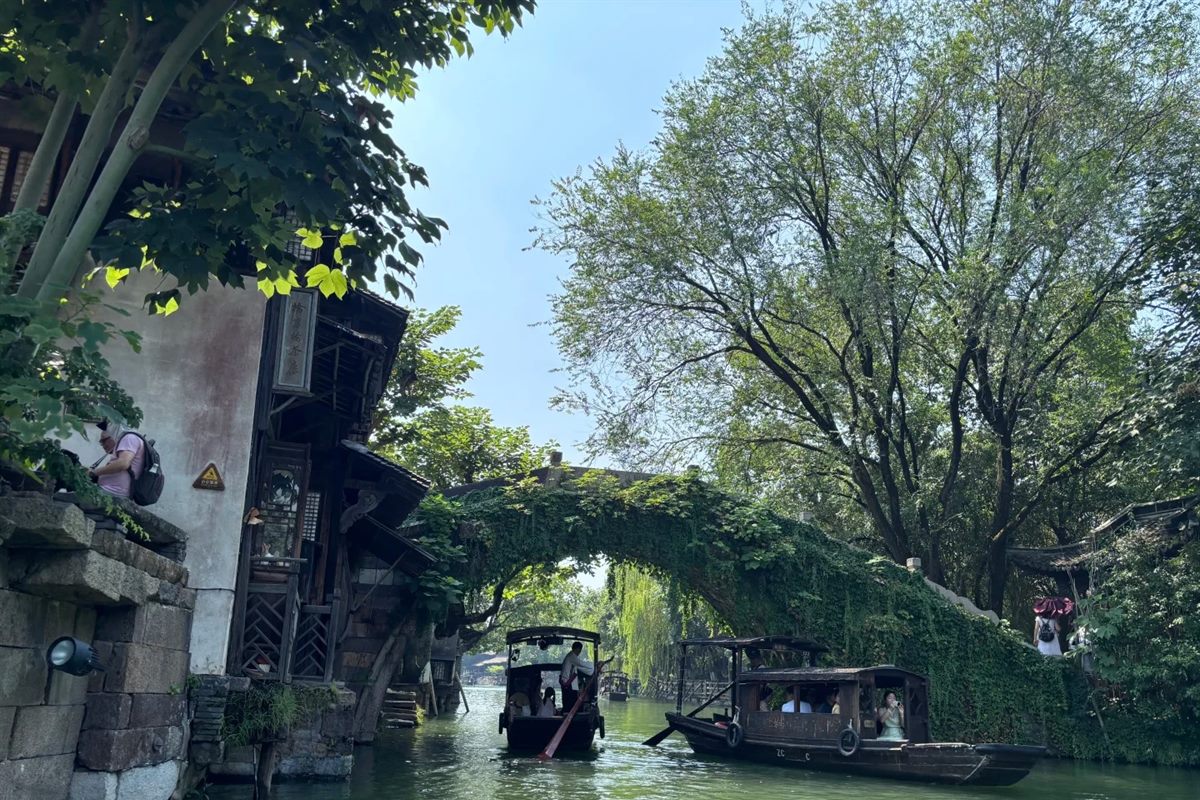
Xizha admits day visitors from 09:00 and stops admitting at 22:00. Everything outside those hours belongs to the people sleeping inside — and that, rather than the room itself, is what you are buying. A night inside gets you the empty lanes after the gate shuts, the mist on the canal at dawn, and the 07:00–09:00 market on the water, which is running before day visitors are let in at all. It also ends the single-entry problem — but not in the way most write-ups suggest.
The room comes with the ticket — and that is the whole argument
Rooms in the officially-run guesthouses and hotels inside Xizha are sold with Xizha admission for the number of guests included, and the room descriptions on Trip.com say so in as many words. At check-in your face is registered at the gate, and from then you can walk out and back in as often as you like — until 12:00 noon on the day you leave, when the right stops with the room.
That changes the sum most people do. Two adults visiting for the day spend ¥150 each before they have slept anywhere. Inside-the-gate rooms are not cheap, but comparing them with a cheaper room outside is comparing the wrong two numbers, because one of them already contains the tickets — and the cheaper one will cost you a fresh ticket every time you come back through the gate.
- Xizha only. Dongzha is a separate gate and a separate ticket no matter where you sleep.
- Staying in Dongzha is not the same deal. Travellers report your host walks you into the Dongzha lanes, but the ticketed houses inside — Mao Dun’s residence, the dye works — still charge, and it includes nothing at Xizha.
- The hostel is excluded — see below. It is the one bed inside the gate that does not carry any of this.
- Check the listing, not the address. Officially the room and the ticket are separate products, and the inclusion is a property of the rate you book — a cheap room advertised as “near Xizha” that sits outside the gate includes none of it.
In practice this is what lets you eat in the modern town where a bowl of noodles costs half as much, fetch your luggage, or take the hot part of the afternoon off and come back for the lights — each of which costs a day visitor another full ticket.
Rooms whose rate already contains the ticketNASDAQ: TCOM
Wuzhen Guest House, Tong’an Inn and the dozen named hotels inside the gate. Read the rate’s own inclusions before you book — that is where the admission appears, and it is what tells an inside room from a cheaper one that only calls itself “near Xizha”.
What you are choosing between. The whole estate is one operator, which produces a quirk that catches people out when they search: the guesthouses are not separate businesses. They are a single branded product — listed as one property, Wuzhen Guest House, and allocated to you by number out of a stock of 79 rather than chosen by name. The number is what you give a driver or a member of staff. The hotels, by contrast, each have their own name and their own listing, and there are a dozen or so of them, not the handful most guides mention. One thing you cannot pick by name is the guesthouse itself: unless you note a preference, the building and room type are assigned.
| Inside Xizha | What it is | Weekday rate |
|---|---|---|
| Wuzhen Guest House 乌镇民宿 | The numbered old houses — small rooms (15–20 m²), timber, some opening straight onto the water. The atmospheric option, and the one people mean by “staying inside”. | ¥500–620 |
| Named hotels Tong’an Inn, Waterside Resort, Passage d’Eau, Zhaoming House and others | Bigger rooms, better insulation and heating, proper front desks. Tong’an sits near the entrance — the easy in-and-out choice; the others are spread through the zone. | ¥610–790 |
| The top end Dockside Boutique, Wuzhen Club House, Dishang Resort | Converted mansions and a modern resort with pools. Comfort rather than atmosphere — you are no longer paying for the lane outside the door. | ¥850–1,500 |
| Shuixiang Youth Hostel 水巷青年旅馆 | The only hostel inside the gate, sex-segregated 2/4/6-bed dorms. ⚠️ Cheap, but it does not carry the same rights — see below. | From ¥75 a bed |
| Outside the gate | Guesthouses and business hotels a short taxi away, including a Hampton by Hilton. Half the price and none of the reason for coming. | ¥230–470 |
Rates are Trip.com lead-in prices for two mid-week nights in August and September 2026, checked 2026-07-30, and move sharply for weekends, holidays and the October theatre festival. Waterside and balcony rooms sit above the band shown.
The hostel is the exception to everything above. Travellers who have stayed report that a dorm bed does not get the temporary in-and-out pass — it is one entry, like a day ticket, so stepping out of the zone ends your visit — and that luggage portering may be charged rather than free. The free shuttle carts and the guest ticket discount do apply. Bedding is in the locker for you to make up and there are no toiletries. Check in at visitor centre No. 1, not at the hostel. None of this is in the official FAQ, which speaks about “guests staying inside” as one category, so treat it as reported rather than posted — and if the freedom to come and go is the reason you are sleeping inside, the hostel is not the way to buy it.
⚠️ The classic Wuzhen mistake is booking a cheap room advertised as “near Xizha” that turns out to be outside the gate. Because the ticket is single-entry, every trip back in costs another ¥150, and none of the inside-the-gate benefits apply. It is an easy mistake to make because outside-the-gate properties legitimately carry “Xizha” in their names. Before booking anything, check whether the property is inside the scenic area — and if you want to be inside, book through the scenic area’s own channel, or look for one of the names in the table above rather than for a listing that merely says “Xizha”.
Which part to sleep in. Everything inside is timber, so sound carries. The noisy stretches are the entrance end, where visitors come and go all evening, and the water-market end, which starts making noise at seven in the morning. Balcony rooms on the main canal have the view and the voices from across the water. The quiet ones are the high numbers deep in the zone (65–79), which are peaceful but a long way from the exits, and the courtyard or side-creek rooms away from the main lane. Light sleepers should bring earplugs regardless.
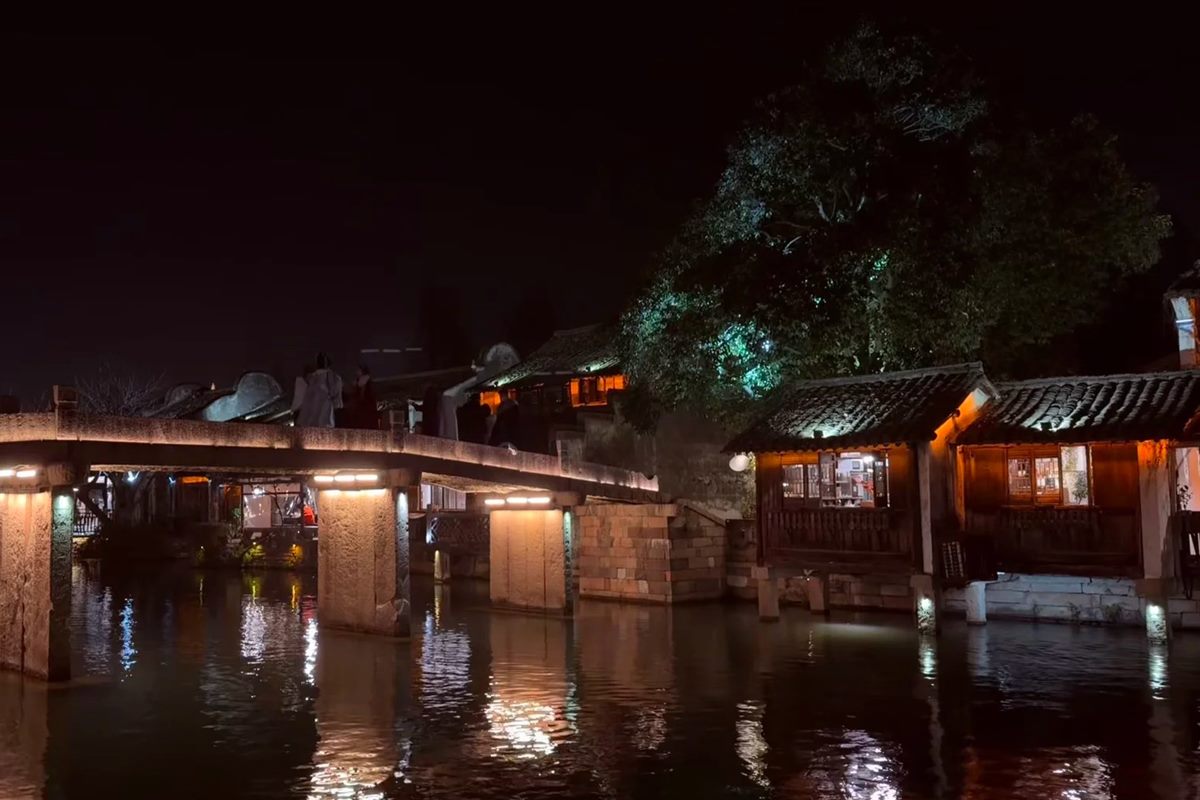
Luggage. Check-in is from 15:00 and checkout by noon, and you may keep walking the zone after you check out. Bags can be left with your guesthouse or forwarded to the visitor-centre luggage room — but forwarding takes roughly 40–60 minutes and is not instant, and the luggage hall is outside the turnstile, so going to collect your bags ends your visit. Take out what you need for the day before you hand them over. One more official rule with real consequences: rooms are sold strictly by bed count and no extra beds are provided, so a family of four cannot squeeze into a double.
What to see in each zone
Xizha is walked slowly rather than ticked off — the pleasure is the lanes and the water — but these are the named stops worth aiming at, and the hours matter because several close well before the zone does.
| In Xizha 西栅 | What it is | Note |
|---|---|---|
| Indigo dye works 草木本色染坊 | Tall bolts of blue-and-white printed cloth hung on drying racks in a courtyard — the town's most photographed corner, and best from the upper floor. | Reachable on the free ferry from the gate |
| Muxin Art Museum 木心美术馆 | A severe modern box on the water holding the paintings and manuscripts of Mu Xin, who grew up here and spent decades in New York. The building itself is the draw. | Separate ticket · closed Mondays |
| White Lotus Pagoda 白莲塔 | The tallest thing in Xizha and climbable, with the old town on one side and the Grand Canal on the other. Time it for sunset. | Amap: 08:00–20:30 |
| Bridge-in-a-bridge 桥里桥 | Two stone bridges meeting at right angles — 通济桥 and 仁济桥 — so that standing on one you see the other framed through its arch. The night-photograph spot. | Best after the lights come on |
| Zhaoming Academy 昭明书院 | A quiet walled courtyard on the site where a Southern Dynasties crown prince is said to have studied; there is a library inside to sit in. | Amap: 08:00–17:30 |
| Lingshui Residence 灵水居 | The largest garden in Xizha, and after dark the venue for a free projection show — no ticket, no seat booking, short and repeating. | Free · after dark |
| Century-old post office 乌镇邮局 | A working post office where you can send a postcard with the town's own postmark — a five-minute stop that people remember. | Amap: 08:00–21:30 |
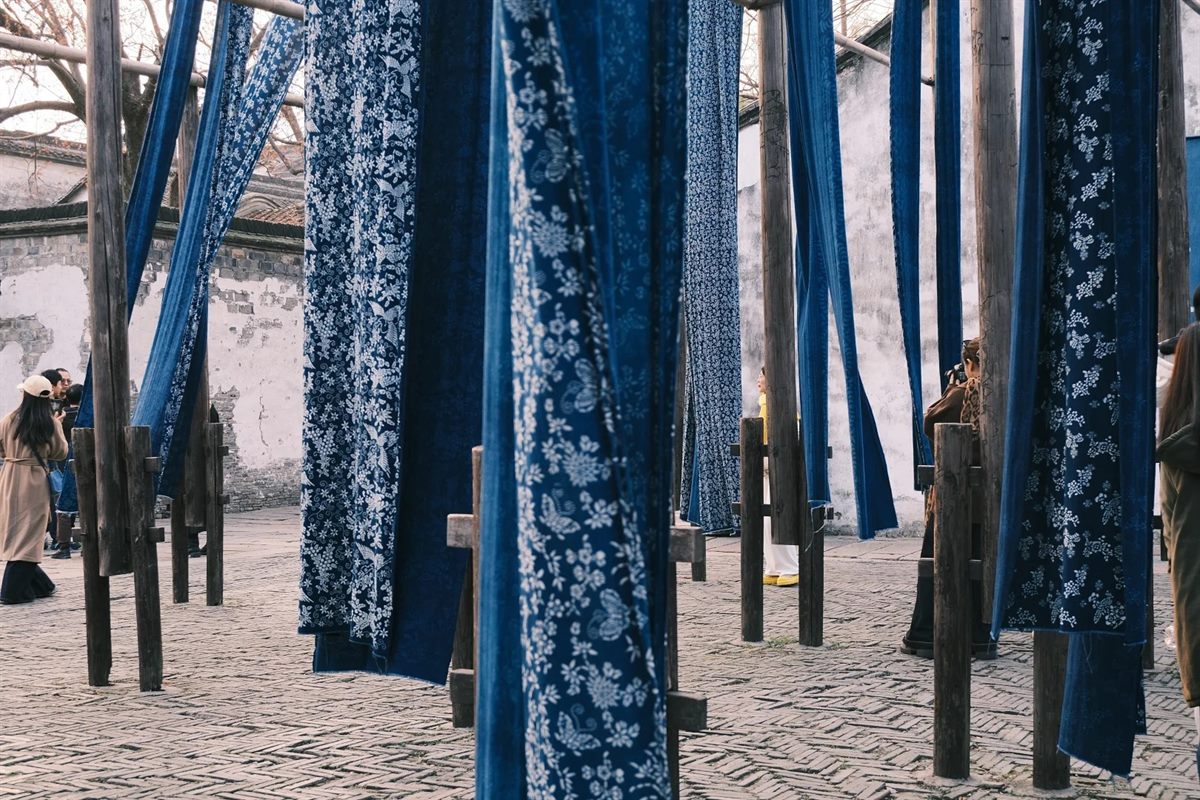
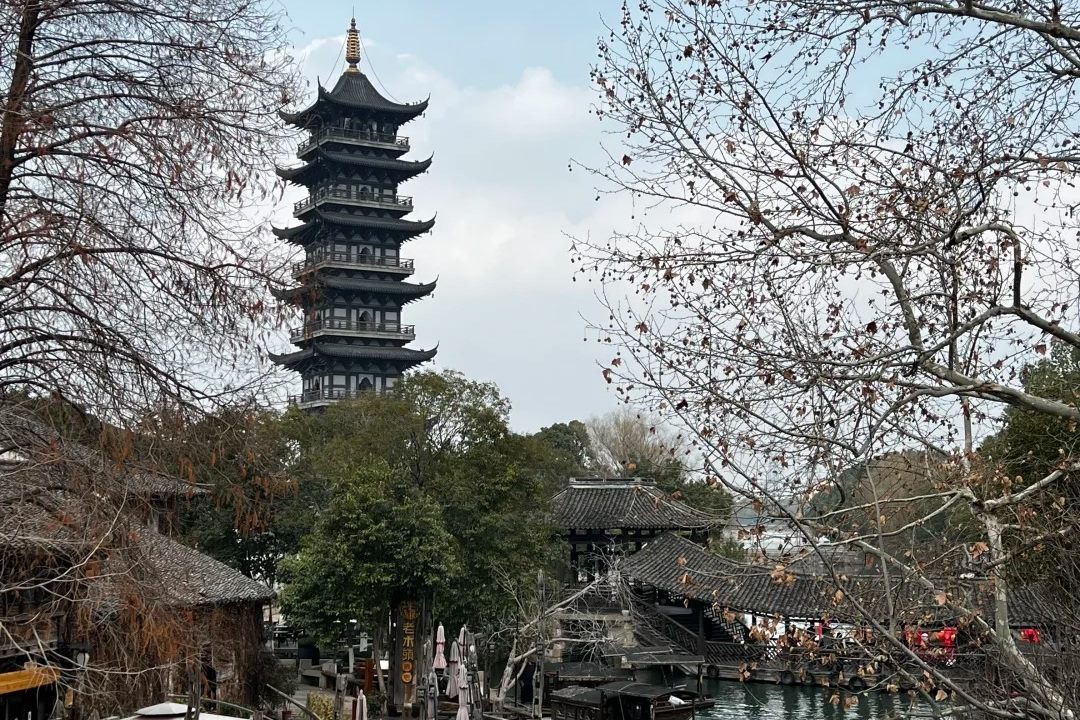
One thing to flag because the ticket does not cover it: the Muxin Art Museum is ticketed separately. For a visitor from outside China it is arguably the most interesting thing in Wuzhen — Mu Xin grew up in this town, spent two decades in New York, and the museum was built for his paintings and notebooks — and it is missing from nearly every English write-up. It closes on Mondays.
| In Dongzha 东栅 | What it is | Note |
|---|---|---|
| Mao Dun's former residence 茅盾故居 | The birthplace of the novelist Mao Dun (Shen Yanbing), author of Midnight — a courtyard house with manuscripts. The anchor of Dongzha. | Closed Mondays |
| Hundred Beds Museum 江南百床馆 | Thirty-odd Ming and Qing beds, including the extravagantly carved "thousand-craftsman bed". Stranger and better than it sounds. | Amap: 07:00–17:30 (to 18:00 Jun–Sep) |
| Hongyuantai dye works 宏源泰染坊 | The older, rawer version of the indigo dye yard — the same drying racks with fewer people around them. | Same hours as the zone |
| Mu Xin's former residence 木心故居纪念馆 | Where Mu Xin actually grew up, presented as a life rather than a collection. Pairs with the museum over in Xizha. | ⚠️ Closed on the 15th of each month |
| Fengyuan twin bridge 逢源双桥 | Dongzha's signature covered double bridge, looking down over the Caishen Bay bend where the canal widens. | Open street |
Dongzha runs a per-house ticket check, so keep your ticket to hand rather than in a bag. And note the two Monday closures above: they take out Dongzha’s anchor sight and Xizha’s best museum on the same day of the week.
The free performances — and how they split by zone
Both zones run traditional performances through the day, included in your ticket and staged in the open — you stand on the bank or in a courtyard and watch. English guides almost never mention them, and the schedules are only posted in Chinese, but the shape is worth planning around because the two zones’ programmes run at opposite ends of the day.
| Dongzha 东栅 — morning & afternoon | Where | Roughly when |
|---|---|---|
| Martial-arts boat 拳船 — a weapons-and-drums routine on a moored stage boat | The shop quarter | Short 10-minute sets, several times from around 09:00 into the afternoon |
| Pole acrobatics 高竿船技 — a performer climbs a bamboo pole stepped into a boat | Caishen Bay 财神湾 | Twice a day, late morning and mid-afternoon; cancelled in bad weather |
| Flower-drum opera 花鼓戏 — local legends sung in dialect | Xiuzhen Temple stage 修真观戏台 | Half-hour shows, roughly hourly from 10:00 |
| Shadow puppets 皮影戏 | Yingjia Bridge puppet hall 应家桥 | Several showings from mid-morning |
| Xizha 西栅 — afternoon & evening | Where | Roughly when |
|---|---|---|
| Flower-drum opera 花鼓戏 | The water market | Half-hour shows through the afternoon, last one around 20:00 |
| Suzhou storytelling 评弹 — professional performers, and the local regulars’ daily habit | Wuzhen storytelling house 乌镇书场 | Running from mid-morning until late |
| ⭐ Open-air films — 16 mm black-and-white reels on a real projector | Riyue Square 日月广场 | Evenings, weather permitting |
| ⭐ The night watchman 巡更 — the old fire-watch round, clapper and call | West Street | Evenings, weather permitting |
| Cormorant fishing 鸬鹚捕鱼 | Around the zone | Daytime, from early morning to late afternoon |
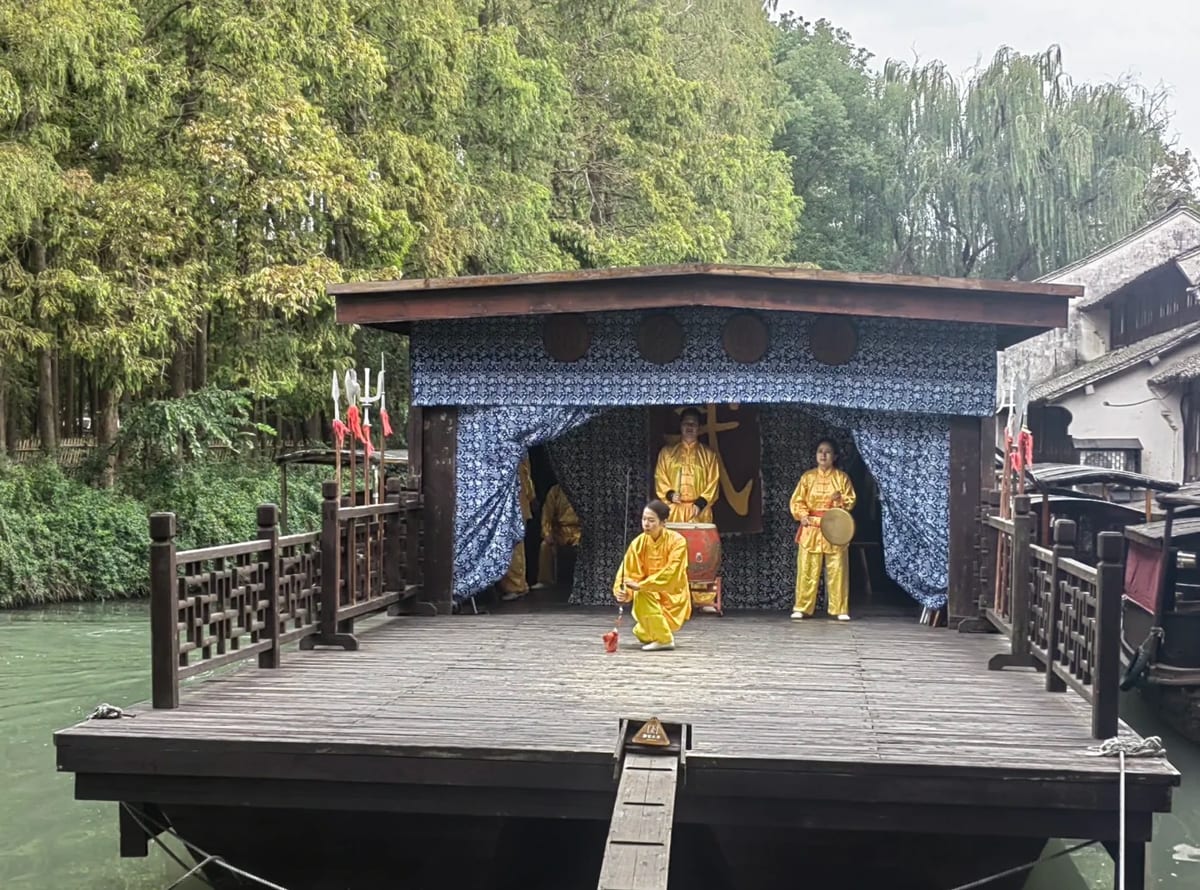
Times shift with the season and the weather, and the acts that happen on the water are the first to be cancelled — treat the above as the shape of the day rather than a timetable, and photograph the programme board at the gate when you go in. The one scheduling consequence worth acting on: Dongzha’s programme is finished by late afternoon, while Xizha’s best two — the open-air films and the night watchman — only happen after dark, which is another reason the combo ticket works better as a two-day split than a single day.
Eating in Wuzhen — and the thing everyone gets wrong
The received wisdom about Chinese water towns is that you will be fleeced at dinner. Inside Xizha that is simply not the case, and it is worth stating plainly because it is the clearest illustration of what this place is: catering inside the zone is centrally priced with the prices posted. A bowl of the town’s scholar’s mutton noodles (书生羊肉面) runs about ¥25–38, an ordinary local restaurant works out at ¥50–100 a head, and the one or two ambitious places are around ¥300. That is roughly what an unremarkable urban shopping street costs.
What to eat: the mutton noodles in autumn and winter, radish-shred pastries (萝卜丝饼) made in front of you, dingsheng cakes (定胜糕) at about ¥3 apiece, and the local braised soy duck. For taking home, the things actually made here are blue calico (蓝印花布), Wuzhen sanbai rice wine and gusao biscuits — bought inside the zone at posted prices.
What to avoid: the riverside “view” restaurants on the main lane (expensive, small portions, and you are paying for the window); loose dyed preserved plums sold from open trays; the famous-queue snacks that people who queued describe as ordinary; and — above all — any restaurant recommended by a driver at the gate.
Getting there — take the coach, not the train
This is one of the few corridors in eastern China where we would not put you on a high-speed train. Wuzhen has no station of its own; the nearest is Tongxiang, about 29 km away, so the train leaves you with a transfer that the direct coach removes entirely.
| From | How | Time | Cost |
|---|---|---|---|
| Hangzhou | ⭐ Direct coach — Hangzhou North bus station or Jiubao coach centre → Wuzhen bus station | ~1.5 h | ¥35–45 |
| Shanghai | ⭐ Direct coach — Shanghai South or Hongqiao West → Wuzhen; some services run to the Xizha gate itself | ~1.5–2 h | ¥55–60 |
| Tongxiang station → Wuzhen | Bus K281 / K282 to Wuzhen bus station, ~every 30 min, then a short hop to the gate | ~40 min | ¥2–5 |
| Tongxiang station → Xizha gate | Taxi — the sane choice for a late arrival, three or more people, or big bags | ~40–60 min | ~¥60–110 |
| Between the two zones | Taxi or local bus — Xizha and Dongzha are ~2 km apart with separate gates | ~10 min | Short hop |
- ⚠️ The K281/K282 buses stop running in the late afternoon — travellers report a last departure somewhere around 17:00–18:00. An evening train into Tongxiang means a taxi, so budget for it rather than discovering it at the kerb.
- Coaches are bookable through the operators’ own mini-programmes; where a service offers “Wuzhen Xizha Scenic Area” as the terminus rather than the bus station, take it.
- Avoid the cut-price “Wuzhen day tour” listings that turn up for a few tens of yuan — they are shopping trips built around a silk or wine works, with very little time in the town.
Planning the wider trip? See our Hangzhou city guide and things to do in Hangzhou.
Wuzhen vs Xitang vs Nanxun
The delta’s water towns get recommended interchangeably, as if the choice were only about travel time from Shanghai. They are not interchangeable: they differ in who runs them, what that does to the prices once you are inside, and how much of each is gated at all.
| Wuzhen 乌镇 | Xitang 西塘 | Nanxun 南浔 | |
|---|---|---|---|
| The character | Managed, immaculate, best-in-class night lighting; an arts identity (Mu Xin, the theatre festival) | Lived-in and loud — a kilometre-long covered riverside arcade, hanfu photography, a bar street | Quiet and under-visited; grand Chinese-Western merchant mansions |
| Entry | Ticketed, two zones | Ticketed | ⭐ The whole town free since 2023; only six houses charge |
| Residents | Almost none inside Xizha | Plenty — this is the point of it | Yes, and few tourists |
| Evening | The best in the region | Bars, music, crowds | Shops shut early |
| Reached from | Hangzhou or Shanghai, ~1.5 h | Mostly Shanghai | Its own HSR station — ~43 min from Shanghai Hongqiao |
Why the verdicts split. Chinese travellers frequently knock Wuzhen for feeling like a large resort rather than an old town — Xizha has almost no permanent residents, every shop is leased and managed by the scenic company, and the messy, improvised street life that makes a place feel alive has been engineered out of it. That criticism is accurate. It is also, for a first-time visitor from outside China, the reason the place works: the prices are posted and fixed, there are no touts inside the gate, the toilets are the industry benchmark, and nothing about the evening requires you to negotiate in Chinese. The same tidiness that reads as sterile to someone on their fourth water town reads as effortless to someone on their first.
The mirror image is Xitang. Its noise and clutter are exactly what its Chinese visitors go for — the bar street, the food stalls, the crowd — and that pleasure depends on being able to read the street, haggle a bit and know which stall is worth queuing at. Without those, the same evening is mostly just loud. So the honest recommendation is not “Wuzhen is better”; it is that Wuzhen is the safer first water town, and Xitang is the better second one. If what you actually want is quiet and old buildings rather than either, Nanxun beats both and costs nothing at all — it has been free to enter since 2023, and only its six merchant houses charge.
Practical for foreign visitors
- Use the staffed lane at the gate. The turnstiles read Chinese ID cards reliably and passports unreliably; the staffed lane takes a minute or two on a weekday.
- The scam layer is entirely outside the gate. Pedicabs and unlicensed cars at the entrance offer “the free old street where locals eat”, drive you to Nanzha, and hand you to shops selling polyester as silk and marked-up rice wine on commission. Inside the zone, prices are posted and there are no touts. Walk, or use the official taxi stand and the buses.
- Lodging registration. Xizha’s guesthouses and hotels are run by one operator and routinely register foreign guests at the front desk with a passport — it is written into their own English house rules. Small independent places outside the scenic area are more variable; if you book one, confirm before you pay that they can complete the registration for a foreign passport.
- Set up mobile payment before you arrive. Link an international card to Alipay or WeChat Pay — small shops, snack stalls and the boat windows are effectively cashless. See our Alipay guide.
- Costume photo shoots. Renting an outfit outside the gate runs about ¥60; studios inside low-ball the package and upsell headpieces, styling and on-water positions. The scenic area formally requires prior approval and a fee for professional shoots in non-everyday clothing, so an unbooked photographer may be stopped.
- Odd but real house rules: no chewing gum, no loudhailers, no wheeled trolleys other than luggage, strollers and wheelchairs, and no pets (there is a fostering desk at the West Gate visitor centre). The zone also provides no disposable tableware.
- Mosquitoes and timber walls. Repellent in summer, earplugs if you are sleeping inside and are a light sleeper.
Frequently asked questions
What is Wuzhen and where is it?
Wuzhen (乌镇) is a canal town on the Grand Canal in Tongxiang, Zhejiang province, between Hangzhou and Shanghai and rather closer to Hangzhou — about 1.5 hours by direct coach from Hangzhou, 1.5 to 2 hours from Shanghai. It is the most heavily restored and most tightly managed of the Yangtze-delta water towns, and the one with the strongest arts identity: it is the birthplace of the novelist Mao Dun, the home town of the painter and writer Mu Xin, the host of the annual Wuzhen Theatre Festival every October, and the permanent venue for China's World Internet Conference. Crucially it is not a single attraction: the town is divided into four quarters, of which two — Xizha (西栅, the West Scenic Zone) and Dongzha (东栅, the East Scenic Zone) — are separately gated and separately ticketed.
Dongzha or Xizha — which should I visit?
If you are only going once, go to Xizha. It is the big zone, it holds the canal-side night lighting, the boats, the museums and every bed inside the gate, and it stays open until 22:00. Dongzha is smaller and more domestic in feel — it is where the house-museums are, including Mao Dun's birthplace, the hundred-beds collection and the old dye works — but it closes in the late afternoon and has no evening at all. Xizha costs ¥150 and Dongzha ¥110; a combo covering both is ¥190 but is valid for one day only, so it commits you to doing both zones in a single day. Travellers who buy the combo on a tight schedule frequently report the same regret: two hours spent in Dongzha, then running out of daylight in Xizha, which is the half that rewards the evening.
How much are Wuzhen tickets, and can I leave and come back?
Xizha is ¥150 per person, Dongzha ¥110, and the east-plus-west combo ¥190 — the combo saves against buying both but is a same-day pass with one entry to each zone. The most important rule is the one nobody writes down: a Wuzhen ticket is valid for a single entry on the day you buy it. Walk back out through the turnstile and it is spent. There are two exceptions, both tied to sleeping inside Xizha: guests can obtain a temporary in-and-out pass, which allows unlimited re-entry for the length of the stay, and at check-in they can buy a two-day version of the combo — Xizha that evening, Dongzha the next morning. Note that the pass is a second step rather than an automatic benefit: the scenic area's own FAQ says guests still buy a ticket to enter the first time, then present a room card and ID to be issued the pass. Concessions are posted at ¥75 / ¥55 / ¥130 for students, ages 6–18 and 60–69; under-sixes and children under 1.2 m go free. Listings also sell an evening-only Xizha ticket at ¥80, but most people do not need it — a normal day ticket already covers the evening, since Xizha admits until 22:00. It is not sold by the scenic area itself.
Do I need to book Wuzhen tickets in advance, and can I use a passport?
On an ordinary day, no — the staffed ticket windows sell walk-up tickets and there is no capacity reservation to secure. That changes on public holidays (May Day, National Day, Spring Festival) and during the October theatre festival, when the scenic area switches to capped, real-name online booking and the windows may not sell walk-ups at all; for those dates, book several days out. On passports: the turnstiles are built around the Chinese ID card and read passports unreliably, so travellers consistently report using the staffed lane instead — one to two minutes on a weekday, but allow ten to twenty more at peak. This is not a Chinese-only operation, which is worth saying because most guides imply it is: Wuzhen runs an English-language site and an English booking line, and posts a fixed price for an official English-speaking guide.
Is it worth staying overnight inside Xizha?
For most visitors this is the single decision that makes or breaks a Wuzhen trip, and the answer is yes if the budget allows. Xizha admits day visitors from 09:00 and stops admitting at 22:00, so guests sleeping inside get two windows that nobody else can buy: the early morning, when the 07:00–09:00 market on the water is running and the lanes are empty, and the late evening after the gate closes. Staying inside also ends the single-entry problem — with your room card and ID you are issued a temporary in-and-out pass and can leave and return to Xizha as often as you like, though you still buy a ticket to enter the first time — and it comes with free luggage forwarding and free rides on the shuttle carts. The estate is run by one operator, which changes how you search for it: the guesthouses are a single branded product, Wuzhen Guest House, allocated to you by number out of 79 rather than picked by name, while the dozen or so hotels each have their own name and listing. On Trip.com, weekday lead-in rates run about ¥500–620 for the guesthouses, ¥610–790 for the named hotels and ¥850–1,500 at the top end, against ¥230–470 outside the gate. The classic mistake is booking a cheap room advertised as 'near Xizha' that turns out to be outside it — you then pay the ticket again every time you go in.
When do the lights come on in Wuzhen, and when is it least crowded?
Roughly 17:30–18:30 in summer and 17:00–17:30 in winter, tracking sunset; the lighting is switched off somewhere between 22:00 and 23:00 depending on the season and the day of the week, later on Fridays and Saturdays. The practical shape of an evening has three parts: the half hour around sunset, when the lanterns are lit and the sky is still deep blue, which is the photograph everyone comes for; roughly 18:30 to 20:00, which is the busiest and liveliest stretch; and after about 20:30, when the tour groups have gone and the canal reflections go still. If the evening is what you came for, be inside by about 16:00 rather than arriving at seven — you want the daytime houses and the sunset on the same ticket.
Wuzhen or Xitang — which water town should I pick?
They split cleanly, and the reason they split is worth knowing. Wuzhen — specifically Xizha — is the polished one: centrally managed, spotlessly maintained, fixed posted prices, no touts inside the gate, and the best night lighting in the region. Chinese travellers often criticise exactly that, calling it a large resort rather than an old town, because Xizha has almost no permanent residents and every shop is leased by the scenic company. Xitang is the opposite: a kilometre-long covered riverside arcade, narrow lanes, hanfu photography and a loud bar street, with real residents and real mess. If you can read the street and enjoy the noise, Xitang has more life; if you are visiting China for the first time, do not read Chinese and want the evening to simply work, the managed quality of Wuzhen is a feature rather than a compromise. There is a third option most foreign visitors never hear about: Nanxun, quieter and cheaper, free to enter since 2023 apart from six houses, and full of extraordinary Chinese-Western merchant mansions.
How do I get from Hangzhou or Shanghai to Wuzhen?
The direct coach is the sane choice from both cities, and this is one of the few corridors in China where we would not put you on the high-speed train. From Hangzhou, coaches run from Hangzhou North bus station and the Jiubao coach centre to Wuzhen bus station in about 1.5 hours for ¥35–45. From Shanghai, coaches from Shanghai South and Hongqiao West take 1.5–2 hours for ¥55–60, and some services terminate at the Xizha gate itself, which removes the last mile entirely. The train alternative is real but awkward: Shanghai Hongqiao to Tongxiang takes about 40 minutes, but Tongxiang's station is around 29 km from Wuzhen — the K281 and K282 buses cover it in about 40 minutes for a couple of yuan, but their last departure is in the late afternoon, and a taxi runs roughly ¥60–110. If you land at Tongxiang in the evening, budget for the taxi.
Sources
Checked July 2026 · Written from our own first-hand travel in China.