Key takeaways
- Nine gardens hold the UNESCO listing — a visitor realistically picks two or three, not all nine.
- See the Humble Administrator’s Garden (拙政园) first — largest, most representative, the one-to-see.
- Metro Line 6 → 拙政园苏博 (opened 2024) drops you 5 min from the Humble Admin + Lion Grove + Suzhou Museum cluster.
- Gardens are now real-name, online-only (no gate sales) — book on the 苏州园林旅游 account; 拙政园 books out ~3 days ahead on peak weekends. Prices ¥30–¥80/garden.
- Arrive at opening (07:30) — the first hour is the empty one; after 4 pm or a drizzly day is the calm backup.
What the Suzhou gardens are
The Classical Gardens of Suzhou (苏州园林) were inscribed on the UNESCO World Heritage List in 1997, with four more gardens added in 2000 — nine listed in total. They are recognised as the highest expression of Chinese garden art, a tradition that matured in Suzhou during the Ming (1368–1644) and Qing (1644–1912) dynasties.
These are not decorative parks. They were built by retired scholar-officials as private retreats — miniature landscapes designed to be read, like a scroll painting, rather than simply walked through. Every composition is deliberate: a view framed by a latticed window, a jagged Taihu-rock formation reflected in still water, a covered corridor that narrows and then opens onto a sudden courtyard. The practical reality is that you cannot see all nine in one trip without making them a blur — pick two or three and give them time. The things-to-do-in-Suzhou guide covers the wider itinerary; the Suzhou city guide has the neighbourhood overview.
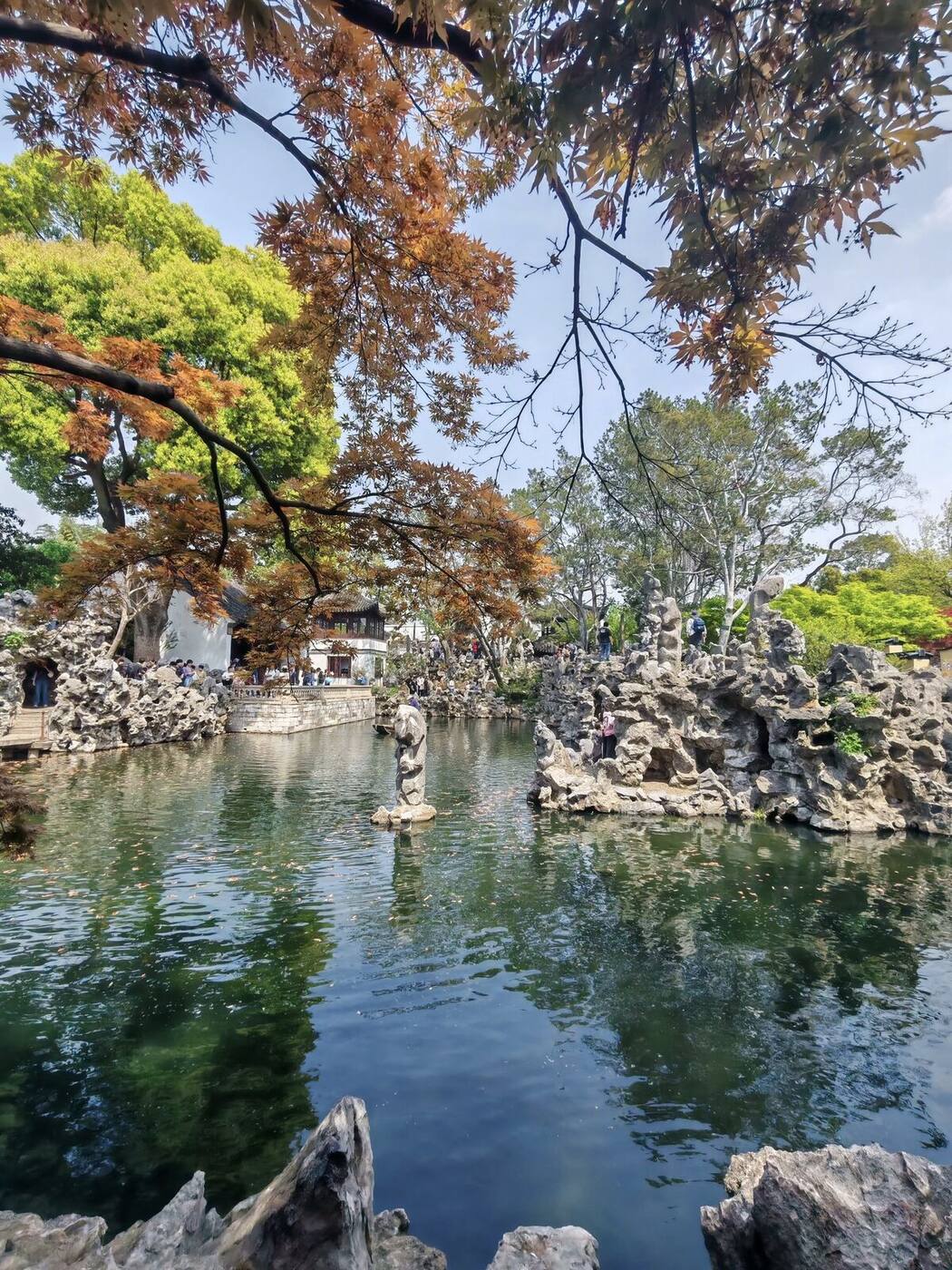
Which to pick — the four that matter
Of the nine listed gardens, four account for the overwhelming majority of foreign visits. Side by side:
| Garden | Size & vibe | Why visit | Ticket |
|---|---|---|---|
| Humble Administrator’s 拙政园 | ~5.2 ha — largest; broad open water gardens | THE classic visit — pavilions, covered galleries and a wisteria pergola (late April) around interconnected pools. Best for first-timers and photography, but the most crowded — go at opening. | ¥80 / ¥70 |
| Lingering Garden 留园 | ~2.3 ha — corridors & courtyards | Garden architecture at its finest: a twisting sequence of halls and corridors, and the Crown of Clouds Peak (冠云峰), a 6.5 m Taihu monolith — the finest garden rock in China. For lovers of spatial design; pairs with Tiger Hill and the West Garden Temple. | ¥55 / ¥45 |
| Lion Grove Garden 狮子林 | ~1.1 ha — rock maze | A labyrinth of Taihu-rock grottoes — caves, tunnels and bridges you genuinely get lost in. The only one that works as a physical puzzle; best for families and kids, though it’s busy and noisy. Adjacent to the Humble Administrator’s. | ¥40 / ¥30 |
| Master of the Nets 网师园 | ~0.5 ha — smallest, most refined | The most refined and quietest composition — small but never cramped. The connoisseur’s pick, and the one to see at night: its ¥120 evening “night garden” stages Kunqu and Pingtan under the pavilions. | ¥40 / ¥30 day ¥120 night |
If you only do one, make it the Humble Administrator’s Garden — it is the largest and the most representative of the whole style. Lion Grove is 588 m away on foot, so the two pair naturally in a single morning. Lingering Garden sits in the northwest near Tiger Hill (a separate half-day), and Master of the Nets is a small, refined stop in the south old town, ideal as a second-day or evening visit.
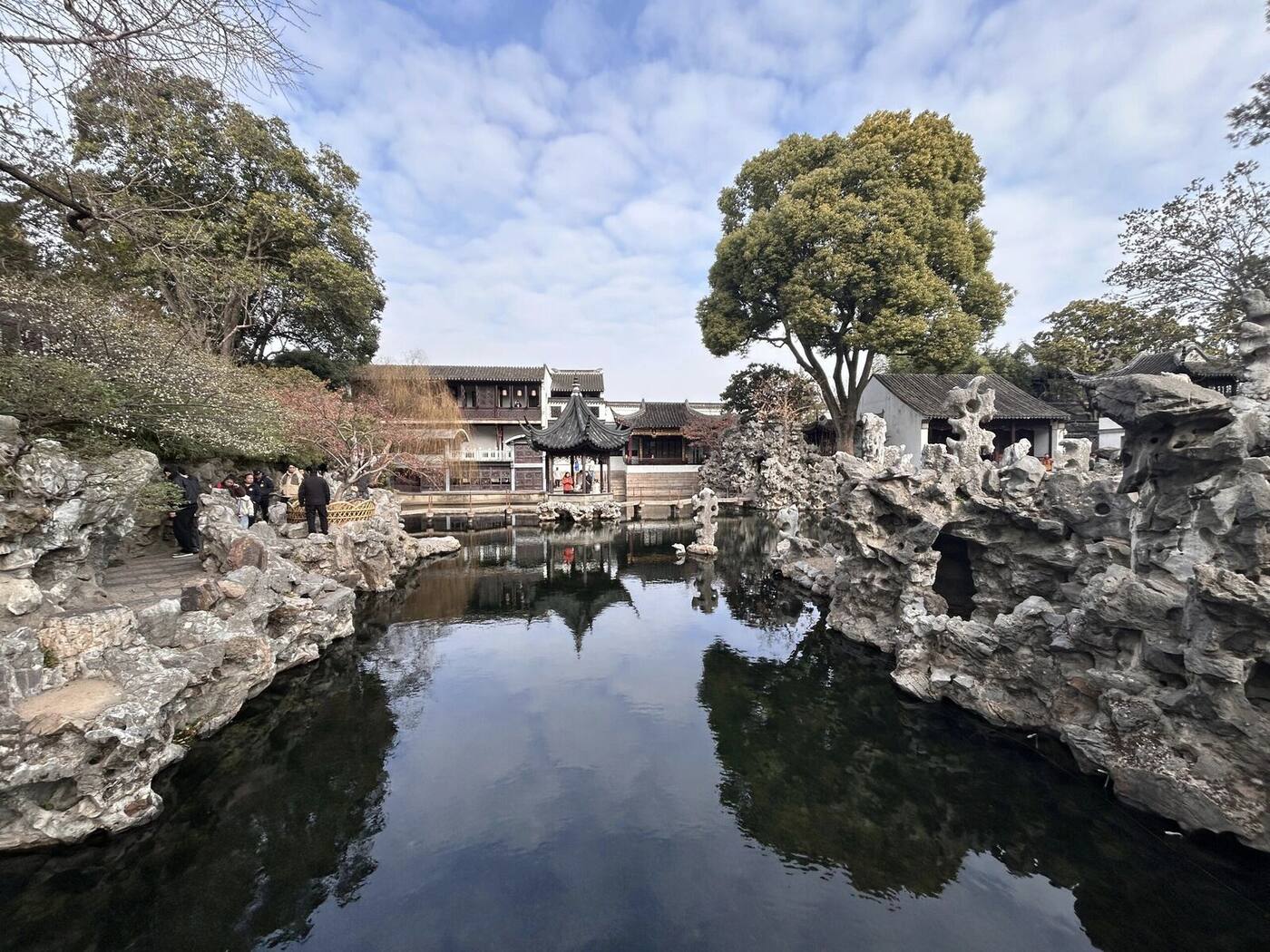
Tickets & booking
UNESCO listing does not make the gardens free — each is a separately ticketed, maintained site, and you buy a ticket per garden. Prices are set by the city and split into a high season (April, May, July–October) and a low season (January–March, June, November–December):
| Garden | Peak / off-peak | Notes |
|---|---|---|
| Humble Administrator’s 拙政园 | ¥80 / ¥70 | The one that sells out first — book several days ahead on peak weekends. |
| Lingering Garden 留园 | ¥55 / ¥45 | Lower visitor cap; also books out on peak dates. |
| Lion Grove Garden 狮子林 | ¥40 / ¥30 | Quicker visit, 45–60 min plus the grotto maze. |
| Master of the Nets 网师园 | ¥40 / ¥30 day | Plus a separate ¥120 evening “night garden” ticket (see below). |
| Suzhou Museum 苏州博物馆 | Free | I.M. Pei’s building — free but requires online pre-registration. |
⭐ Book ahead — this changed. The Suzhou gardens are now real-name, online-only: the on-site ticket windows no longer sell tickets, so turning up without a booking means a closed gate. Reserve on the official “苏州园林旅游” WeChat account (or the 苏州博物馆 mini-program if your day includes the museum) and scan your passport to enter. Same-day slots are usually fine on a quiet weekday, but the Humble Administrator’s Garden sells out about three days ahead on summer, May 1 and October 1 weekends — book early, or let a booking site like Trip.com handle the reservation in English. Student and senior discounts apply with valid ID; Spring Festival is half price.
The Master of the Nets night garden (网师夜花园). From April to October the smallest garden stages an evening tour — ¥120, batched entry from 6:25pm (open to 9:40pm Sun–Thu, 10:20pm Fri–Sat & holidays). A guide walks you through while six intangible-heritage sets play in the pavilions — Pingtan ballad-singing and Kunqu opera (the Peony Pavilion excerpt is the highlight). It’s the standout Suzhou night experience; book the same “苏州园林旅游” account, as the 6:25 and 7:00pm slots go fast in summer.
Getting there & the morning cluster
Suzhou Metro Line 6 opened in 2024 with a station named 拙政园苏博(Zhuōzhèngyuán-Sūbó) — literally “Humble Administrator’s Garden & Suzhou Museum.” It resolves the northeast cluster entirely: the Humble Administrator’s Garden, Lion Grove Garden and the Suzhou Museum all sit within a 5–10 minute walk, on the same 园林路 / 东北街 corridor. Suzhou Metro runs on Alipay and WeChat QR; fares ¥2–9.
| Garden | Metro | Note |
|---|---|---|
| Humble Admin + Lion Grove + Suzhou Museum | Line 6 — 拙政园苏博 | The northeast cluster; all three within 5–10 min on foot (拙政园 ↔ 狮子林 588 m; 拙政园 ↔ 苏博 346 m; 狮子林 ↔ 苏博 586 m). Combine in one morning. |
| Lingering Garden 留园 | Line 2 — 虎丘 area | Northwest old town near Tiger Hill; ~20–25 min taxi from the northeast cluster. Pair with Tiger Hill as a separate day. |
| Master of the Nets 网师园 | Line 6 — 望星桥苏大 | South old town, ~1 km / 12–15 min walk from the station; three Line 6 stops south of 拙政园苏博 (or ~15 min taxi). |
From Shanghai this is the classic day trip — ~23–28 min by HSR from Shanghai Hongqiao to Suzhou Railway Station, then Metro Line 2 + Line 6 (or a ~¥20, 10-min taxi) to the cluster. Full detail in the Shanghai-to-Suzhou guide. A practical sequence: reach 拙政园苏博 before opening → Humble Administrator’s Garden at 07:30 (~90 min) → walk 400 m south to Lion Grove (45–60 min) → 586 m west to the Suzhou Museum (opens 9:00 am). Out by noon.
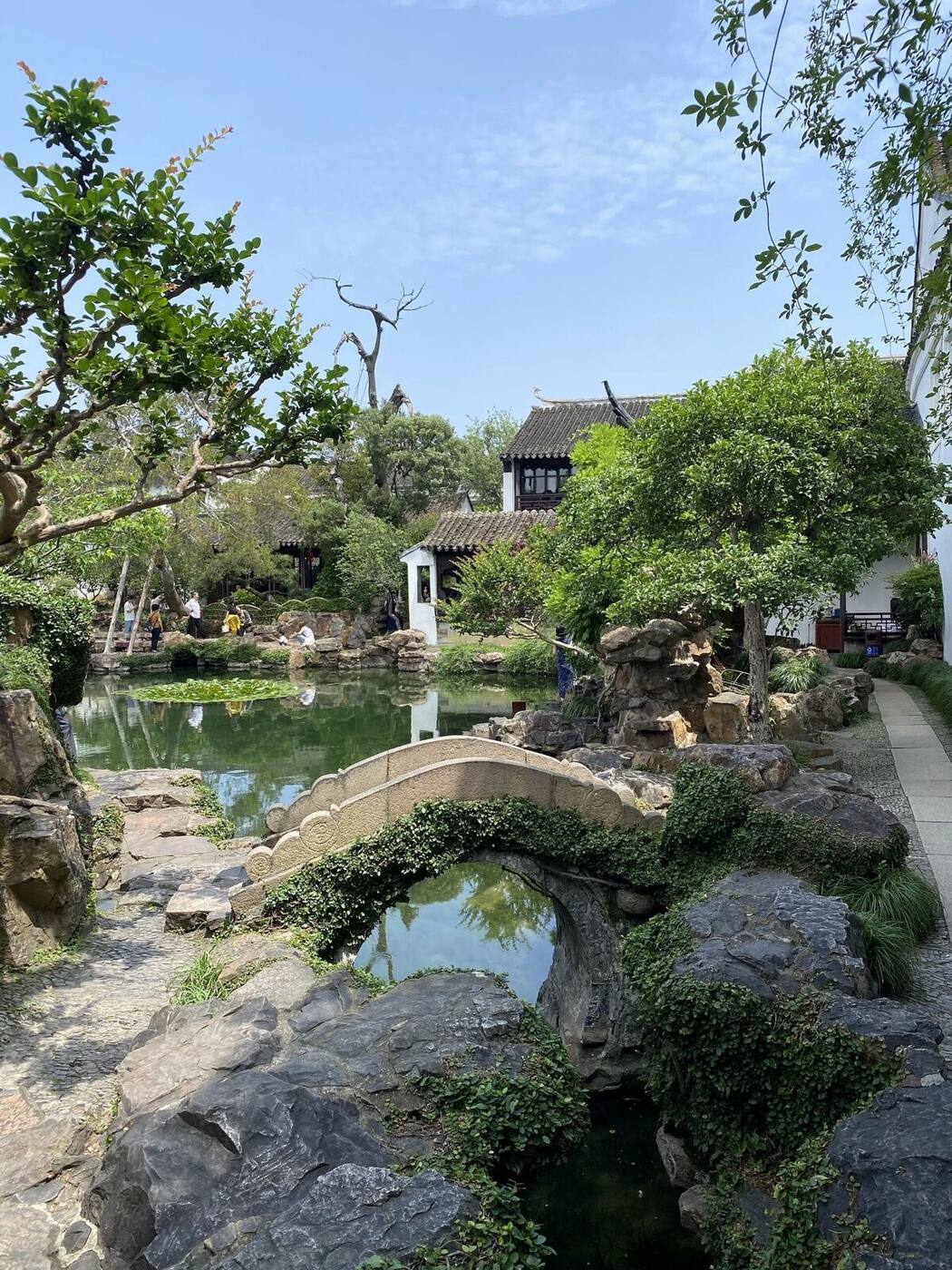
Best time & how long
Season. Spring (March to early May) and autumn (late September to November) are best — spring brings cherry blossom, wisteria (late April, the Humble Administrator’s pergola) and peonies; autumn delivers maple and ginkgo colour. Summer is hot and humid, but the lotus ponds peak in July–August (go early morning only). Winter is quiet and the stripped-back compositions can be beautiful under grey light.
Time of day. The Humble Administrator’s Garden opens at 07:30, and 7:30–8:30 is the golden hour — near-empty, the only time you get clean photos. Tour groups flood in after 8:30 and the 10 am–3 pm peak is shoulder-to-shoulder. If you can’t make the early start, the after-4 pm window is the backup: the coaches have gone, the light softens, and a drizzly day is quietest of all — misty water and rain on the tiles is exactly the Jiangnan mood the gardens were built for. Avoid the October 1–7 and May 1 blocks and Spring Festival (the big garden books out days ahead). The Master of the Nets night garden is the exception — a smaller, calmer crowd than the daytime peak.
How long. Allow a half-day (~3–4 hours) for the northeast cluster including the museum. A one-day visit can add Lingering Garden in the afternoon; two days lets you fold in Master of the Nets, Tiger Hill, Pingjiang Road and Hanshan Temple without rushing. See our best time to visit China guide for the broader picture.
Practical for foreigners
Hours, payment & access
- Hours: the Humble Administrator’s Garden runs 07:30–17:30 (last entry 17:00) in peak season, with shorter winter hours.
- Payment: Alipay and WeChat Pay are universal at gates, machines and shops; carry a little cash for small vendors. Foreign-card POS is hit-or-miss at counters.
- Suzhou Museum: free, but book online in advance — walk-ups are often turned away when the daily cap is full.
- Accessibility: paths are paved but uneven, with stepped corridors, narrow doorways and the Lion Grove grotto stairs; wheelchair access is partial.
- English: signage is bilingual at the major gardens; bring a translation app for menus and smaller sites.
Guides & avoiding touts
The gardens are designed to be “read,” and a little context transforms them. At each garden gate there’s an official guide desk: a shared-group human guide runs ¥100–200(split across a few people, so tens of yuan each), and some slots have a free guide (register and queue, ~15–20 per batch). The clip-on audio units (¥30–40) aren’t worth it — poor positioning and one earpiece in a noisy garden. Book a private English tour through a booking site if you want depth without the queue.
Refuse the touts. At Suzhou’s stations and around the gardens (Lindun Road especially), people push a “¥100 for four sights” day tour or “discount insider tickets” — these are shopping tours that haul you to a silk or freshwater-pearl “museum,” and the “discount tickets” are scalped and won’t scan, since the gardens are now real-name. Plan your own route and buy only on the official 苏州园林旅游 account.
How it fits a Suzhou & Jiangnan trip
Suzhou is the classic day trip from Shanghai (~25 min by HSR), and the gardens are the reason most visitors come. Stitch them with the rest of the old town — Pingjiang Road’s canal street, Tiger Hill, Hanshan Temple, the silk story — or extend to the Tongli water town (~18 km southeast), which holds the ninth listed garden, the Retreat & Reflection Garden (退思园). The Suzhou city guide has the full plan.
Book Suzhou garden tickets & a guided tourNASDAQ: TCOM
Trip.com lists garden tickets, half- and full-day guided Suzhou tours, and day trips from Shanghai with a bilingual guide — booked in English on a foreign card.
Where to stay for the gardens
The gardens are spread across the central old town, so base yourself there. The most atmospheric choice is the Pingjiang Road historic district (平江路) — a canal street of courtyard guesthouses 10–15 minutes’ walk from the northeast cluster. The Guanqian Street area (观前街) is the commercial centre with more choice at every price point, one Metro Line 6 stop away. The full area breakdown is in the where-to-stay-in-Suzhou guide.
Frequently asked questions
Which Suzhou classical garden should I visit first?
Visit the Humble Administrator's Garden (拙政园) first if you only have time for one. It is the largest (~5.2 hectares) and most representative of the Suzhou style — broad water gardens, winding covered galleries, pavilions reflected in still pools. It is also the most crowded, so arrive right at opening (07:30) to get the pavilions and rock-and-water compositions to yourself. Lion Grove Garden is 588 m away on foot, so pairing the two in one morning is very efficient. The Suzhou Museum — I.M. Pei's building, free entry — is 346 m, which makes it the NEAREST of the three rather than the farthest, and the natural third stop.
Do I need to book garden tickets in advance?
Yes — this changed. The Suzhou gardens are now real-name and online-only: the on-site ticket windows no longer sell tickets, so arriving without a booking means a closed gate. Reserve on the official '苏州园林旅游' WeChat account (or the 苏州博物馆 mini-program if your day includes the museum) and scan your passport to enter. On a quiet weekday a same-day slot is usually fine, but the Humble Administrator's Garden sells out about three days ahead on summer, May 1 and October 1 weekends; Lingering Garden and Lion Grove are easier but still worth booking 2-3 days out in peak season. If you'd rather not use the Chinese account, a booking site such as Trip.com sells the tickets in English on a foreign card. Ignore anyone offering 'discount' or 'insider' tickets — scalped tickets won't scan on the real-name system.
How much do the Suzhou garden tickets cost?
2026 city-set prices, split high season (April, May, July-October) / low season (January-March, June, November-December): Humble Administrator's Garden ¥80 / ¥70; Lingering Garden ¥55 / ¥45; Lion Grove Garden ¥40 / ¥30; Master of the Nets Garden ¥40 / ¥30 daytime, plus a separate ¥120 evening 'night garden' ticket (Kunqu and Pingtan performances, April-October). Spring Festival is half price. UNESCO listing does not make the gardens free — they are maintained ticketed sites. Student and senior discounts apply with valid ID. The Suzhou Museum next door is free but requires prior online registration.
What is a Taihu rock (太湖石)?
Taihu rocks (太湖石, tài hú shí) are the distinctive pocked limestone rocks that define Suzhou garden aesthetics — and Chinese garden design more broadly. They come from the bed and shores of Lake Taihu (太湖), west of Suzhou, where millennia of wave erosion have hollowed them into irregular forms with holes, wrinkles and cavities. In classical garden theory, the ideal Taihu rock should be 'thin, wrinkled, porous and penetrating' (瘦、皱、漏、透). Lion Grove Garden is named for rocks said to resemble crouching lions; the Lingering Garden's Crown of Clouds Peak is a single 6.5 m Taihu monolith considered the finest garden rock in China.
How do I get from Shanghai to the Suzhou gardens?
Take a high-speed train from Shanghai Hongqiao or Shanghai Railway Station to Suzhou Railway Station (苏州站) — journey is about 23-28 minutes, multiple departures per hour, tickets from ¥35-50 second class. From Suzhou Railway Station, Metro Line 2 runs to Guanqian Street (观前街) in 3 stops (~8 min), and from there it is a short taxi (~5 min, ~¥15) or a 20-minute walk to the garden cluster (Humble Administrator's Garden, Lion Grove, Suzhou Museum). See the full route detail in the Shanghai-to-Suzhou guide.
How long do I need to visit the Suzhou gardens?
Allow half a day for the northeast cluster (Humble Administrator's Garden + Lion Grove + Suzhou Museum) — that is roughly 3-4 hours of walking at a relaxed pace, plus time in the museum. Add a separate half-day for Lingering Garden if you are pairing it with Tiger Hill, which is nearby on Metro Line 2. Master of the Nets Garden is small (~30-45 min) and best done in the south old town on a second day or evening. A one-day Suzhou visit can hit the northeast cluster in the morning and Lingering Garden in the afternoon; two days lets you include Master of the Nets, Tiger Hill, Pingjiang Road and Hanshan Temple without rushing.
Is there a Metro Line 6 stop at the gardens?
Yes — Suzhou Metro Line 6, which opened in 2024, has a station called 拙政园苏博 (Zhuozhengyuan-Subo), named after the Humble Administrator's Garden (拙政园) and the Suzhou Museum (苏博). This is the single most convenient public-transport approach to the northeast garden cluster: the Humble Administrator's Garden entrance, Lion Grove Garden, and the Suzhou Museum are all within a 5-10 minute walk of that station. From Suzhou Railway Station, take Metro Line 2 to Guanqian Street then transfer to Line 6 one stop, or take a taxi directly (~10 min, ~¥20).
When is the best time to visit the Suzhou gardens?
Spring (March to early May) and autumn (late September to November) are the best months. In spring the gardens have cherry blossom, wisteria and peonies, and the light is soft; in autumn the maple and ginkgo colour comes in. Summer (June to August) is hot and humid but the lotus ponds in the Humble Administrator's Garden peak then — go early morning. Winter is quiet and the stripped-back compositions can be beautiful under grey skies. Avoid the October 1-7 Golden Week, the May 1-5 Labour Day and the Spring Festival — these are the most crowded periods in the year. Early morning on any day, right at opening, is always better than midday.
Sources
Checked August 2026 · Written from our own first-hand travel in China.