Airport guide · Zhangjiajie & Wulingyuan
Zhangjiajie Hehua Airport (DYG) 2026: everything is close except the park
One terminal, a cable car thirteen minutes away, and more flights to Korea than most provincial capitals. The transfer that actually costs you is the one to Wulingyuan.
China for Travelers EditorialUpdated Save this — opening times and closures changeChecked Aug 2026
- Terminal
- T2 only
- no other passenger building
- Into the city
- ~11 min
- 5.0 km by road
- To Wulingyuan
- ~39 min
- 33.8 km, no direct bus
- Airport coach
- ¥10
- inbound only
Sort your ride out before you leave arrivals. The coach into town only runs one way, and nothing here connects to the national park. Whatever you arrange on landing, you will be arranging again to get back.
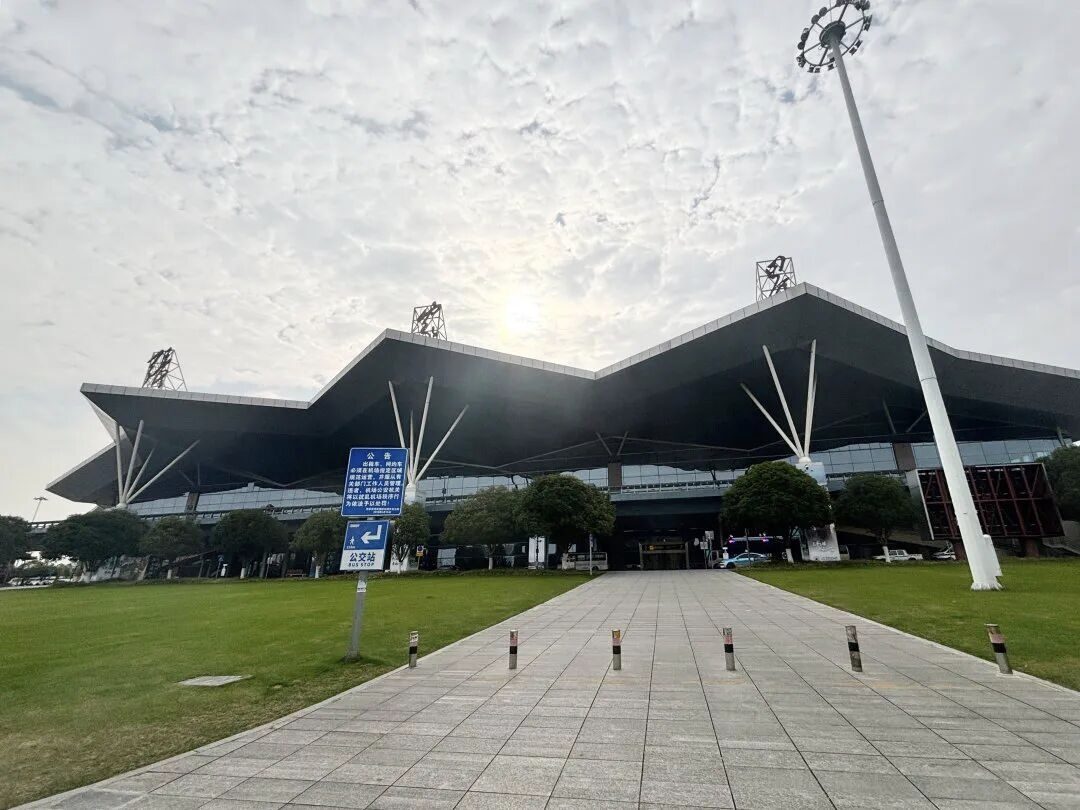
Getting out of the airport
Start with the geography, because it decides everything else and almost no English write-up states it plainly. Measured by road from the terminal:
| From the terminal | Distance | Drive | What is there |
|---|---|---|---|
| Central Zhangjiajie | 5.0 km | ~11 min | hotels, restaurants, the bus station |
| Tianmen Mountain cable car | 4.9 km | ~13 min | the world's longest passenger cableway, straight from the city |
| Zhangjiajie Station | 5.4 km | ~13 min | the older station — direct conventional trains via Changde |
| Zhangjiajie West | 9.6 km | ~17 min | the high-speed station — Changsha, Chongqing, Guangzhou, Hong Kong |
| Wulingyuan | 33.8 km | ~39 min | the national park gateway — the one thing that is genuinely far |
Amap routing, measured 3 August 2026. Read the table once and the shape of the trip is obvious: this airport is practically in town, and the national park is not.
The coach — cheap, reliable, and only goes one way
It boards outside the domestic arrivals doors and leaves when it fills rather than to a timetable, so it meets flights instead of missing them. ⚠️ It runs one way only — there is no scheduled coach back out to the airport, which matters far more when you leave than when you arrive.
Where it actually drops you is worth pinning down. Sources name the terminus inconsistently — traveller reports say the buses and the signage read 民航大酒店, older write-ups say 机场大酒店, and Chinese map apps carry neither as a point of interest. What is consistent is the location: the Huilong Road and Renmin Road junction, in the middle of the city and about 2 km short of the Tianmen Mountain cable car.
The city bus, the taxi, and which to take
For most arrivals the answer is the taxi, and unusually the reason is not comfort but arithmetic. Insist on the meter. This is a short enough run that a negotiated flat price is always worse than the metered one. At ~¥20 on the meter by day, ~¥30 at night for ~11 min for the 5.0 km into the centre; ~13 min to the cable car (Amap, 2026-08-03), splitting it two ways costs less than the coach.
The genuinely cheap option is city bus route 4: Zhangjiajie city buses are a flat ¥2 a ride all year, and route 4 calls at 机场航站楼 — a stop about 120 m from the terminal doors. It is a loop, so check which direction you are boarding. Take it if you are travelling light and unhurried; skip it if you have a case and a hotel to find.
⚠️ Ignore anyone who approaches you inside the hall. Touting is the complaint travellers make most often about this airport, and the offer is always a flat price. On a 5 km run the meter wins every time.
To Wulingyuan and the national park
This is the transfer that costs real money, and the one the airport does nothing to help with. There is no direct public bus. The alternative is a taxi or the coach 5.5 km to Zhangjiajie Central Bus Station and a Wulingyuan service from there — ¥13-15, and 50 to 90 minutes depending on how it runs.
Reckon on ~¥100-150; shared cars work out around ¥20-30 a head for ~39 min for 33.8 km (Amap, 2026-08-03). If there are two or three of you, that is the whole decision — the bus-station route saves perhaps ¥60 between you and costs an hour and a change with luggage.
What you can actually do on your arrival day
Because the cable car is thirteen minutes from the terminal, Zhangjiajie is one of the few Chinese destinations where landing time changes the itinerary rather than just the bedtime. Travellers split it cleanly in two.
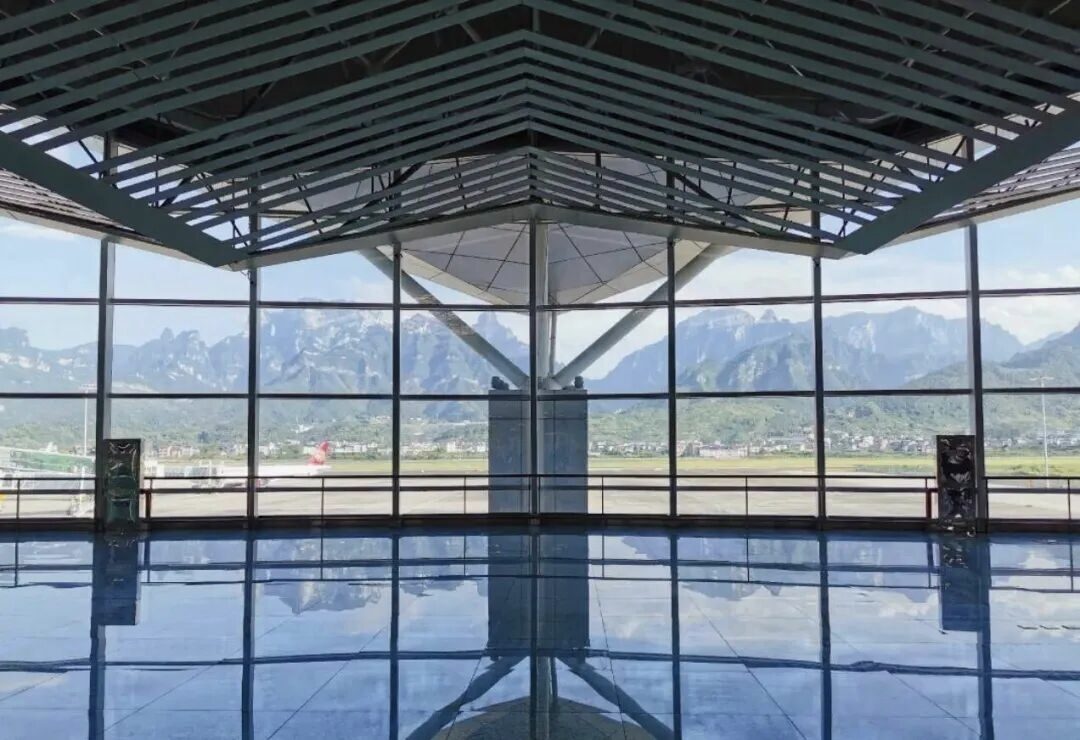
Land in the morning → Tianmen Mountain that afternoon
Head into the city, drop your bags near the cable-car station and go up. Tianmen Mountain sits directly above the city rather than out in the park, which is why it fits into half a day at all. Allow four to five hours on the mountain itself.
Land in the afternoon → go straight to Wulingyuan and start tomorrow
Sleep by the park gate and enter first thing. Do not try to start the national park on arrival afternoon: its internal shuttle buses stop around 19:00, so you would be buying a ticket for a couple of hours and then walking out.
Book Tianmen Mountain before you fly, not on landing. Entry is timed and sold in advance, so the plan above only works if the ticket already exists. Our Tianmen Mountain guide covers the booking window, the two cable-car products and which route up suits you.
Where you sleep follows directly from which of those two days you are having — the city and the cable car for one, the park gate for the other. Our where to stay in Zhangjiajie comparison works through it properly.
Where DYG actually flies — and why that surprises people
The standing English description of this airport is that it is small, mostly domestic, and carries a thin scattering of seasonal charters. That has stopped being true. The 2026 summer-autumn season, which began on 29 March, runs 39 routes to 41 cities and opened at 464 flights a week — up 15.4% on the year before.
The international half is the part worth knowing about. Korea alone accounts for more than 80 weekly round trips across four cities — Seoul, Busan, Daegu and Cheongju — with roughly two flights a day to Incheon and Busan. Beyond that the map covers Bangkok, Singapore, Penang, Hanoi, Ho Chi Minh City and Hong Kong. Travellers put the weekly international total above a hundred round trips and note, correctly, that this is more international service than several provincial-capital airports manage.
You will see the consequence before you see a timetable. Korean demand has reshaped the destination, not just the flight schedule: travellers report Chinese, English and Korean signage at hotels and inside the scenic areas, and some hotels taking Korean won across the counter. If you have wondered why an obscure Hunan mountain range has such polished trilingual signposting, this is why.
Airline schedules turn over twice a year, so treat any route list — including this one — as a snapshot rather than a promise, and check your own city against live schedules before planning around a direct flight.
Fly into DYG, or into Changsha and take the train?
The usual answer — go via Changsha, it is cheaper — is right for some readers and actively wrong for others. What decides it is which continent you are starting from.
Coming from Europe, North America, the Middle East or Australia → probably Changsha
Nothing flies to either airport from your part of the world, so you are connecting somewhere in any case and the only question is where. Changsha Huanghua takes far more inbound long-haul traffic than Hehua does, which usually means more choice of departure and a lower total fare, at the cost of a high-speed train at the end.
Coming from Korea, Southeast Asia, Hong Kong or Taiwan → almost certainly DYG
There is a good chance your city has a direct flight, and routing through Changsha would add a train ride to a journey that did not need one. This is the case the English-language advice consistently gets backwards, because it was written for a network that no longer exists.
If you do go via Changsha, the station you leave from matters more than the fare you booked. Trains to Zhangjiajie West run from two different Changsha stations by two different routes — one direct to the north-west, one the long way round to the south-west — and the difference is about an hour and roughly double the ticket price. The airport link lands you at the slower, dearer one. Our Changsha to Zhangjiajie guide has the per-station times, fares and frequencies.
One thing that does not separate them: the transit entitlement. Both airports are 240-hour visa-free transit ports on identical terms, so routing via Changsha costs you nothing there.
Zhangjiajie is a 240-hour visa-free transit port
Small airports are usually excluded from this, which is why nobody thinks to check — and why it is worth stating plainly here.
The designation dates from 17 December 2024, and it belongs to this airport rather than being borrowed from Changsha. Passengers who qualify may travel anywhere in Hunan province during the window — which covers Zhangjiajie, Wulingyuan, Fenghuang and Changsha. ⚠️ The route only applies to passports that need a visa in the first place; many nationalities now enter visa-free for 30 days and need none of it.
Practically, it means a trip built around Zhangjiajie alone can work on the transit route: land here, spend the window in Hunan, leave from here or from Changsha. Fenghuang and the Furong ancient town are both inside the province, so the classic western-Hunan loop fits without touching a visa application. Check your passport against the transit rules before you build a trip on it.
Connecting to a train
Zhangjiajie has two railway stations and, unusually, this airport is close to both. Which one you want is decided by your train, not by distance. Zhangjiajie West is the high-speed station on the Zhangjiajie–Jishou–Huaihua line and handles the Changsha South, Chongqing and Guangzhou services; Zhangjiajie Station is the older station and takes the direct conventional trains via Changde.
Taxi — both of Zhangjiajie's stations are closer to this airport than most cities' single station is to theirs — ~17 min to Zhangjiajie West (9.6 km); ~13 min to Zhangjiajie Station (5.4 km), Amap 2026-08-03. There is no airport rail link and no metro; Zhangjiajie is a small prefecture city and everything here moves by road.
Our Zhangjiajie railway stations guide covers both in detail, including which services use which and how to get from either to Wulingyuan.
The terminal, and how early to arrive
the only passenger terminal — every flight, domestic and internationalOpened 30 September 2015; the international and Hong Kong / Macau / Taiwan hall followed on 22 March 2016. Bookings and signage say "T2", which reads like a warning that there is a T1 to avoid. There is not: no other passenger building is in use, so T2 is simply the terminal. Amap carries the domestic and the international/HK-Macau-Taiwan arrival and departure halls as separate points inside the one building.
The number that costs people flights: Domestic check-in and bag drop close 40 minutes before scheduled departure. International departures need far longer — customs, border control and quarantine all sit in front of you, and three hours is the figure locals use.
Add the transfer to whatever figure you settle on. Coming in from Wulingyuan that is 39 minutes of road before you reach the door, with no coach to fall back on if the car does not show — which is a good argument for booking the ride the night before rather than hoping on the morning.
If you are stuck here for a few hours
Under 4 hours
Stay in the terminal or take the 11-minute ride into the city for a meal. Nothing worth seeing here can be done in four hours — Tianmen Mountain alone wants half a day.
4-8 hours
Not enough for Tianmen Mountain, despite the cable car being 13 minutes away — the mountain itself takes four to five hours and tickets are timed and sold in advance. Central Zhangjiajie and a proper Hunan lunch is the realistic version.
Overnight
Sleep in the city rather than the terminal. The nearest hotel is about a kilometre from the doors and there is nothing to gain from staying airside at an airport this small.
Sleeping here, SIM cards and left luggage
Sleeping
Nothing airside — no sleep pods, no capsule hotel, no terminal hotel. The building is small and closes down around the last flight.
Two useful ones, both verified on the map. The Hilton Garden Inn Zhangjiajie Tianmen Mountain is at 32 Airport Road, about a kilometre from the terminal, and runs free airport and scenic-area shuttles; travellers single out the soundproofing and the Tianmen Mountain views, and it takes a lot of Korean guests. The JI Hotel (全季) by the Tianmen Mountain cable-car station is roughly 4 km out and puts you next to the cable car rather than next to the runway — usually the better trade.
Hotels at Zhangjiajie airport for a dawn departure — remember there is no coach out
Connectivity
Travellers describe a service desk for overseas visitors in the terminal that sells SIM cards and changes money, which is more than most airports this size offer — but its hours are not something we could confirm, and an arrival at 23:00 is not the moment to find out. Arrange data before you fly.
The setup that works — an eSIM for data plus your home SIM kept on roaming so Chinese apps can text you a passcode — is in our connectivity guide. You will want a ride-hail app live before you walk out of arrivals here, because the alternative is negotiating with the people holding signs.
Left luggage
There is a left-luggage point, and travellers report it on the departures side to the right of the hall, at roughly ¥35 a day for a large item. If your plan is the morning-arrival Tianmen Mountain one, the more useful locker is not at the airport at all: the cable-car station has its own, at about ¥5 for a normal bag and ¥10 for a large one, collected the same day.
Paying for things
QR payment is universal inside the terminal and in the taxis. A foreign Visa or Mastercard linked to Alipay covers all of it, and DiDi works in Zhangjiajie through the app or the mini-programme inside Alipay. Set both up before you fly — five minutes at home, a bad twenty minutes in an arrivals hall.
Frequently asked questions
How far is Zhangjiajie Hehua Airport from the city, and from the Avatar mountains?
The airport is 5.0 km from central Zhangjiajie — about 11 minutes by road. What surprises people is how close everything else is too: the Tianmen Mountain cable car is 4.9 km away, Zhangjiajie Station is 5.4 km and Zhangjiajie West high-speed station is 9.6 km, so all of them sit inside a 17-minute drive. The exception is the one most visitors are actually heading for. Wulingyuan, the gateway town for the national park and the sandstone pillars used in Avatar, is 33.8 km and about 39 minutes away, and there is no direct public bus.
Does Zhangjiajie Airport have international flights?
Far more than an airport this size would suggest, and considerably more than most English write-ups claim. The 2026 summer-autumn season runs 39 routes to 41 cities. On the international side that means four Korean cities — Seoul, Busan, Daegu and Cheongju, with roughly two flights a day to Incheon and Busan and over 80 weekly round trips to Korea in total — plus Bangkok, Singapore, Penang, Hanoi, Ho Chi Minh City and Hong Kong. Travellers report the airport carrying more than 100 international round trips a week, which is more international service than several provincial-capital airports manage.
Should I fly into Zhangjiajie (DYG), or into Changsha and take the train?
It depends which continent you start from, and the usual advice only answers half the question. Coming from Europe, North America, the Middle East or Australia there is no direct flight to either airport, so you are connecting regardless — and Changsha Huanghua has far more inbound long-haul options, which usually makes it cheaper. Coming from Korea, Southeast Asia, Hong Kong or Taiwan, DYG very often has a direct flight and connecting through Changsha simply adds a train ride to a journey that did not need one. If you do go via Changsha, note that which Changsha station your train leaves from changes the journey by about an hour and roughly doubles the fare.
Can I use the 240-hour visa-free transit at Zhangjiajie airport?
Yes — DYG has been a 240-hour visa-free transit port in its own right since 17 December 2024, which is unusual for an airport of this size and is genuinely useful if Zhangjiajie is your first stop in China. The permitted area is Hunan province, which covers Zhangjiajie, Wulingyuan, Fenghuang and Changsha. Changsha Huanghua is a port on the same terms, so routing in via Changsha keeps the entitlement. The important limit: the transit route only applies to passports that need a visa in the first place, and many nationalities now enter China visa-free for 30 days and do not need any of it.
Is there an airport bus from Zhangjiajie Hehua Airport, and does it come back?
There is a ¥10 airport coach into the city, and no, it does not come back — this is the detail that catches people out. It boards outside the domestic arrivals doors, leaves when it fills rather than to a timetable, and takes 20 to 30 minutes to a city-centre stop near the Huilong Road and Renmin Road junction, about 2 km from the Tianmen Mountain cable car. Because it runs on arrivals it covers a late landing well. In the other direction there is no scheduled coach at all, so a morning flight out means a taxi arranged the night before or a hotel that runs its own shuttle.
How do I get from the airport to Wulingyuan and the national park?
By road, and you will be paying for it. Wulingyuan is 33.8 km and about 39 minutes from the terminal, with no direct public bus. A taxi or chartered car runs roughly ¥100–150, and shared cars work out around ¥20–30 a head. The cheaper alternative is to go 5.5 km into Zhangjiajie Central Bus Station and take a Wulingyuan service from there for ¥13–15, which takes 50 to 90 minutes depending on how it runs — worth it if you were heading into the city anyway, rarely worth it otherwise.
Can I go straight to Tianmen Mountain or the national park on the day I land?
Tianmen Mountain yes, the national park no — and the reason is a hard cut-off rather than a matter of energy. The cable car is 13 minutes from the terminal, so travellers who land in the morning routinely check in near the cable-car station and spend the afternoon on the mountain. If you land in the afternoon, go straight to Wulingyuan and sleep by the park gate instead: the national park's internal shuttle buses stop running around 19:00, so a late-afternoon start inside the park does not work. Tianmen Mountain sells timed, advance tickets, so book before you fly rather than on landing.
How early should I get to DYG for my flight?
Check-in and bag drop close 40 minutes before scheduled departure on domestic flights, which is the number that actually matters and the one most guides omit. International departures need much longer — customs, border control and quarantine all sit in front of you, and three hours is what locals allow. Build in the transfer as well: if you are coming from Wulingyuan that is 39 minutes of road before you even reach the terminal, and there is no coach to fall back on.
What is the IATA code for Zhangjiajie Airport, and why is it DYG?
DYG, from Dayong — the city's name until it was renamed Zhangjiajie in 1994. The full name is Zhangjiajie Hehua International Airport (张家界荷花国际机场). Searching either 'DYG' or 'Zhangjiajie' will find it; 'Dayong Airport' is the historical name that still shows up on some booking platforms. You will also see 'T2' on bookings and signage, which reads like a warning that there is a T1 to avoid — there is not, and T2 is simply the terminal.
Related Zhangjiajie guides
- Zhangjiajie National Forest Park — gates, routes, lifts and the ticket maths, once you get there.
- Tianmen Mountain — the mountain thirteen minutes from this terminal.
- Where to stay in Zhangjiajie — city, park gate or cable car, compared.
- Zhangjiajie railway stations — West and the old station, and which trains use which.
- Zhangjiajie itineraries — one to six days, built around the transfers on this page.
- Zhangjiajie city guide — everything we publish on the region.
Sources
Checked August 2026 · Written from our own first-hand travel in China.