Key takeaways
- China’s first Buddhist temple, founded 68 CE under Han Emperor Mingdi — where Buddhism formally entered China from the Silk Road.
- Admission ¥35 (half ¥17.5; under 1.4 m free); now real-name reservation via the “洛阳白马寺” WeChat account. Peak hours 7:40–18:40, off-season 8:00–17:30.
- Don’t miss the International Zone (Thai / Burmese / Indian halls), the 清凉台 where the first sutras were translated, and the 齐云塔 echo — all on one ticket.
- Incense is free inside — ignore the high-price touts, and refuse anyone offering fortune-telling or a fake ¥40 “guide” tent (the real desk is ¥50/group, inside).
- About 13 km east of Luoyang; Bus 56 (~45–60 min, ¥2) or DiDi (~25 min). Pair with Longmen the same day via the 神都游 No.7 shuttle (¥10).
What it is — China's first Buddhist temple
White Horse Temple (白马寺, Bái Mǎ Sì) occupies a dateable moment in Chinese history: the year 68 CE, the reign of Han Emperor Ming (汉明帝, Mingdi), when Buddhism formally entered China as an institutionally-recognised religion. For almost two millennia the site has been treated as the birthplace of Chinese Buddhism — “China’s first ancient temple” (中国第一古刹). Luoyang was the eastern capital of the Han dynasty and the eastern terminus of the Silk Road — the city where Central Asian ideas and religions first reached the Chinese interior.
The founding legend: Mingdi dreamed of a golden figure radiating light, flying from the west. His ministers read it as the Buddha. The emperor sent envoys along the Silk Road; in the Kushan Empire (modern northern India / Afghanistan) they met two Indian monks — Kasyapa Matanga (摄摩腾) and Dharmaratna (竺法兰). The monks returned to Luoyang carrying the Sutra in Forty-two Sections and Buddha-images on two white horses. Mingdi built a temple for them outside the western gate, named in honour of the horses; the two monks lived here until their deaths and their tombs remain on the grounds. The current buildings are largely Ming and Qing restorations, but the site has been in continuous religious use since 68 CE.
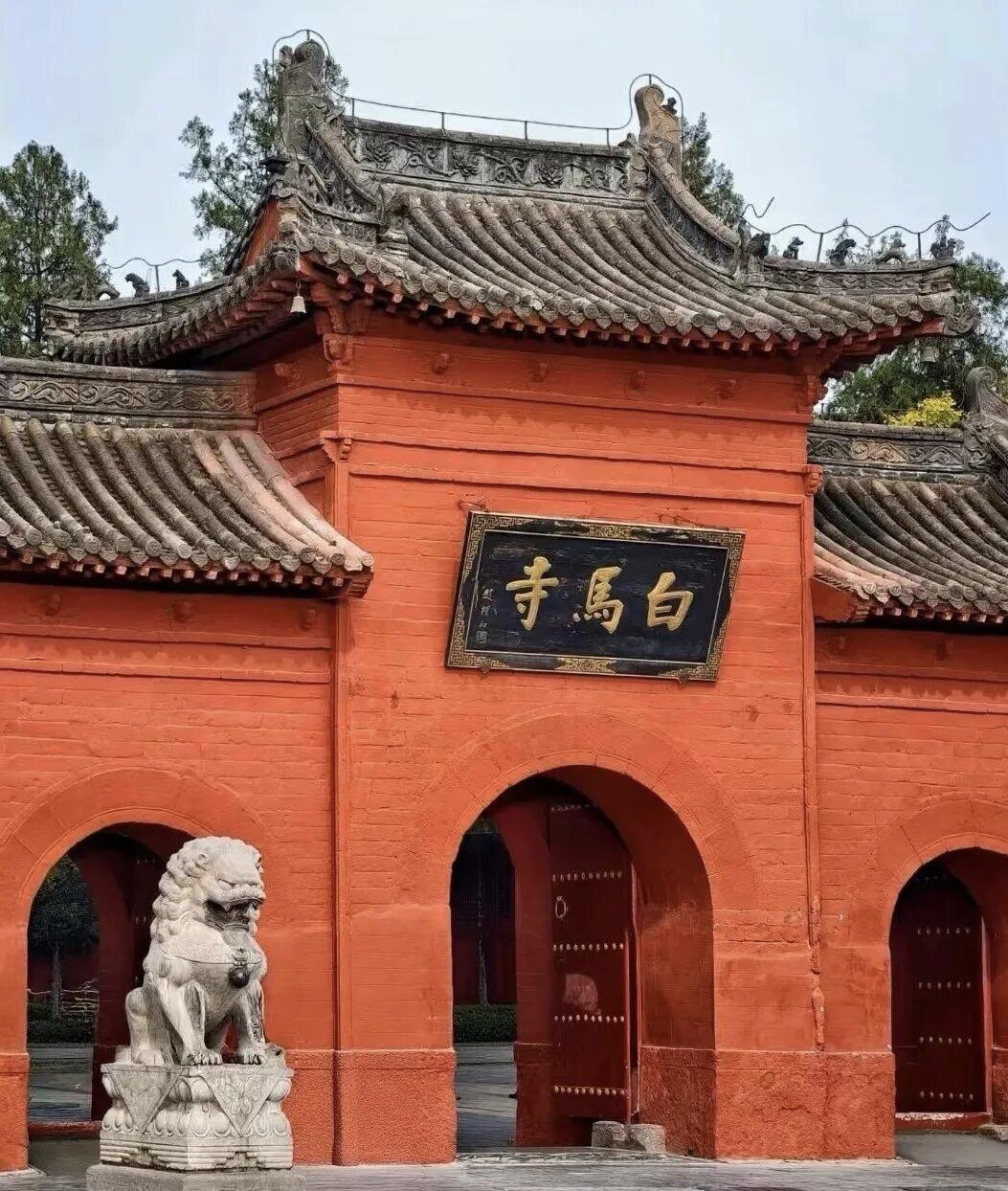
The main halls & the Cool Terrace
The complex follows the standard Buddhist monastery plan along a south-north axis, entered through the main gate (山门) where two Ming-dynasty stone horses stand. Allow about an hour for the core circuit — and don’t rush the Cool Terrace, the historical heart of the place:
| Hall | What’s inside |
|---|---|
| Hall of Heavenly Kings 天王殿 | First hall after the gate — the four guardian Heavenly Kings plus a laughing Maitreya Buddha (free incense point in front). |
| Mahavira Hall 大雄殿 | The main worship hall, holding rare Yuan-dynasty hemp-and-lacquer (夹纻干漆) statues — the temple’s single most valuable art. Resident monks chant here in the mornings. |
| Cool Terrace 清凉台 | A raised platform where Emperor Mingdi summered and where the two founding monks translated China’s first Buddhist scriptures — the spiritual origin point of Chinese Buddhism. |
| Monks’ tombs 二僧墓 | Two low burial mounds for Kasyapa Matanga and Dharmaratna — among the oldest Buddhist monks’ tombs in China. Easy to walk past; the signs are worth reading. |
| Ordination platform 戒坛 | A raised platform for ordination rites — the mark of a head monastery with full ordination rights. |
The International Zone & the Qiyun Pagoda
The most eye-catching part of a visit for most foreign visitors is not the Chinese halls but the International Zone (国际佛殿苑) — full-scale foreign-style Buddhist halls built inside the compound by partner governments, marking Luoyang as the city where Buddhism entered China. This is the temple’s most photographed spot: three Southeast Asian styles in a row without leaving China. All of it is on the standard ¥35 ticket; allow 30–45 minutes.
| Section | What it is | Note |
|---|---|---|
| Thai hall 泰国风格 | Full Thai Theravada style — multitiered gilded roof, naga serpent sculptures, royal-monastery interior. | The most photogenic — a golden roof that shoots best in morning light (faces east). |
| Burmese hall 缅甸风格 | Whitewashed, multi-tiered Myanmar-style pagoda — a serene white contrast to the Thai gold. | Completed 2014. A Cambodian-style pavilion has since been added too. |
| Indian hall 印度风格 | Stupa-and-courtyard layout with a bodhi-tree court and fine relief, referencing the Sanchi tradition. | Reflects the two founding monks’ Indian origin. |
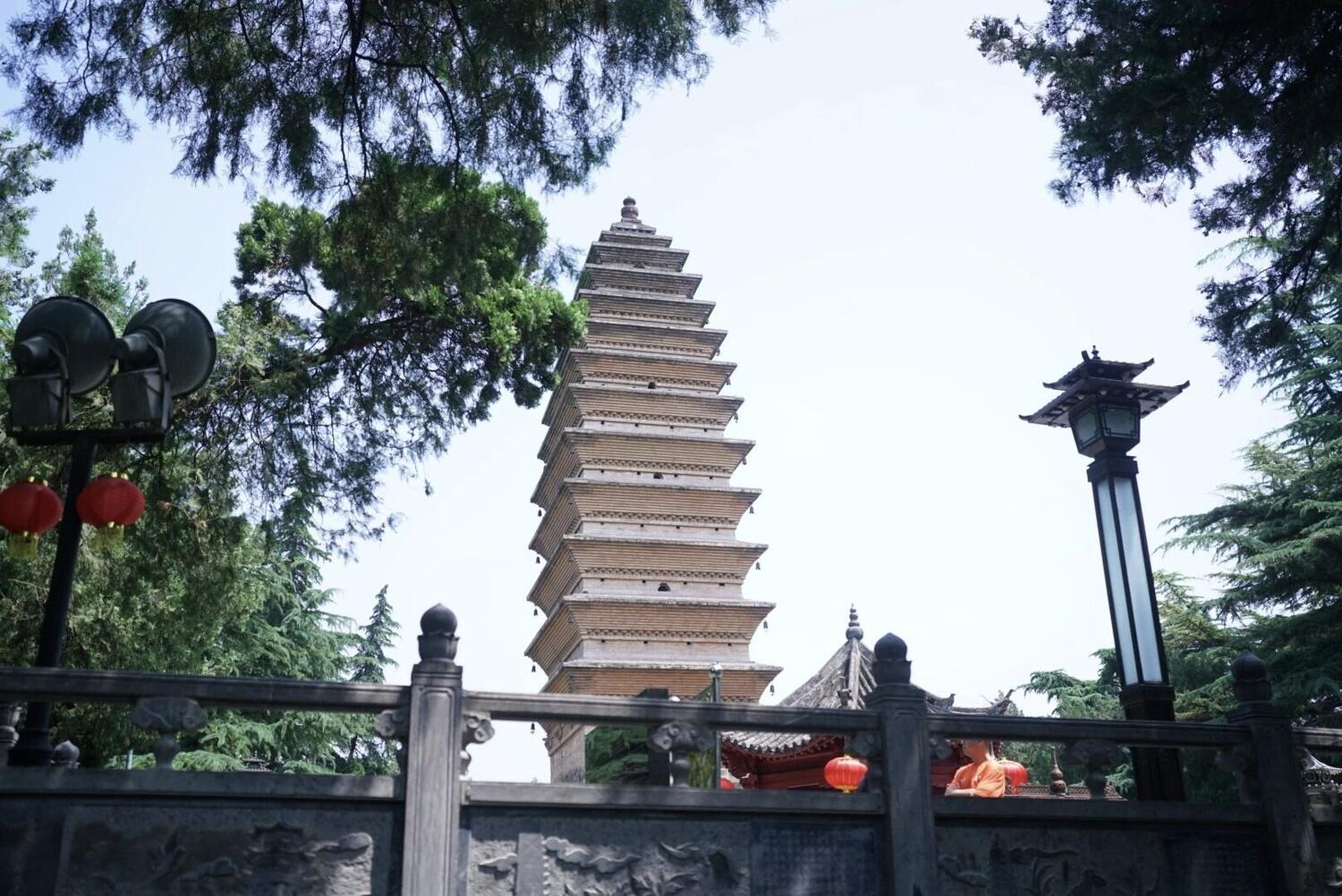
| Qiyun Pagoda 齐云塔 | A 13-story square brick pagoda (~35 m) in its own courtyard just outside the main walls — China’s first relic pagoda. | Jin dynasty (12th c.); interior not open to climb. Clap near the base for its famous frog-like echo. |
Walking between radically different Buddhist architectural traditions in a single complex is an unusual experience — a deliberately constructed diplomatic statement, each hall funded and designed by the respective country’s government.
Tickets, booking & hours
Reservation is now required. Book real-name on the “洛阳白马寺” official WeChat account — at least a day ahead on holidays — then scan the QR to enter (passport for foreigners). Trip.com is the simplest English path if you can’t use the mini-program.
| Item | Detail |
|---|---|
| Admission | ¥35 adult (half ¥17.5 for students, teachers and seniors; children under 1.4 m free) — covers the main halls + International Zone + Qiyun Pagoda courtyard. |
| Peak-season hours | 1 Apr–31 Oct: 7:40–18:40 (last admission 18:00). |
| Off-season hours | 1 Nov–31 Mar: 8:00–17:30 (last admission 17:00). |
| Booking | Real-name via the 洛阳白马寺 WeChat account (or Trip.com); scan the QR / show a passport at the gate. |
| Site | Flat and well-paved — accessible for most mobility levels; ~1.5–2.5 hours for a full visit. |
White Horse Temple is an active monastery: monks live and practise here, and early-morning visitors (8:00–9:30) may hear chanting from the Mahavira Hall. Quiet voices, hats off in the shrine halls, and no irreverent posing near altars are expected; photography of some altar areas is restricted. English signage has improved on the main halls but is patchy in the International Zone.
Free incense & scams to avoid
A working temple with tourist traffic attracts a few touts. None are hard to dodge once you know them:
- Incense is free inside. Pick up three sticks on the left just past the main gate, and again in front of the Hall of Heavenly Kings. You can’t bring your own incense in, so ignore the vendors selling “high-price” incense outside — you don’t need it.
- Refuse fortune-telling and “fate readings.” Anyone who approaches offering to tell your fortune, “read your fate” or “read the incense” — wave them off. If they use fear to push you to scan a QR code and transfer money to “resolve” something, it is almost always a scam.
- Beware fake “official” guide tents. Outside the gate, some tents dressed up to look like official guide kiosks scan you ¥40 per person — they are not the real thing. The genuine official guide desk is inside, at a flat ¥50 per group (any group size, one hour).
Book White Horse Temple tickets & a Luoyang tourNASDAQ: TCOM
Since entry is real-name reservation, Trip.com is the easy foreigner path — admission on a passport, or same-day Luoyang tours that pair the temple with the Longmen Grottoes and a bilingual guide, in English on a foreign card.
How to get there & best time
The temple is about 13 km east of central Luoyang in Luolong District. There is no metro stop — the two practical options are Bus 56 or a taxi/DiDi.
| From | How | Time · cost |
|---|---|---|
| Luoyang Station 洛阳火车站 (city-centre rail) | Bus 56 direct to the White Horse Temple stop (白马寺站), no transfers | ~45–60 min · ¥2 |
| Central Luoyang old town / Wangcheng Park | DiDi or taxi, ~13 km east | ~25 min · ~¥30–45 |
| Luoyang Longmen Station 洛阳龙门站 (HSR) | DiDi or taxi straight from the station — skips the city centre | ~30–40 min · ~¥45–65 |
Bus 56 leaves from near Luoyang Station (the older city-centre station — not Luoyang Longmen Station 洛阳龙门站, the HSR terminus ~9 km south). Pay the ¥2 flat fare on board with an Alipay or WeChat bus code (carry cash as backup); frequency is roughly every 15–20 minutes.
Best time: arrive at 8:00 opening — the tour groups haven’t arrived, you get the red walls and old cypresses in near-silence, and the cool morning light suits the atmospheric shots. Spring (March–May) and autumn (September–November) are the most comfortable seasons; April is peak peony season (洛阳牡丹节), Luoyang’s biggest event, with heavy crowds everywhere. For the wider picture, see our best time to visit China guide.
How it fits a Luoyang trip
White Horse Temple is a half-day stop. The easiest way to build a full day around it is to pair it with the Longmen Grottoes — and, contrary to the old “opposite directions” advice, there is now a direct shuttle between them.
- Recommended full day — temple first, then Longmen: White Horse Temple from 8:00 opening (~2–3 h for the axis, International Zone and Qiyun Pagoda), then from the temple’s West Gate take the 神都游 No.7 direct shuttle (¥10/person) straight to the Longmen Northwest Service Area (you can stop at the Luoyang Museum on the way). Reach Longmen by early afternoon, and in season stay for the lit night tour (~19:00).
- Slower alternative: White Horse Temple in the morning, then the Sui-Tang Luoyang City ruins (隋唐洛阳城 / Luoyi Ancient City 洛邑古城) for the afternoon — the Yingtian Gate plus a lantern-lit night market — giving Longmen its own full morning on a second day. See things to do in Luoyang.
If you only have one site in Luoyang, most first-timers pick Longmen Grottoes for the carvings; White Horse Temple is the deeper choice for visitors specifically interested in the origin of Chinese Buddhism and Silk Road history.
Frequently asked questions
Is White Horse Temple the oldest Buddhist temple in China?
It is the first imperially-sponsored Buddhist temple in China, founded 68 CE under Han Emperor Ming (Mingdi) — the conventional starting point of institutional Buddhism in the country, which is why it is called 'China's first ancient temple' (中国第一古刹). Whether it is the physically 'oldest' depends on definition: a few cave shrines predate it, and the site has been rebuilt many times over two millennia. The current structures are mostly Ming and Qing dynasty restorations of earlier foundations. Its significance is historical and symbolic — it is where organised Buddhist practice in China officially began.
How much does White Horse Temple cost, and do I need to book?
Admission is ¥35 for adults; students, teachers and seniors pay half (¥17.5), and children under 1.4 m enter free. You now have to book ahead: reservation is real-name via the '洛阳白马寺' official WeChat account — book at least a day ahead on holidays, then scan the QR to enter (bring your passport). Opening hours are seasonal: peak season (1 April–31 October) 7:40am–6:40pm with last admission 18:00; off-season (1 November–31 March) 8am–5:30pm with last admission 17:00. Prices and hours shift — confirm on the official channel before visiting. This covers the whole complex: the main axis halls, the International Zone and the Qiyun Pagoda courtyard.
What is the white horse legend?
The legend tells that Han Emperor Mingdi dreamed of a golden figure radiating light in the west. His ministers interpreted the dream as the Buddha. The emperor dispatched envoys westward along the Silk Road; they reached the Kushan Empire area (modern Afghanistan/India) and met two Indian Buddhist monks, Kasyapa Matanga (摄摩腾) and Dharmaratna (竺法兰). The monks returned to Luoyang in 68 CE, their Buddhist scriptures and Buddha-images carried on two white horses. The emperor had a temple built for them outside the western gate of the capital — named White Horse Temple (白马寺, Baima Si) in honour of those horses. Stone-carved horses still flank the main gate today.
What should I not miss at White Horse Temple?
Two draws for two kinds of visitor. For photos and the exotic, the International Zone (国际佛殿苑) is the standout — full-scale Thai, Burmese and Indian Buddhist halls in a row, so you can shoot 'Southeast Asia' without leaving China (the Thai hall's gold roof, the Burmese hall's white pagoda, the Indian hall's fine relief). For history and atmosphere, the main axis is the soul of the place: the Mahavira Hall (大雄殿) holds rare Yuan-dynasty hemp-and-lacquer (夹纻干漆) statues, the Cool Terrace (清凉台) is where the two founding monks translated China's first Buddhist scriptures, and just outside the walls the Qiyun Pagoda courtyard (齐云塔院) has China's first relic pagoda — clap near its base for the famous frog-like echo.
How long does a visit take, and what's the best time to go?
A self-guided visit runs 1.5–2.5 hours: about an hour for the main hall circuit, plus 30–45 minutes for the International Zone and a short walk to the Qiyun Pagoda. It's a half-day stop, not a full-day destination. Arrive at 8:00 opening if you can — the tour groups haven't arrived, you get the red walls and old cypresses in near-silence, and the cool morning light suits the atmospheric shots. Spring (March–May) and autumn (September–November) are the most comfortable seasons; April is the peony festival (洛阳牡丹节), Luoyang's biggest tourist event, when every site is crowded.
What are the international pavilions at White Horse Temple?
In the 2000s and 2010s, foreign governments donated and co-built separate Buddhist halls within the complex, each in their own national architectural style: an Indian-style hall (stupa layout and a bodhi-tree courtyard, reflecting the origin of Buddhism); a Thai-style hall (donated by the Thai government, with the distinctive tiered golden roof of Thai Theravada architecture); and a Burmese-style hall (a whitewashed Myanmar-style pagoda). A Cambodian-style hall has also been added. The International Zone reflects Luoyang's historic position as the eastern terminus of the Silk Road — the city where Buddhism first entered China from the west — and is the most photographed part of a visit.
Are there scams or touts to watch for at White Horse Temple?
A few, all avoidable. Incense is free inside — pick up three sticks on the left just past the main gate (and in front of the Hall of Heavenly Kings); outside vendors selling 'high-price' incense should be ignored, and you can't bring your own incense in anyway. Refuse anyone who approaches offering fortune-telling, 'reading your fate' or 'reading the incense' — anyone using fear to push you to scan a QR code and transfer money is almost always a scammer. And watch for fake 'official' guide tents outside the gate that scan you ¥40 per person: they are not the real thing. The genuine official guide desk is inside, at a flat ¥50 per group (any group size, one hour).
Can I combine White Horse Temple with the Longmen Grottoes in one day?
Yes, and it's easy to do well: White Horse Temple first, then the Longmen Grottoes. Do the temple from 8:00 opening (~2–3 hours for the axis, International Zone and Qiyun Pagoda), then from the temple's West Gate take the 神都游 No.7 direct shuttle (¥10 per person) straight to the Longmen Northwest Service Area — you can even stop at the Luoyang Museum on the way. Reach Longmen by early afternoon for the West and East Hills, and in season (April–October) stay for the lit night tour (~19:00–19:30). If you'd rather not rush, do White Horse Temple in the morning and the Sui-Tang City ruins (隋唐洛阳城) in the afternoon on one day, giving Longmen its own full morning on the next.
Is White Horse Temple still an active religious site?
Yes — White Horse Temple is both a tourist attraction and a functioning Buddhist monastery. Resident monks conduct ceremonies in the main halls; visitors are expected to behave respectfully (no loud voices in the halls, no posing disrespectfully near altars, remove hats in the main shrine halls as a courtesy). Photography of the main altar areas in some halls may be restricted. Incense burning areas are designated (with the free incense noted above). Morning visits (8:00–9:30) sometimes coincide with monk chanting — an atmospheric element absent from midday tour-group visits.
Sources
Checked August 2026 · Written from our own first-hand travel in China.