Key takeaways
- A UNESCO World Heritage Buddhist cave site: ~100,000 carved statues in 1,400+ caves along a 1 km Yi River cliff, carved 493 CE through the Tang dynasty.
- The headline carving is the 17.4 m Vairocana Buddha at Fengxian Temple (c.670s, Tang) — the “Chinese Mona Lisa.”
- One flat ¥90 通票 covers all four areas: West Hill, East Hill, Xiangshan Temple and Bai Garden. Online-only real-name booking since April 2025 — book ahead (passport on Trip.com); peak days sell out.
- Walk the single-line route: West Hill core → the bridge → the Ritual Terrace (礼佛台) for the best Vairocana panorama → East Hill / temple / garden only if you have the energy. Navigate to 西北服务区 (800 m walk).
- Go at 8am opening or after 14:30; best light is 16:00–17:00. The lit night tour (夜游龙门) runs Apr–Oct on a separate ¥90 ticket. Avoid the Oct 1–7 Golden Week.
What the Longmen Grottoes are
The Longmen Grottoes (龙门石窟, lóng mén shí kū — “Dragon Gate Stone Caves”) are one of China’s three great Buddhist cave-sculpture sites alongside Dunhuang and Yungang, inscribed as a UNESCO World Heritage Site in November 2000. They line both banks of the Yi River (伊河) in a steep limestone gorge ~12 km south of central Luoyang, Henan.
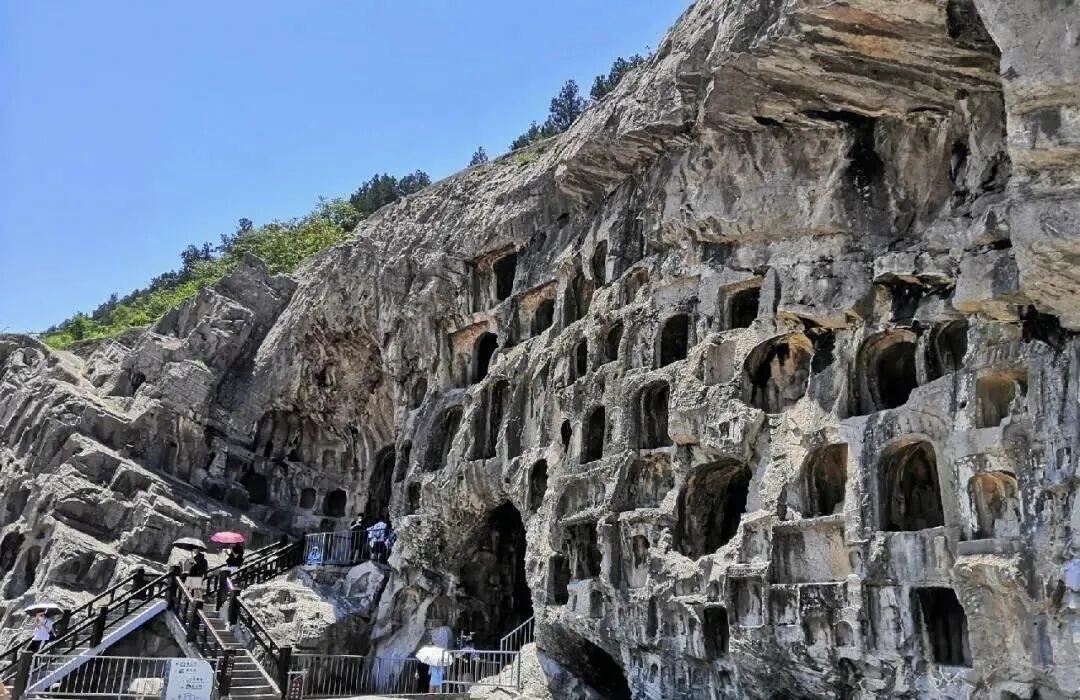
The scale only registers from the cliff base: more than 1,400 caves and niches and over 100,000 carved figures — from fingernail-sized devotional Buddhas to a 17.4 m main statue — across a cliff face roughly 1 km long. Carving began in 493 CE, when the Northern Wei moved its capital to Luoyang, and reached its peak density and ambition under the Tang dynasty in the 7th century — the period that produced Fengxian Temple.
The site is divided into four areas linked by one walking path and a bridge across the river; a single ¥90 ticket admits all four:
| Section | What it is | Note |
|---|---|---|
| West Hill 西山 | The main cliff face, densest with major caves — Fengxian Temple, the Binyang Caves, Wanfo and Lotus caves. | The essential core; ~1 km paved path, where most time goes. |
| East Hill 东山 | The opposite bank — fewer, more weathered Tang caves, plus the Ritual Terrace (礼佛台). | Cross mainly for the terrace: the best panorama of the West Hill cliff and Vairocana. |
| Xiangshan Temple 香山寺 | A Tang Buddhist temple on the East Hill ridge, rebuilt across the dynasties; steep step climbs. | Where the poet Bai Juyi spent his final years; skip if you are not into temples. |
| Bai Garden 白园 | A small wooded garden around the tomb of Tang poet Bai Juyi (白居易). | Quiet rest at the end; inessential for pure cave-art visitors. |
Tickets, booking & the ¥90 combined ticket
Admission is a flat ¥90 all year — one combined ticket (通票) for all four areas, with no peak/off-peak split and no separate cave charge. Children under 1.2 m are free; student and senior discounts apply with valid ID. The single most important change: since 1 April 2025 the site is online-only real-name reservation.
Book ahead — don’t gamble on the gate. Chinese residents book 1–3 days out on the “龙门石窟” WeChat account or mini-program with an ID card; foreign visitors book on Trip.com and enter on a passport. Only a small on-site emergency (应急) quota remains, and it stops once the daily cap is hit — in Golden Weeks, summer and holidays, online tickets can sell out several days ahead.
| Item | Detail |
|---|---|
| Combined ticket | ¥90 flat — West Hill + East Hill + Xiangshan Temple + Bai Garden. No separate cave fees. |
| Opening hours | Peak (~Apr–early Oct) ~08:00–18:30, last tickets ~18:00; winter (Nov 1–Feb 28) 08:00–18:00, sales to 16:30, last entry 17:00. |
| Sightseeing cart 电瓶车 | ¥10 one way (Northeast Service Area ↔ ticket check, ~25 min walk otherwise). |
| Yi River boat 游船 | Skippable — the return dock is awkwardly placed with no East Hill / Xiangshan stop; just walk the Manshui Bridge. |
| Night tour 夜游龙门 | Separate ¥90 ticket, seasonal Apr–Oct (see below). |
The must-see — Fengxian Temple & the route
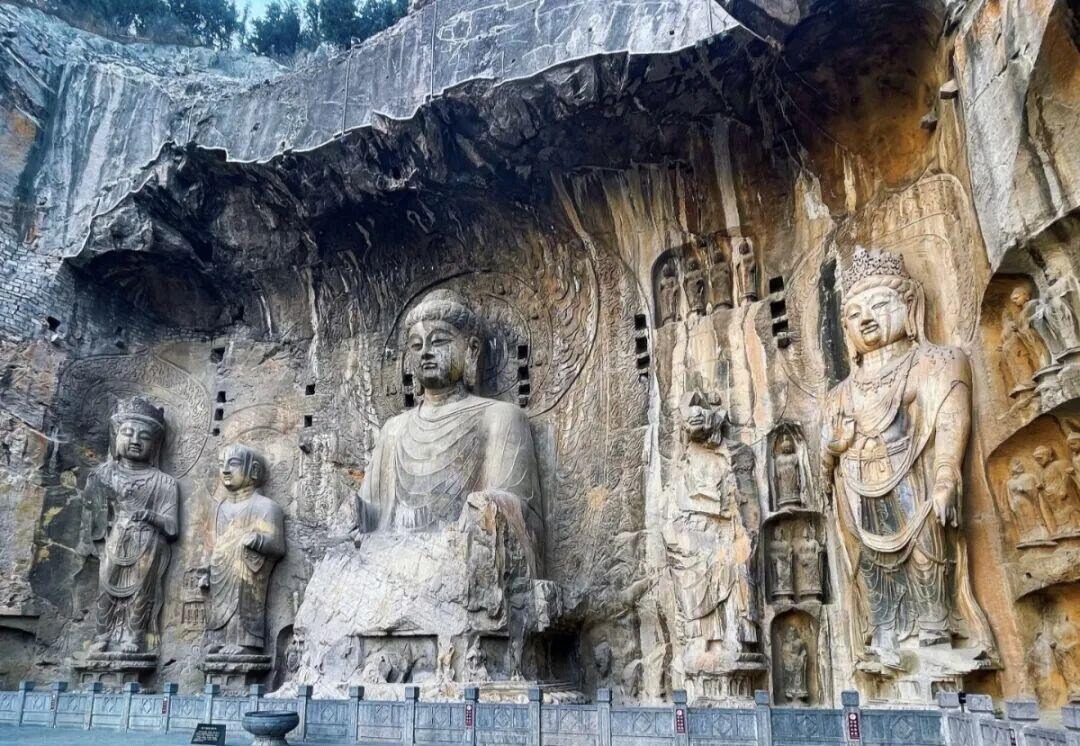
Fengxian Temple cave (奉先寺) is the centrepiece — an open-air rock-cut temple ~39 m wide and 33 m deep, housing nine monumental figures carved straight from the cliff. The central Vairocana Buddha (毗卢遮那佛) sits 17.4 m tall (head 4 m, ears 1.9 m each), carved in the 670s CE under Emperor Gaozong and Empress Wu Zetian — who, tradition holds, funded the final stages and may have lent her face to the statue. The half-smile that shifts with the light is why it is nicknamed the “Chinese Mona Lisa.” Eight attendants (disciples, bodhisattvas, heavenly kings and guardians) flank it, scaled so the group reads as one composition. The best light on the face is the west-lit 16:00–17:00.
The other West Hill highlights, moving south to north along the path:
| Cave | Era | Why it’s worth it |
|---|---|---|
| Binyang Three Caves 宾阳三洞 | Northern Wei | The finest Northern Wei work at the site — elongated faces and flying-apsaras relief; a clear contrast with the fuller Tang figures next door. |
| Wanfo Cave 万佛洞 (Ten Thousand Buddhas) | Tang | ~15,000 tiny Buddhas set in registers across every surface, plus one of the most elegant single Tang bodhisattvas at the site. |
| Lotus Cave 莲花洞 | Northern Wei | A large carved lotus on the ceiling with fine flying-apsaras relief (may be closed for restoration — normal, adjust expectations). |
| Guyang Cave 古阳洞 | Northern Wei | One of the oldest caves (begun c.493 CE) — dense with donor niches and inscriptions; the medical-prescription cave (药方洞) nearby carries 140+ stone-inscribed formulas. |
The site is a single one-directional loop — no backtracking. Good-fitness visitors do the full deep route (~3–4 h): West Hill (1.5–2 h) → the Manshui Bridge → East Hill → Xiangshan Temple → Bai Garden → exit at the Northeast Service Area. With less time or older visitors/children, take the easy essence route (~2 h): West Hill (Fengxian, Binyang, Wanfo) → the bridge → the Ritual Terrace (礼佛台) for the cross-river Vairocana panorama, then straight out by electric cart — skipping East Hill’s caves, Xiangshan Temple and Bai Garden.
Day vs night — 夜游龙门
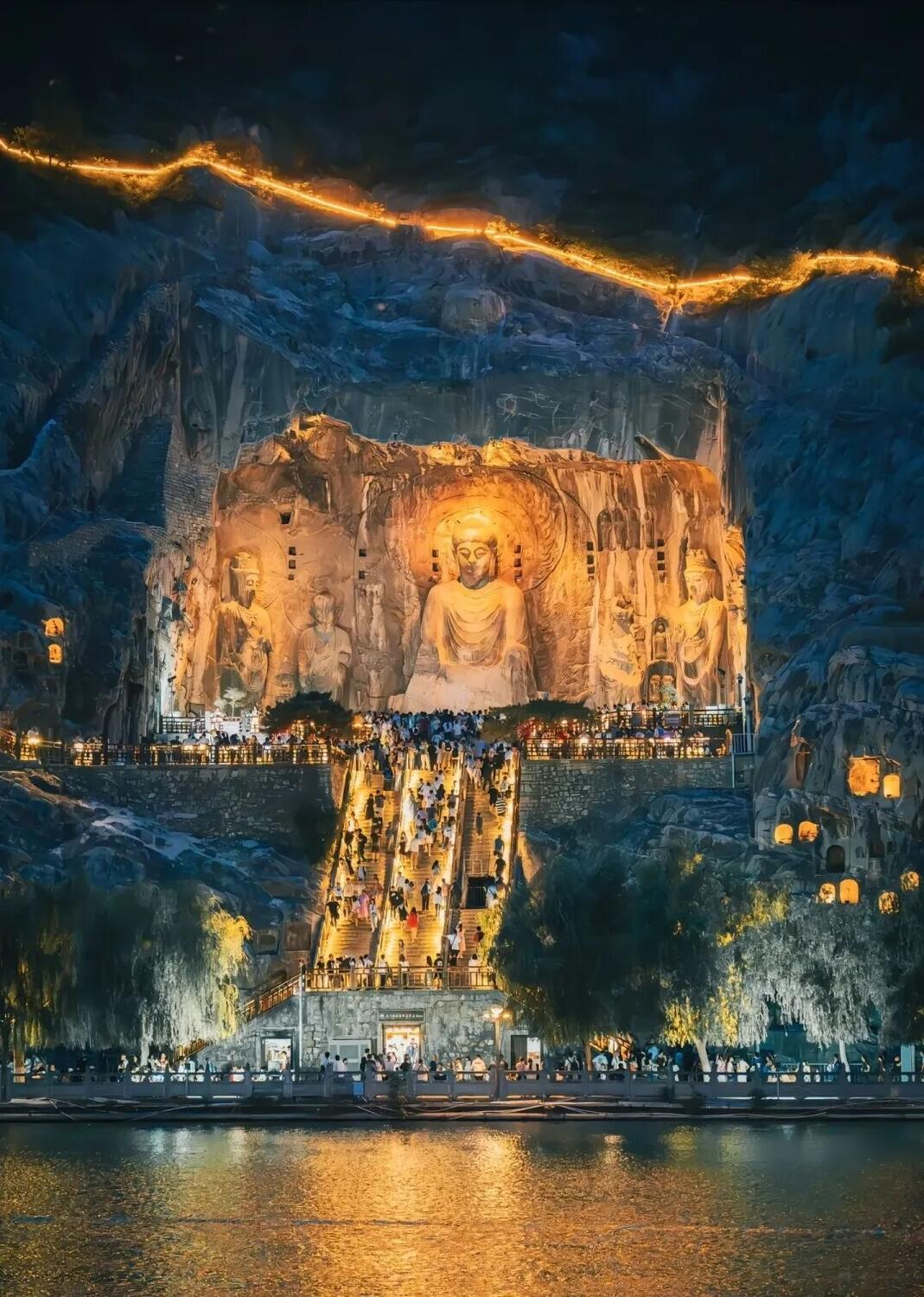
Longmen is one of the few of China’s great cave sites you can see lit at night. The night tour (夜游龙门) reopened on 30 March 2026 and runs seasonally, roughly April to October (no lights in winter). It is a separate ¥90 ticket: sales 17:30–19:30, admission 18:00–20:00, clearance 21:00, with the lights coming on about half an hour after sunset — usually around 19:00–19:30 in summer. Only West Hill, Xiangshan Temple and the Manshui Bridge open at night (East Hill and Bai Garden are daytime only).
- Day — best for cave-level detail and the upper-tier niches; morning (gates 08:00) gives the Fengxian platform nearly to yourself, and 16:00–17:00 is the best light on the Vairocana Buddha.
- Night — the warm floodlighting picks out the relief carving, and from the Ritual Terrace the lit cliff reflected in the Yi River is genuinely striking. Book the night ticket ahead in peak season.
If you can only pick one, choose a daytime visit for the carving detail; the night tour is a strong bonus if you are staying over in Luoyang between April and October.
How to get there from Luoyang
The grottoes sit ~12 km south of central Luoyang in Luolong district. Driving or by taxi, navigate to the Northwest Service Area (西北服务区) — only ~800 m on foot to the West Gate ticket check; the Northeast Service Area is ~3 km from the Vairocana Buddha and needs the ¥10 cart. Routing below is Amap-verified (2026-07).
| From | How | Time · cost |
|---|---|---|
| Luoyang Longmen HSR station 洛阳龙门站 | Taxi/DiDi, bus 71 direct, or the 神都游 No.3 shuttle line (9:00–17:00) — ~6 km | ~10–15 min taxi · ¥20–30 |
| Luoyang Station 洛阳站 (central, non-HSR) | Bus 81 direct (also 53 / 60 / 99 to the 龙门石窟 stop) | ~40–50 min · ¥1–2 |
| Xi’an North 西安北站 | HSR G-train → Luoyang Longmen, then taxi / bus 71 | ~1h 25m + ~15 min |
| Zhengzhou East 郑州东站 | HSR G-train → Luoyang Longmen, then taxi / bus 71 | ~30 min + ~15 min |
The HSR station is named for the grottoes and is the fastest approach from Xi’an, Zhengzhou or Beijing. From central Luoyang, Bus 81 is cheapest. Full arrival routing is in the Luoyang railway station guide.
Best time & how long
For crowds, arrive at 8:00 opening or after 14:30 — in the morning the tour groups haven’t arrived and you can have the Vairocana nearly to yourself; after 2:30pm the groups thin out. For photography, 16:00–17:00 is the best light, when the sun comes from the west across the West Hill cliff.
Season: spring (mid-March to mid-May) and autumn (October to November) are the most comfortable. Spring overlaps Luoyang’s famous peony festival (~mid-April; the city is China’s peony capital) — beautiful but crowded. Summer is hot and humid in the valley (morning-only visits work); winter is cold but the carvings are fully accessible and crowds thin. Avoid October 1–7 National Day Golden Week, when the cliff path is shoulder-to-shoulder. Allow 2–4 hours(the easy essence run vs the full four-area loop). See our best time to visit China guide for the broader seasonal picture.
Guides, audio & scams to avoid
Guide or audio — don’t go in blind
Cave art is “three parts looking, seven parts listening” (三分看七分听) — without narration it is easy to end up “staring at rocks.” Your options:
- Official human guide — booked at the guide centre ~150 m past the ticket check. Standard ¥200 per group (1 hour), premium ¥300 (1.5 hours), up to five people (+¥20 per extra). Book ahead on the WeChat account; hard to get on the day in peak season.
- Electronic audio guide — ¥30 (¥200 deposit); comprehensive but the signal is patchy and it’s a bit mechanical.
- Free official audio — the cheapest option: follow the “龙门石窟景区” WeChat account and use its 语音讲解 (voice guide) menu on your phone.
Scams to refuse
- Freelance “guides” / 野讲解. Anyone who approaches offering a “cheaper tour” or to “show you a shortcut” — wave them off. One traveller paid ¥40 for a 15-minute rote spiel and was then abandoned mid-route.
- Fake shuttles & black cabs. Navigate to the Northwest Service Area (西北服务区). If a taxi or three-wheeler says “the Northwest area is closed, I’ll take you to another gate,” don’t believe it — they want you in their unlicensed car.
- Knock-off halls & fake tickets. Touts near the site offering “a grottoes/museum next door, half-price tickets” run fake replica halls. Buy only on the official 龙门石窟 WeChat account or mini-program (or Trip.com).
What to bring
- Comfortable shoes — ~1.5 km of paving plus the Fengxian stairs and (if you go) Xiangshan Temple’s steep steps.
- Sun protection & water — the path is exposed; on-site vendors are pricey.
- Passport — real-name entry; scan it at the gate.
Book Longmen Grottoes tickets & a Luoyang tourNASDAQ: TCOM
Since booking is online-only and real-name, Trip.com is the simplest foreigner path — advance admission on a passport, plus guided Luoyang day tours (often paired with White Horse Temple), in English on a foreign card.
How it fits a Luoyang trip
A half-day site — most visitors pair it with a second Luoyang stop:
- + White Horse Temple (白马寺) — the natural pairing. China’s first Buddhist temple (founded 68 CE), ~12 km northeast: compact, walled, still in active worship — a sharp contrast to the cliff site. Allow 2–3 h. See the White Horse Temple guide.
- + Guanlin Temple (关林庙) — the burial site of Guan Yu (Three Kingdoms general), ~7 km north; a shorter 1.5–2 h stop on the way back to the city.
- + Luoyang Museum (洛阳博物馆) — Tang Sancai ceramics and the imperial-capital context behind the grottoes; allow 2–3 h.
Day-trip from Xi’an: Xi’an North → Luoyang Longmen is ~1h 25m by HSR. A same-day return is possible on an early G-train (~08:00 out, last train back ~19:00–20:00 — about 8 hours on the ground), but a night in Luoyang gives the grottoes in full and adds the night tour and the Sui-Tang City night shows. For the broader rail picture see Beijing to Xi’an by rail — Luoyang sits on the same line.
Where to stay for a Longmen visit
You don't base at the grottoes — they’re ~12 km out of the city with no foreigner-friendly chain at the gate. The sensible call is to stay in central Luoyang (near the old town or Wangcheng Park, an easy bus/taxi ride out) and treat the grottoes as a half-day. If you’re arriving late or starting early, the cluster around Luoyang Longmen HSR station is closest (~10–15 min taxi).
Frequently asked questions
How much do Longmen Grottoes tickets cost, and do I need to book ahead?
Admission is a flat ¥90 all year — a single combined ticket (通票) covering all four areas: West Hill, East Hill, Xiangshan Temple and Bai Garden (Bai Juyi's tomb). There is no peak/off-peak split and no separate cave charge. Since 1 April 2025 the site is online-only real-name reservation: book 1–3 days ahead on the '龙门石窟' WeChat account or mini-program (foreign visitors book on Trip.com and show a passport). Only a small on-site emergency (应急) quota remains, and it closes once the daily cap is hit, so in peak periods (Golden Weeks, summer, holidays) online tickets can sell out several days ahead — don't gamble on the door. Children under 1.2 m free; student and senior discounts with valid ID. The night tour (夜游龙门) is a separate ¥90 ticket.
Do I need to see East Hill, Xiangshan Temple and Bai Garden, or is West Hill enough?
West Hill (西山) is the essential core — the Fengxian Temple Vairocana Buddha, the Binyang Caves and Wanfo Cave are all here; if you only do one section, it is West Hill. The rest is a matter of energy and interest. Cross the bridge to East Hill (东山) mainly for the Ritual Terrace (礼佛台) — the best spot to photograph the whole West Hill cliff and the Vairocana Buddha from across the river; the East Hill caves themselves are fewer and more weathered, so many travellers just walk to the terrace, take the panorama, and continue. Xiangshan Temple (香山寺) has steep step climbs and is skippable if you are not into temples; Bai Garden (白园), the poet Bai Juyi's tomb garden, is a quiet rest at the end but inessential if you are here purely for cave art.
What is the best route and how long does a visit take?
The scenic area is a single one-directional loop — no backtracking. The full deep route (~3–4 hours, for good fitness) is: enter at the Northwest Service Area (西北服务区) → West Hill (~1.5–2 h) → the Manshui Bridge → East Hill (~40 min) → Xiangshan Temple (~30 min) → Bai Garden (~30 min) → exit at the Northeast Service Area. The easy essence route (~2 hours, for older visitors or kids) is: West Hill (focus on Fengxian Temple, the Binyang Caves and Wanfo Cave) → the bridge → the Ritual Terrace for the Vairocana panorama → then straight out by electric cart, skipping East Hill, Xiangshan Temple and Bai Garden. Morning arrivals (8am opening) have the calmest cliff and, later, the west-lit afternoon (16:00–17:00) is the best light on the Vairocana Buddha.
How do I get from Xi'an to the Longmen Grottoes?
Xi'an North Station (西安北站) → Luoyang Longmen Station (洛阳龙门站) by HSR G-train: about 1 hour 25 minutes, trains roughly every 30–60 minutes. Luoyang Longmen Station is named for the grottoes and is about 6 km away; from there take a taxi/DiDi (~10–15 min), city bus 71 direct, or the 神都游 No.3 shuttle line (9:00–17:00, links the HSR station and the grottoes). Xi'an to Luoyang is one of central China's most natural day-trip or one-way HSR moves — many travellers spend 2–3 days in Luoyang before continuing to Zhengzhou or Beijing. A same-day return from Xi'an is possible on an early train, but a night in Luoyang lets you see the grottoes in full and adds the night tour.
How do I get to the grottoes from Luoyang city, and which entrance?
From central Luoyang, city buses 53, 60, 81 and 99 run to the 龙门石窟 stop; from Luoyang Station (洛阳站, the central non-HSR station) bus 81 is the direct option, ~40–50 minutes, ¥1–2. From Luoyang Longmen HSR Station (~6 km) take a taxi/DiDi (~10–15 min), bus 71, or the 神都游 No.3 line. Driving or by taxi, navigate to the Northwest Service Area (西北服务区) — it is only ~800 m on foot to the West Gate ticket check. The Northeast Service Area is ~3 km from the Vairocana Buddha and requires the ¥10 sightseeing cart, though it has larger parking on holidays. Amap-verified 2026-07.
What is the Vairocana Buddha and why is it called the "Chinese Mona Lisa"?
The Vairocana Buddha (毗卢遮那佛) in the Fengxian Temple cave is a 17.4 m seated figure carved in the 670s under Emperor Gaozong of the Tang dynasty. Tradition holds — though historians debate the evidence — that the face was modelled on Empress Wu Zetian, who is said to have personally funded the final stages of carving. The 'Mona Lisa' comparison is a modern phrase for the sculpture's enigmatic half-smile, which shifts with the angle and light. Whatever the truth of the Wu Zetian story, the proportions, the downward gaze and the slight upturn of the mouth give it an unusual psychological depth for monumental Buddhist carving. The best light on the face is the west-lit late afternoon, 16:00–17:00.
Is the night tour (夜游龙门) worth it, and when does it run?
Very worth it — Longmen is one of the few of China's great cave sites you can see lit at night. The night tour (夜游龙门) reopened on 30 March 2026 and runs seasonally, roughly April to October (no lights in winter). It is a separate ¥90 ticket; ticket sales 17:30–19:30, admission 18:00–20:00, clearance 21:00, and the lights come on about half an hour after sunset — usually around 19:00–19:30 in summer. Only West Hill, Xiangshan Temple and the Manshui Bridge open at night (East Hill and Bai Garden are daytime only). The warm floodlighting picks out the relief carving and, from the Ritual Terrace, the lit cliff reflected in the Yi River is genuinely striking. Book the night ticket ahead in peak season.
Should I hire a guide, and are there scams to avoid?
Cave art is 'three parts looking, seven parts listening' (三分看七分听), so some form of narration is strongly recommended or you end up 'staring at rocks'. Options: an official human guide, booked at the guide centre ~150 m past the ticket check — a standard tour is ¥200 per group (1 hour), a premium tour ¥300 (1.5 hours), up to five people (+¥20 per extra person); an electronic audio guide at ¥30 (¥200 deposit), though the signal is patchy; or the free official audio — follow the '龙门石窟景区' WeChat account and use the 语音讲解 menu, the cheapest option. Scams to refuse: freelance 'guides' who approach you offering a 'cheaper tour' or to 'show you a shortcut' (one traveller paid ¥40 for a 15-minute rote spiel, then was abandoned); fake-shuttle touts and black cabs claiming the Northwest Service Area is 'closed, I'll take you to another gate'; and knock-off 'grottoes/museum' halls near the site selling half-price 'tickets' — buy only on the official 龙门石窟 channel.
Sources
Checked July 2026 · Written from our own first-hand travel in China.