This guide is written by an editorial team based in Chongqing — the editor has lived in mainland China since 2018 (8 years on the ground). The picks, logistics and priority calls draw on aggregated 2024-2026 r/travelchina, r/chinatravel and r/Zhangjiajie threads, Trip.com listings, and 2026-05-23 Amap (高德地图) routing and POI data. This is aggregated editorial coverage — corrections from Zhangjiajie residents and recent visitors are welcomed (see the about page).
How to think about Zhangjiajie — and how to prioritise
Zhangjiajie is the most visited nature destination in Hunan province and one of the most visually distinctive landscapes in the world. The Zhangjiajie National Forest Park — part of the broader Wulingyuan UNESCO World Heritage Area (listed 1992) — is home to roughly 3,000 sandstone quartz pillar formations, some rising over 200 metres from heavily forested valley floors. The landscape became globally known as the visual inspiration for the floating Hallelujah Mountains in James Cameron's Avatar (2009), and the “Avatar effect” has driven an internationally distributed wave of visitors ever since — with particularly strong draw from Southeast Asia, Europe and North America.
There are two distinct sites that foreign visitors typically combine, and understanding the geography prevents confusion:
- The National Forest Park / Wulingyuan area — roughly 30 km north of Zhangjiajie city. This is the Avatar pillars. It needs at least 2 full days. The three key zones inside the park — Yuanjiajie, Tianzi Mountain and Golden Whip Stream — are described in sections 1 through 5 below.
- Tianmen Mountain (天门山) — a separate peak located closer to Zhangjiajie city, with its own dedicated cable car, glass skywalks and the famous natural arch at 1,300 m. It is described in section 6 and is a full separate day.
A 3-day trip can cover Tianmen Mountain (1 day, from the city) plus the park (2 days, based in Wulingyuan). A 4- or 5-day trip allows the glass bridge and the secondary sites (Yellow Dragon Cave, Baofeng Lake, a Tujia evening show) without rushing. If your time is short, two days entirely inside the National Forest Park is the better call than spreading thinly across all sites.
For where to sleep — Wulingyuan town for park-focused trips, the city centre if you want to include Tianmen Mountain or have an early train — see where to stay in Zhangjiajie. The full practical overview — getting to Zhangjiajie, getting around, transport between park and city, emergency contacts — is at the Zhangjiajie city guide.
1. Zhangjiajie National Forest Park — the Avatar sandstone pillars
The Zhangjiajie National Forest Park (张家界国家森林公园) is the world's first national forest park designated under China's system (1982) and is inscribed, together with Suoxiyu and Tianzi Mountain reserves, under the Wulingyuan UNESCO World Heritage Area. Its defining feature is around 3,000 sandstone quartz pillars, sculpted over hundreds of millions of years by tectonic uplift and water erosion, many rising sheer from valley floors with dense subtropical forest growing on their flat tops and climbing their sides.
The main park entry is at the Zhangjiajie Forest Park Gate (张家界国家森林公园大门) in the south. A multi-day park ticket (2026: ¥236 for the 4-day pass, in-park eco-buses included) is the standard purchase — buy in advance online; the park requires real-name registration. The lifts — the Bailong Elevator and the cable cars to Tianzi Mountain and Huangshi Village — are charged separately. Most visitors enter via the south gate and exit via the Wulingyuan east gate after traversing the valley; the shuttle system links the zones inside the park, but not the gates to each other.
Two days inside the park is the minimum to cover Yuanjiajie, the Bailong Elevator, Tianzi Mountain and Golden Whip Stream without rushing any of them. The full deep-dive — navigation, shuttle routes, multi-day ticket logistics — is in the Zhangjiajie National Forest Park guide.
2. Yuanjiajie (袁家界) — the Avatar pillar and the First Bridge Under Heaven
Yuanjiajie (袁家界, Yuán Jiā Jiè) is the park zone on the central-northern plateau and is the single most photographed spot in Zhangjiajie. It is home to two of the park's most celebrated sights:
The Avatar Hallelujah Mountain — officially named “Southern Sky Column” (南天一柱, Nán Tiān Yī Zhù) and renamed after the film's release — is a single sandstone pillar rising approximately 1,080 m above sea level, draped in vegetation and hovering above the valley below in the classic Avatar floating-island composition. The viewpoint from Yuanjiajie's plateau edge, with the pillar framed against the valley haze, is the image that defines the destination. It is at its most dramatic in early morning fog or after rainfall.
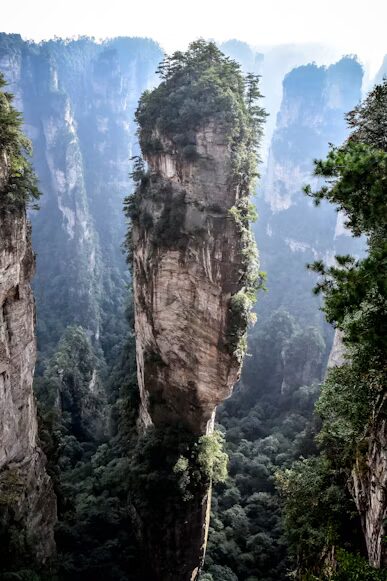
The First Bridge Under Heaven (天下第一桥, Tiān Xià Dì Yī Qiáo) is a natural rock arch spanning two pillars approximately 40 m above a vertiginous drop — reportedly the highest natural stone bridge in the world. The approach path from the plateau edge and the crossing itself are both a short walk from the main Yuanjiajie viewpoint.
Yuanjiajie is reached most efficiently via the Bailong Elevator from the valley floor (section 5 below), on foot, or by eco-bus across from the Tianzi Mountain side — there is no cable car to Yuanjiajie itself. Arrive early: The park’s longest queue, in BOTH directions: 60–90 min up on a normal summer morning (up to ~3h over May Day) and another 1–1.5h to come down in peak season — many descend on foot or by the Tianzi cable car.
Yangjiajie (杨家界) — the quietest pillar zone next door
Yangjiajie (杨家界, Yáng Jiā Jiè) sits between Yuanjiajie and Tianzi Mountain on the same free eco-bus loop — roughly 15-20 minutes between stops — yet most tour groups drive straight past it, which is exactly its appeal: the quietest of the four zones and the only place the “peak wall” stage of the landform fills the horizon — the Natural Great Wall rivals Yuanjiajie’s pillars with a tenth of the crowd; the Wulongzhai / Tianbofu spur adds real climbing, skip it on a tight day. The “natural great wall” is a knife-edge sandstone rampart best seen from the Wulongzhai (乌龙寨) walk, a squeeze-through cliff path ending at the Tianbofu (天波府) viewpoint.
The zone has its own cable car — ¥76 one way / ¥152 return (杨家界索道), and the calmest lift on the mountain — near queue-free most of the day, ~30–50 min only on summer/holiday mornings. ⚠️ The classic trap is riding it DOWN mid-visit: the lower station sits by the quiet west-side exit, far from everything else — ride it UP to start (or skip it), never down as a shortcut If your park reservation is an east-gate A-line or B-line day, Yangjiajie slots naturally between Yuanjiajie and Tianzi Mountain; give it 3-4 hours with the spur, or ride through and save the climbing on a tight two-day plan.
3. Tianzi Mountain (天子山) — the sea-of-cloud panorama
Tianzi Mountain (天子山, Tiān Zǐ Shān — “Son of Heaven Mountain”) is the northernmost and highest of the park's main zones, reaching 1,262.5 m at its peak. It is celebrated for the sea-of-cloud (云海, yún hǎi) effect — when morning fog fills the valley to the base of the pillars and the summits emerge above the white surface, the landscape looks genuinely otherworldly. The effect is most reliable in spring (April-May) and after autumn rain; arriving on the mountain before dawn — staying overnight in one of the park-edge guesthouses at Wulingyuan — is the way to catch it.
Tianzi Mountain is reached by a cable car from Wulingyuan (十里画廊 / Suoxiyu side) or by shuttle bus from the south park gate, ascending to the plateau at roughly 1,100 m. The cable car ascent itself is dramatic, rising through the pillar formations. At the top, key viewpoints include the Imperial Brush Peak (御笔峰) — a cluster of slender pillars said to resemble writing brushes held upright — and the Natural Gallery (十里画廊), a lower-level path through dense pillar scenery that is one of the most accessible walking routes in the park.
Late October and early November bring the red-leaf season to Tianzi Mountain — the maples and ginkgos turn and the pillar-top colour contrasts with the grey stone and white cloud; this is one of the most visually arresting versions of the landscape the park offers.
Ten-Mile Gallery (十里画廊) — the level valley below Tianzi
The Ten-Mile Gallery is a roughly 5 km valley in the Suoxiyu section, lined with the named rock formations that give it its reputation — Three Sisters Peak (三姐妹峰), the Old Man Gathering Herbs (采药老人), the Longevity Star Greeting Guests (寿星迎宾). It is less about the individual shapes than about finally seeing the pillar landscape at eye level after a day spent above it.
⚠️ Chinese trip reports are blunt about this one, and we'll pass that on: it is the most criticised stop in the park. From the valley floor the sightlines close in, and after a day on the plateaus the pillars here read as ordinary. The electric tram — ¥38 one way (¥19 concession, on top of park admission) — covers the valley in a few minutes, and enough travellers call that poor value that “skip Ten-Mile Gallery” is the single most common cut in a three-day plan.
Our read: treat it as a way to leave the park at ground level rather than as a destination. The floor is level and paved, so walk a stretch and turn back if you have energy left (1-2 hours end to end on foot), and skip the tram unless your legs are done. If the day is already 7-8 hours old, ride the shuttle straight past it.
4. Golden Whip Stream (金鞭溪) — the gentlest walk through the pillars
Golden Whip Stream (金鞭溪, Jīn Biān Xī) is a roughly 7.5 km trail that follows a clear stream along the valley floor through the park's southern zone, winding between the bases of the sandstone pillars. It is the most accessible and least strenuous walk in the park — largely flat, paved, and shaded, with the pillars rising 200-400 m on both sides.
The trail takes approximately 2 to 3 hours at a leisurely pace. Unlike the plateau routes, Golden Whip Stream is a “valley-floor-up” perspective on the pillars — you look up at them rather than across them — and the scale registers viscerally from inside the canyon. The stream is clear and cold; the path is lined with subtropical vegetation; wild macaques are regularly spotted along the trail, particularly near the middle section — they are bold enough to snatch clear plastic bags and open snacks and can turn aggressive, so keep food out of sight and don’t feed them. The Golden Whip Rock (金鞭岩) — the pillar for which the stream is named, shaped roughly like a golden whip — stands at roughly the midpoint and at 350 m is one of the tallest single pillars in the park.
A logical park-day sequence is: Bailong Elevator up to Yuanjiajie in the morning → the Avatar pillar and First Bridge Under Heaven → shuttle to Tianzi Mountain for the afternoon cloud views → descend to the valley and walk Golden Whip Stream in the late afternoon, exiting at the Zhangjiajie Forest Park Gate. This covers the park's full vertical range in one day, though it is a long day; most visitors spread this across two.
Huangshizhai (黄石寨) — the south-gate plateau most foreigners skip
Huangshizhai is the flat-topped plateau directly above the forest park's southern gate — a rim walk around the mesa, with Zhaixingtai (摘星台) the best known of its lookouts and a resident macaque population along the path. It is the one major zone that almost never appears in English itineraries, which is exactly why it stays quiet: the cable-car queue runs 20-40 minutes even in season, against 60-90 at the Bailong Elevator.
The Huangshizhai cable car is ¥65 one way (¥33 concession) on top of park admission — a 973 m haul up a 430 m rise, running since 1997. Climbing on foot is a couple of hours of stairs. Allow 2-3 hours for the lift plus the rim loop, which makes it the natural first half of a south-gate day: up Huangshizhai in the morning, down to the Great Oxygen Bar Square, then the Golden Whip Stream walk out to the east gate.
⚠️ Two caveats worth knowing before you build a day around it. Cable-car ticket sales stop at 17:30 from May to October and 16:30 from November to April (the lift runs to 18:00 in peak season, 17:00 off-season), so it does not work as a late add-on — start it in the morning or not at all. And the old line “you haven't really seen Zhangjiajie until you've been up Huangshizhai” is no longer how travellers rate it: current reports call the views ordinary next to Yuanjiajie and Tianzi. On a three-day trip it is one of the first things people cut, and we'd cut it too if the choice is Huangshizhai or the Avatar pillars.
5. The Bailong Elevator (百龙天梯) — the world's tallest outdoor elevator
The Bailong Elevator (百龙天梯, Bǎi Lóng Tiān Tī — “Hundred Dragons Sky Ladder”) is a glass-sided cliff lift ascending 326 m inside a sandstone pillar from the valley floor to the Yuanjiajie plateau. It holds the Guinness World Record for the world's tallest outdoor elevator. The ascent takes under two minutes; the descent is equally fast. Three double-deck lift cars operate in parallel; capacity is roughly 50 people per car.
The views during the ascent — looking out through glass walls as the valley floor drops away and the pillar formations come level — are dramatic and have contributed to the lift becoming the park's most visited single structure. It is also the fastest way to reach Yuanjiajie and the Avatar pillar viewpoint from the valley floor (the alternative is a shuttle bus that takes considerably longer).
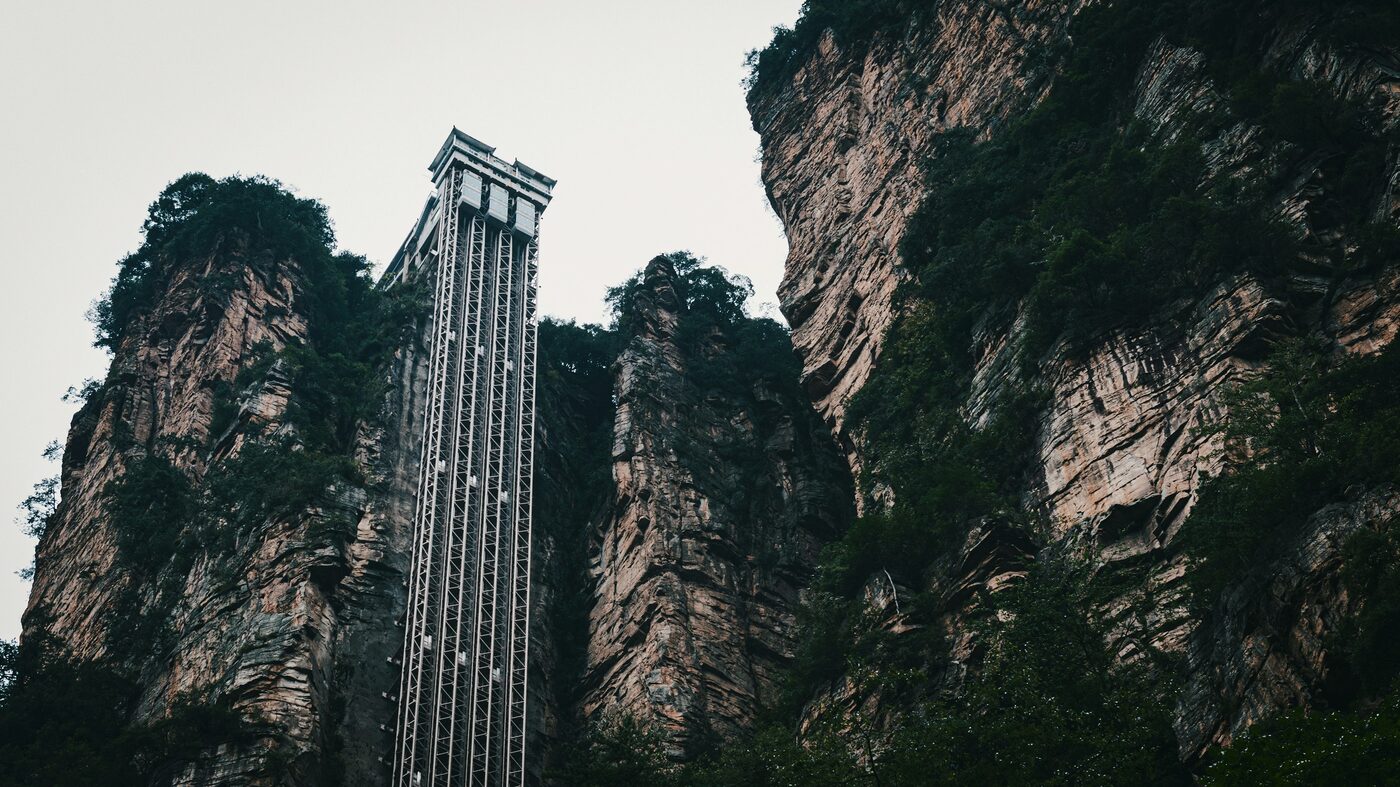
A separate ticket is required on top of the park entry fee — the official fare is ¥65 one way (¥130 round-trip; confirm at the ticket window). It carries the park’s longest queue, and the wait runs in both directions: 60-90 minutes to go up on a normal summer morning and up to ~3 hours over the May Day holiday, with another 1-1.5 hours to come down in peak season. Arrive by 8 am, and consider descending on foot or by the Tianzi cable car rather than queuing twice.
6. Tianmen Mountain (天门山) — glass skywalks and the celestial cave
Tianmen Mountain (天门山) is entirely distinct from the National Forest Park — a separate scenic area located 8 km south of Zhangjiajie city centre, managed by a different operator. Its key assets:
- The cable car — a 7,455 m line, one of the longest cable car systems in the world, climbing from a city-side base station. While its upper section is rebuilt (since November 2025) you ride the lower half to the mid-station, then the 99-bend shuttle and the through-mountain escalators finish the ascent — all covered by the combined ticket. The ride passes through pillar scenery and across deep valleys at altitude; the ascent is considered one of the most spectacular cable car experiences in China.
- The glass skywalk — a transparent glass-bottomed walkway (玻璃栈道) clinging to the cliff face near the summit, with a 1,400 m drop visible beneath your feet. Visitors are given shoe covers. This is one of China's most photographed “glass cliff” experiences.
- Tianmen Cave (天门洞) — a natural archway (technically a karst dissolution arch) at approximately 1,300 m altitude, 131.5 m high and .57 m wide. It is considered sacred in the local tradition and is the defining image of Tianmen Mountain — the arch framing a rectangle of sky above the forested cliff is visible from the city on clear days. Reaching it from the cave plaza below means the 999 stone steps or the paid escalator alongside.
- The 99 Bends road — the switchback road that ascends the mountain face on 99 hairpin turns is visible from the cable car. The shuttle-bus ride on this road (~40 minutes) is included in the standard scenic-area ticket and gives a perspective not available from the cable car.
The full guide — ticket prices, cable car queue times, the skywalk access sequence — is in the Tianmen Mountain Zhangjiajie guide.
Browse Tianmen Mountain tickets and tours on Trip.com →
7. Zhangjiajie Grand Canyon Glass Bridge — 430 m over the gorge
The Zhangjiajie Grand Canyon Glass Bridge (张家界大峡谷 玻璃桥) is located in the Zhangjiajie Grand Canyon Scenic Area, roughly 30-40 km east of Wulingyuan. When it opened in 2016 it was the world's longest and highest glass bridge — approximately 430 m long, spanning a gorge at around 300 m above the canyon floor. Multiple records have since been broken elsewhere in China, but the Zhangjiajie bridge remains one of the most dramatic and most visited.
The bridge is transparent underfoot across its full length; the glass panels are rated for a significant load and have not failed in operation. Many visitors nonetheless find the transparent floor viscerally vertiginous. The experience is typically described as either thrilling or terrifying, with no middle ground. In addition to the bridge, the Grand Canyon Scenic Area has canyon-floor hiking trails and a zipline that crosses the gorge.
Advance booking is required on peak days (the park caps daily visitor numbers). Travel by taxi, private car or tour — public bus options from Wulingyuan are limited and infrequent. Getting there independently adds time; a half-day tour from Wulingyuan or Zhangjiajie city is the most efficient approach for travellers without a private vehicle.
The full guide — logistics, booking, and what to expect — is at Zhangjiajie glass bridge guide.
8. Yellow Dragon Cave (黄龙洞) — China's showpiece karst cave
Yellow Dragon Cave (黄龙洞, Huáng Lóng Dòng) is a large karst cave system in the Suoxiyu part of the Wulingyuan scenic area, 7.9 km east of Wulingyuan town — about 13 minutes by taxi (an earlier version of this page put it much further away and on the wrong side of town; these figures are the corrected, route-measured ones). It is one of the most visited caves in China and one of the largest accessible to tourists: the operator lists four levels — two dry, two carrying water — with about 13 km of mapped passage, 13 halls, 96 linking galleries, two underground rivers, three underground waterfalls, and a largest chamber of roughly 12,000 m².
The cave is toured on a fixed route combining walking sections and a short underground river boat ride. Key formations include:
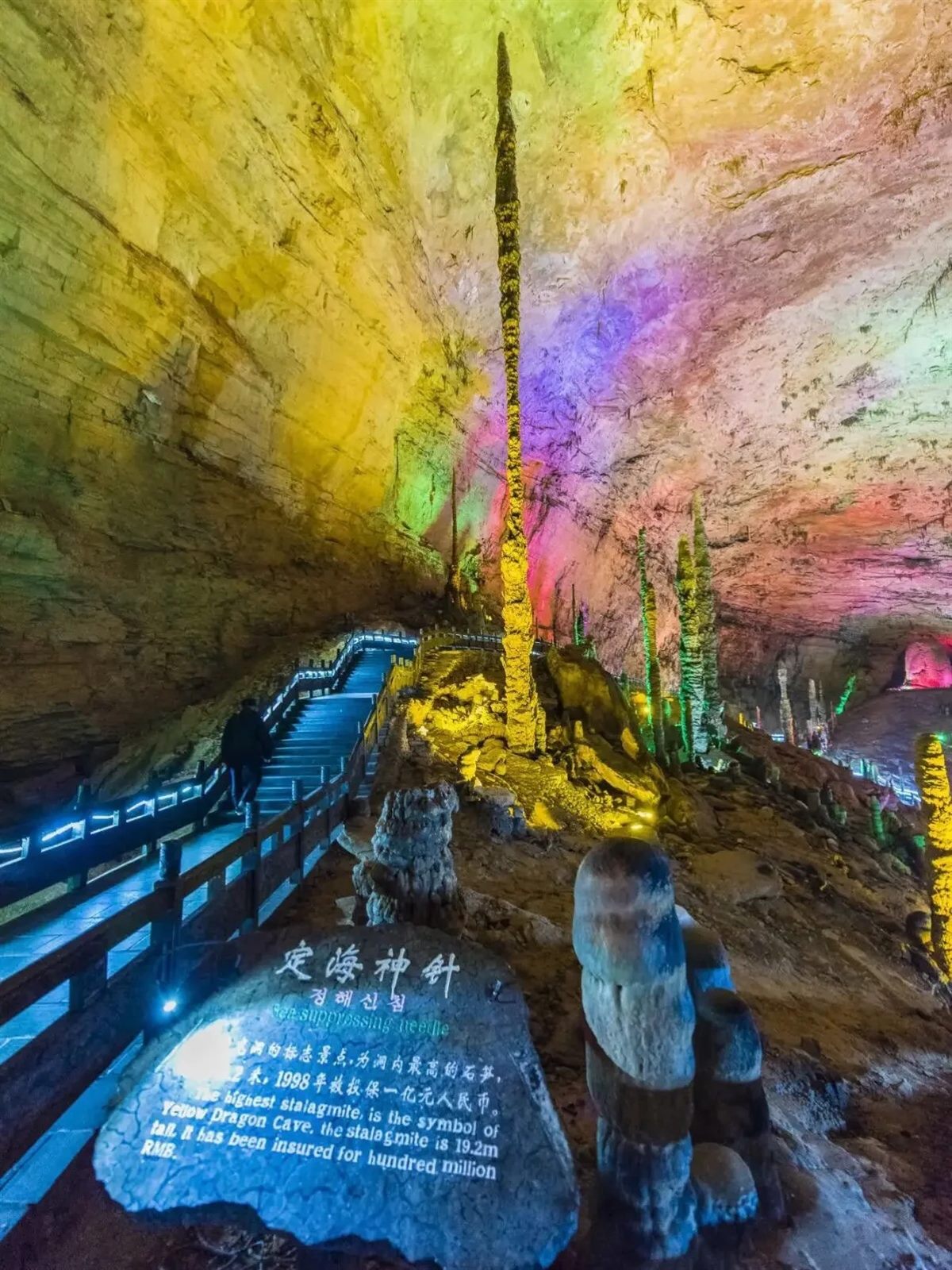
- The “Sea-Calming Needle” (定海神针) — a single stalagmite 19.2 m tall and about 10 cm across at its narrowest point, insured by the operator for ¥100 million. It is the cave's signature exhibit.
- Dragon Palace — the large central chamber; the boat ride navigates a stretch of this underground waterway, lantern-lit.
- Crystal Palace — a stalactite-dense upper chamber lit for visual effect; the density and variety of speleothems here is among the highest in any tour-accessible cave in China.
Entry is ¥121, and the way that number is built matters, because it is not one ticket: the government-approved price is ¥60 admission + ¥36 boat + ¥25 audio guide, with ¥4 insurance offered on top as a voluntary extra. The audio-guide component is not optional in practice — it is inside the standard combined price, and even visitors entitled to free admission still pay it at full rate. Concession holders (students, 60-65s) pay ¥77 all-in; the free-admission categories (under-14s, 65+, disabled, serving military) still pay ¥47. There is also a small self-select add-on inside the cave, the “Labyrinth” (迷宫) at ¥15, which is not part of the standard route.
The cave maintains a constant internal temperature of around 16 °C year-round — a genuine escape from a Hunan summer, and cold enough that a light jacket matters. Allow 2 to 2.5 hours for the standard one-way route (and note that the ten-minute walk from the scenic-area gate to the cave mouth is not included in that). The honest caveat travellers raise: the boat section is the bottleneck. It is a short ride — commonly reported at under ten minutes — and in peak season the queue for it can run to well over an hour, so a visit that should take 90 minutes stretches past three. The fix is simply to be there when it opens rather than arriving with the mid-morning tour groups. Expect the lighting to be heavily theatrical (coloured floods, projections) rather than naturalistic; if you have seen a major show cave elsewhere, this is a competent example of the genre, not a revelation. It pairs with Baofeng Lake (below) into one unhurried day out of Wulingyuan — though the two sit on opposite sides of the town, the cave 7.9 km east and the lake barely 2 km south, so this is two short taxi hops rather than one neighbourhood.
Full guide: Yellow Dragon Cave — the ¥121 breakdown, the boat queue and is it worth it →
9. Baofeng Lake (宝峰湖) — a lake held among the cliffs
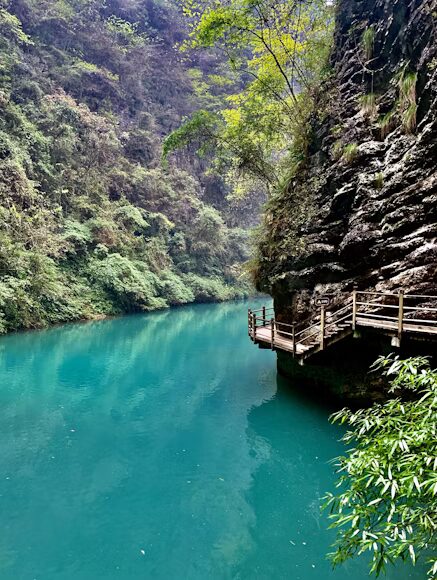
Baofeng Lake (宝峰湖, Bǎofēng Hú) is a reservoir set among sandstone cliffs in the Suoxiyu scenic area, about 2.2 km south of Wulingyuan. The lake itself — a vivid blue-green set against sheer cliff faces and dense forest — is the draw, and the standard experience is a 30-minute electric boat ride on the water, navigating through the cliffs as they close in around the lake's narrower inlets. Tujia minority folk performers sometimes sing from the clifftops as boats pass beneath — one of the more unusual staging decisions in Hunan tourism, and usually mentioned approvingly in visitor accounts.
Entry is ¥110, and it is a sum of parts rather than one ticket: ¥30 admission + ¥60 boat + ¥20 return shuttle (concession ¥55). Your ¥236 park pass does not cover it — this is a separately ticketed scenic area. The boat is about 30 minutes, which is where the “not worth it” verdicts come from; the lakeside walk afterwards is the half that changes the verdict. Hikers have a quieter option in the same area, the Yingwozhai (鹰窝寨) cliff trail, reopened in 2025.
Full guide: Baofeng Lake — tickets, the boat and is it worth it →
Baofeng Lake is compact: the boat itself is only about 30 minutes, which is the whole visit unless you add the Yingwozhai cliff trail — that takes it to 2 to 3 hours and is what the good reviews are actually about. Yellow Dragon Cave is 15-20 minutes away by taxi on the far side of the town; both are easy hops from Wulingyuan.
10. Tujia (土家族) minority culture — the people whose homeland this is
The sandstone pillar landscape that draws foreign visitors was inhabited for centuries — and remains the ancestral homeland — of the Tujia (土家族) people, one of China's recognised ethnic minorities. The Tujia are the dominant non-Han group in western Hunan and Hubei; the Zhangjiajie area is part of their historical territory. Engaging with Tujia culture is one of the most distinctive aspects of a Zhangjiajie trip.
What to look for and experience:
- Stilt-house villages (吊脚楼, diào jiǎo lóu) — the traditional Tujia architectural form: timber-framed houses on stilts built into hillsides, with carved wooden balconies and upturned eave corners. The best-preserved examples are in villages in the Suoxiyu valley area and in the reconstructed Tujia Cultural Village near Wulingyuan. Some are genuine inhabited villages; some are tourist reconstructions — the former are worth seeking out.
- Tujia embroidery and brocade (西兰卡普, xīlán kǎpǔ) — a traditional woven textile using a back-strap loom, with geometric patterns in strong colour combinations (red, black, white, yellow). Genuine Tujia brocade is labour-intensive to produce and sold at craft markets and the cultural village shop. A mass-produced version is ubiquitous as a souvenir; the handwoven kind is distinguishable by its irregular weave pattern and significantly higher price.
- The Tujia Hand-Waving Dance (摆手舞, bǎi shǒu wǔ) — the traditional Tujia community dance, performed at festivals and re-staged at the large-scale cultural evening shows in Wulingyuan. The evening folk show — a 70-90 minute performance combining dance, song, ritual and theatrical staging in an outdoor amphitheatre — is the most accessible introduction for visitors. Multiple productions run in Wulingyuan town in peak season; prices range from ¥100-¥200.
- Tujia food — the cuisine of the region is Hunan cooking with distinctly Tujia characteristics: sour-fermented vegetables (酸菜, suān cài), smoked cured meats (腊肉, là ròu), “three-cup dishes” (三杯 style) and a heavy use of fresh chillies. Restaurants in Wulingyuan town serve this as standard; the wild-mushroom dishes are a local specialty.
The broader Tujia and Hunan culinary context — san xia guo (三下锅), la rou (腊肉), the sour-spicy base, and where to find the genuine versions in Wulingyuan town versus tourist reconstructions — is covered in the Zhangjiajie food guide.
The two city-centre attractions we would not build a day around
Everything above is in or around the Wulingyuan scenic area. Zhangjiajie city, ~30-40 minutes away and where you sleep on a Tianmen day, has two large built attractions that show up in social feeds far more than they deserve to. Neither is a reason to add a day, and it is worth knowing why before one eats an evening.
The 72 Wonder Buildings (七十二奇楼) — on Wulingshan Avenue in the city — is a modern themed complex, not a historic quarter, built around a 109.9 m tower styled as a Tujia stilt-house and billed as the tallest of its kind. Tickets are tiered by entry time, not by what you get: ¥48 to go in before 16:30 and ¥88 from 16:30onwards — and because the site does not clear out at the changeover, the cheaper ticket covers the lit evening and the performances as well. (Third-party platforms discount the day ticket to around ¥20–30, which is where the “tickets from ¥20” figure circulating in English — including in an earlier version of this page — comes from; it is a promo price, not the gate price.) The verdict Chinese visitors give, and we agree with, is blunter than the marketing: the building photographs better from the outside than it experiences from the inside — the exterior shot everyone has seen is free from the footbridge across the road, and what the ticket buys is a bar-and-shopping street with performances. Worth an evening if you are already sleeping in the city; not worth a special trip, and not worth rearranging a park day for.
Full guide: 72 Qilou — the ticket trick, the free viewpoint and is it worth it →
Dayong Ancient City (大庸古城) — now “Qihuan Dayong City” (奇幻大庸城) is the more interesting story, and the one where most English guidance is now out of date. It is a 2016-2021 new-build reconstruction, not a surviving old town, and it became a well-known cautionary tale in China: roughly ¥2.44 billion invested, losses of over ¥1 billion across 2021-2025, national television coverage of the failure, and reporting that the car park was the only part of the operation making money. It closed for restructuring and reopened on 10 July 2026 under new joint operation with a Hunan broadcast-media group, rebranded, repositioned around entertainment IP and TV-variety tie-ins, and — the significant change — free to enter, with paid attractions inside rather than a gate fee.
Our verdict, stated with its uncertainty: at the time of writing it has been open in its new form for about two weeks, which is not long enough for anyone — us included — to tell you whether the relaunch worked. What we can say is that the old advice (“an expensive, empty ghost-town”) describes a version that no longer exists, and that free entry changes the calculation: if you are in the city anyway, walking in costs you nothing but the walk. Do not build a day around it, do not pre-book anything on the strength of old reviews, and treat any confident “must-see” or “avoid” verdict published about it right now — including in the guidebooks — as describing a different place.
Putting it together — a 3-5 day plan
The following sequence assumes one night in Zhangjiajie city on arrival for Tianmen Mountain, then a base in Wulingyuan town for the park days (minutes from the east gate), and uses taxis or DiDi for side trips:
- Day 1 — Tianmen Mountain. Do it from the city you arrive into: the cableway base is in the city centre beside the central railway station, so there is no transfer to arrange. Glass skywalk in the morning while fit; 999-step climb to Tianmen Cave; descend the 99 Bends by bus. Then move out to Wulingyuan (~40 min) and stay there for the rest of the trip — one hotel move instead of two. Optional, city evening only: if you arrived the night before and had an evening spare in the city — or you delay the move by a night — the 72 Qilou night complex is 3.4 km from Zhangjiajie West station. It is a walk round a lit shopping street, not a sight; the photograph everyone wants is free from the footbridge opposite, and it is never worth keeping a city hotel for.
- Day 2 — Yuanjiajie and the Bailong Elevator. Enter at the east gate early (by 8 am) — it is minutes from the Wulingyuan hotels — then take a park shuttle to the Bailong Elevator base by 9 am before queues peak. Ascend to the Yuanjiajie plateau: the Avatar Hallelujah Mountain viewpoint, the First Bridge Under Heaven. Shuttle across to Tianzi Mountain for the afternoon sea-of-cloud panorama. Descend by cable car; dinner in Wulingyuan.
- Day 3 — Golden Whip Stream. Shuttle (~¥8) or taxi round to the south gate — no park bus links the gates, so that hop is an outside one — then walk the stream one way east at a slow pace, 7.5 km and 2.5-3 hours on the flat, finishing back at the east gate by your hotel rather than retracing to the south. The macaques are most active in the morning; keep food out of sight.
- Day 4 (if time allows) — glass bridge. Half-day excursion to the Zhangjiajie Grand Canyon and glass bridge (pre-book online) — ~35-40 min east of Wulingyuan, which is exactly why it belongs on a Wulingyuan night rather than a city one. Return for an afternoon rest; Tujia evening show in Wulingyuan.
- Day 5 (if time allows) — Yellow Dragon Cave and Baofeng Lake. These sit on opposite sides of the town, so do the cave first: be there for the 08:00 opening rather than mid-morning, because the underground boat is the bottleneck — the walk itself is 2 to 2.5 hours, and a peak-season queue for the eight-minute boat adds up to another two on top. Note also that admission stops around 16:00, so the cave has no late-afternoon fallback the way the rest of Zhangjiajie does. Baofeng Lake is the other way — only 2.2 km south of Wulingyuan, a few minutes by taxi — for its 30-minute boat, or the reopened Yingwozhai cliff trail (~4 km, ~2 h) if you would rather walk than queue for another boat. Rest of afternoon free.
The Zhangjiajie city guide has the full 3 / 4 / 5-day itinerary planner, transport details, and emergency essentials. For hotels in Wulingyuan or the city, see where to stay in Zhangjiajie.
Browse Zhangjiajie tours and attraction tickets on Trip.com →
Frequently asked questions
What are the top things to do in Zhangjiajie?
How many days do you need in Zhangjiajie?
What is the Bailong Elevator and do I need to buy a separate ticket?
Is Tianmen Mountain the same as the National Forest Park?
What is the Zhangjiajie glass bridge?
What is the best time of year to visit Zhangjiajie?
Where is the best base for exploring Zhangjiajie — the city or Wulingyuan?
How do I get to Zhangjiajie by train?
Related Zhangjiajie guides
- Zhangjiajie city guide — getting to Zhangjiajie by HSR (via Changsha), getting around (park shuttles, cable cars, taxis), where to stay, and the itinerary planner.
- Zhangjiajie National Forest Park guide — the headline deep-dive: multi-day park ticket logistics, Yuanjiajie, Tianzi Mountain and Golden Whip Stream in full detail.
- Tianmen Mountain guide — separate from the National Forest Park; glass skywalk, Tianmen Cave, 99 Bends road, cable car booking.
- Zhangjiajie glass bridge guide — the Grand Canyon 430 m glass span; advance booking, logistics from Wulingyuan.
- Where to stay in Zhangjiajie — Wulingyuan town vs. the city centre; which base for park-first trips vs. Tianmen Mountain.
- Getting around Zhangjiajie — park shuttle system, cable cars, Bailong Elevator, and the city-to-Wulingyuan connection.
Sources: editorial team based in Chongqing (8-year mainland-China resident), editor's about page, Amap (高德地图) routing and POI data queried 2026-05-23, and aggregated r/travelchina, r/chinatravel and r/Zhangjiajie threads 2024-2026. Ticket prices, daily visitor caps and operational status of the Bailong Elevator and cable cars change — confirm before your visit. The Huangshizhai and Ten-Mile Gallery sections, and the lift fares quoted throughout, were checked on 2026-07-20 against the Wulingyuan tourism authority's official ticket pages (hnzjj.com).