Key takeaways
- Two different things: Yu Garden is the ticketed Ming garden (~¥30–40 seasonal); Yuyuan Bazaar is the free market around it.
- The garden is a 16th-century Ming-dynasty classical garden — about 2 hectares, ~90 minutes to walk.
- The famous curved-roof-over-the-lake photo is usually the bazaar, not the walled garden.
- Eat xiaolongbao at Nanxiang Mantou Dian (lineage from 1900) — touristy, queued, but part of the visit.
- Pair it with the Bund: an 11-minute walk, garden in the afternoon then the waterfront at night.
Yu Garden vs Yuyuan Bazaar — get this straight first
The single most common confusion for foreign visitors is treating “Yu Garden” as one thing. It is two:
| What it is | Cost · hours | |
|---|---|---|
| Yu Garden 豫园 | The actual garden — a walled, ticketed, 16th-century Ming-dynasty classical garden of rockeries, ponds and pavilions. | ¥40 · 09:00–16:30 |
| Yuyuan Bazaar 豫园商城 | The shopping-and-snack market wrapping around the garden — mock-traditional buildings, souvenir shops, restaurants, the City God Temple. | Free · until ~10pm |
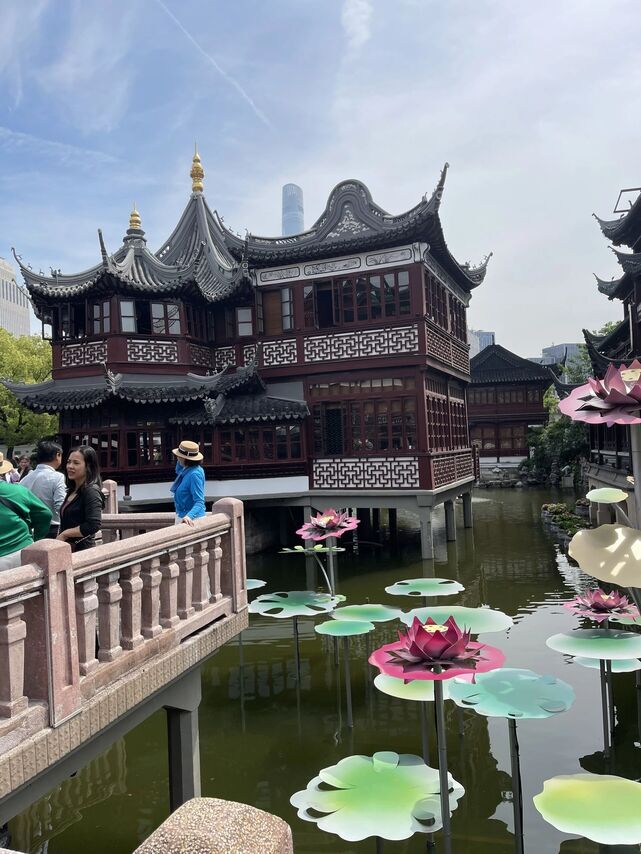
You can visit the bazaar without entering the garden; you cannot do the reverse, because the garden entrance sits inside the bazaar zone. When a photo shows curved tile roofs reflected in a pond with crowds and red lanterns — the much-shared shot of the lakeside Huxinting teahouse and the zigzag Nine-Turn Bridge — that is almost always the bazaar, not the walled garden. Knowing the difference avoids disappointment either way: visitors who want the quiet classical garden buy the ticket and step inside; those happy with the lively market and the dumplings never need to.
The garden itself
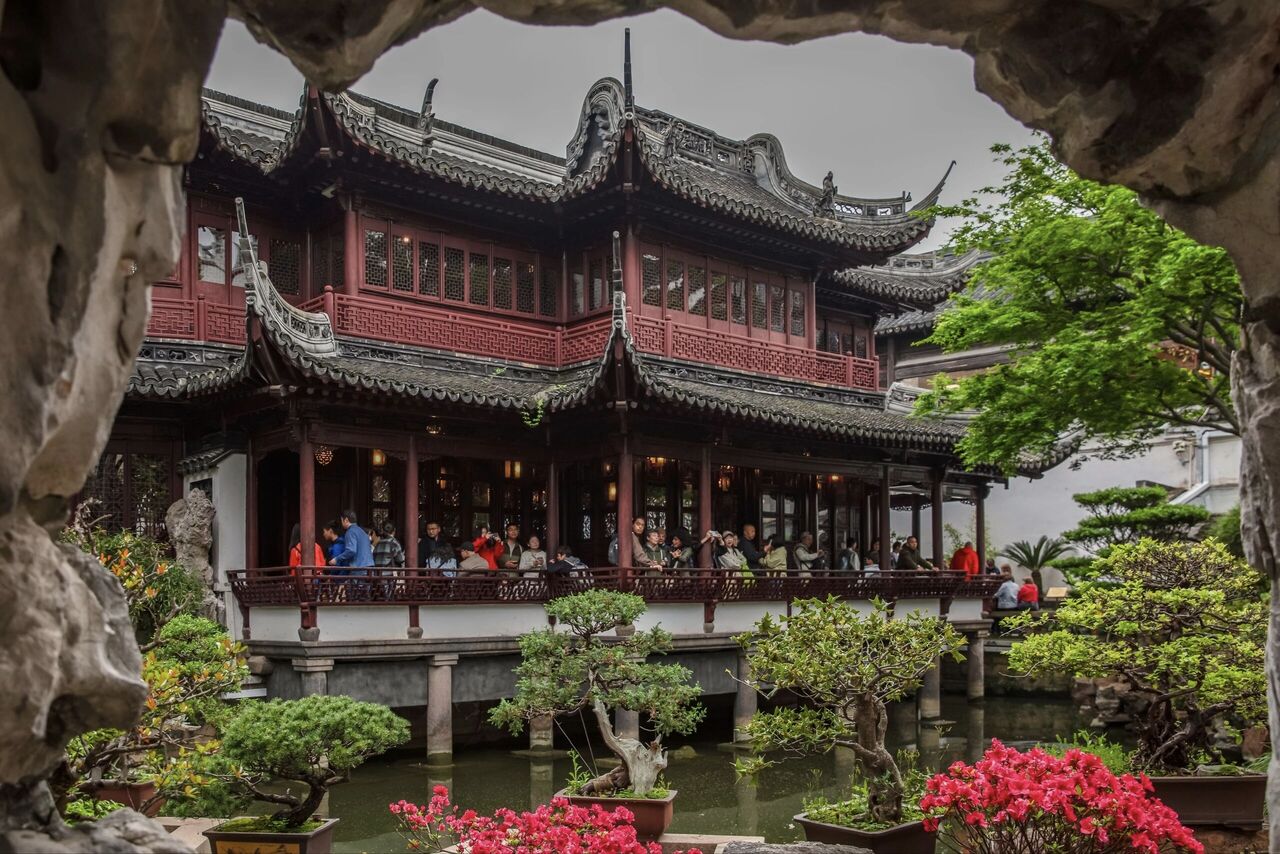
Yu Garden was built in the 1550s–1570s by a Ming official, Pan Yunduan, as a private retreat for his family — yu (豫) means roughly “peace and contentment.” It is a classic example of a southern Chinese scholar’s garden: about two hectares of carefully composed rockeries, ponds, halls, covered walkways and “borrowed” views, designed so that every turn reveals a new framed scene.
A few set-pieces anchor the walk. The Grand Rockery (大假山) is a 14-metre artificial mountain of yellowstone, the largest of its kind in southern China, with a path that climbs to a small viewing pavilion. The Exquisite Jade Rock (玉玲珑) is a celebrated 3-metre piece of porous Taihu lake stone, prized for its many holes — water poured at the top is said to trickle from every opening. The Hall of Heralding Spring (点春堂) was a meeting hall of the Small Swords Society during the 1850s uprising. A small classical theatre stage and the Dragon Wall (an undulating tiled wall topped with a dragon’s head) round out the circuit.
The garden is intricate rather than vast — the “borrowed views” technique means walls, doorways and rockery are arranged so each turn frames a new composed scene, making two hectares feel larger. Because it is compact and central, it can get busy; the calmest experience is at opening (09:00) or in the last hour. Allow about 90 minutes.
A note on scale: travelers also planning a Suzhou day trip (23 minutes by HSR) will find Suzhou’s UNESCO-listed classical gardens — the Humble Administrator’s Garden, the Lingering Garden — larger, older and quieter. Yu Garden is the convenient, central, lighter version: a genuine Ming garden you can fit into a Shanghai afternoon, not a reason to skip Suzhou if gardens are the thing you came for. For a half-day in central Shanghai, though, it pairs naturally with the Bund and earns its ¥40.
Tickets, hours and how long to allow
The garden is ticketed; the bazaar around it is not. Prices and closed days shift, and we re-check them here — the working numbers:
| Item | Detail |
|---|---|
| Garden ticket | ¥40 peak (1 April to 30 June and 1 September to 30 November) / ¥30 low; the Lantern Festival is a separate, dated, timed-entry product each winter |
| Opening hours | 09:00–16:30 Tue–Sun; last entry 16:00; closed Mondays |
| Closed days | Some Mondays — posted at the gate and in the mini-program |
| Yuyuan Bazaar | Free; open until ~10pm |
| Time in the garden | ~90 minutes |
| Time for the quarter | +1–2 hours for the bazaar & City God Temple |
The bazaar, the temple, and the food
The Yuyuan Bazaar is touristy and commercial — there is no point pretending otherwise — but it is also genuinely the historic heart of Shanghai’s Old City, and the place to do a few specific things:
| What | Why it’s worth it |
|---|---|
| Nanxiang Mantou Dian 南翔馒头店 | The famous soup-dumpling (xiaolongbao) shop, a lineage from 1900 often credited with popularizing them. The ground-floor takeaway window is cheap (~¥25 for 12) but has the longest queue and no seat; the upstairs sit-down has the nicer specials (crab-roe xiaolongbao ~¥40 for 6) at higher prices. Travellers call the upstairs a fun once — but say you’re partly “paying for the nostalgia.” |
| City God Temple 城隍庙 | A working Taoist temple, the spiritual centre of the old town, right in the bazaar area. |
| Godly 功德林 | A long-established vegetarian Buddhist restaurant nearby — the quieter food option in the quarter. |
| Snacks & souvenirs | Wall-to-wall stalls of Old-Shanghai snacks and souvenirs. Browse, haggle, and expect tourist pricing. |
A practical note on the xiaolongbao queue: the ground-floor takeaway window has the longest line and hands you a paper tray to eat standing up; the upstairs sit-down restaurant usually moves faster and lets you rest. The classic order is the plain pork xiaolongbao; the crab-roe version costs more and divides opinion. Eat the dumpling carefully — nip the top, sip the scalding soup, then eat the rest — the filling is genuinely hot.
Two food cautions from travellers: (1) ignore the look-alike “fresh xiaolongbao” stalls with no proper sign around the bazaar — thick-skinned imitations; only queue at the real Nanxiang Mantou Dian shopfront. (2) For a real meal, locals slip out of the bazaar: Da Hu Chun (大壶春) for pan-fried buns, the century-old vegetarian Chunfeng Songyue Lou (春风松月楼) on Jiuxiaochang Road (旧校场路), and the 本帮菜 (Shanghainese) restaurants a couple of minutes away on Fumin Street (福民街) and Anting Street (安亭街) — better value than the bazaar proper.
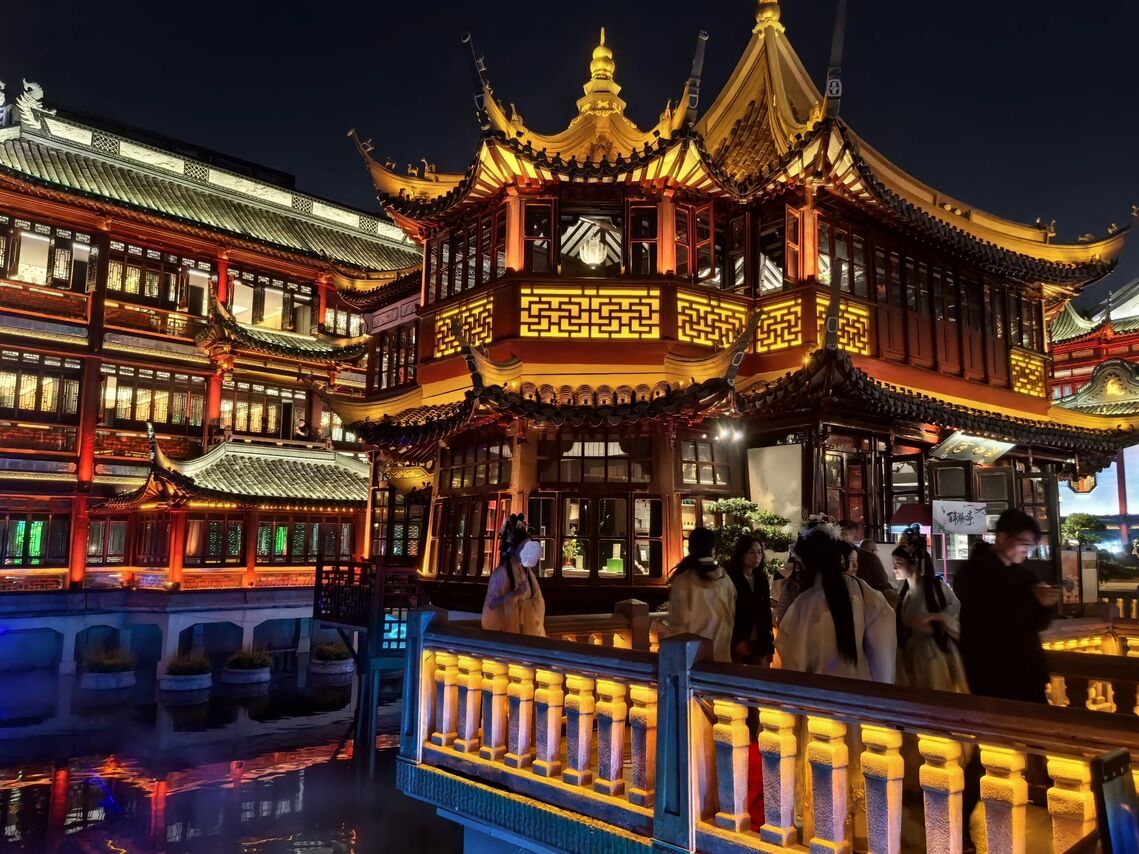
For a quieter xiaolongbao meal away from the crowds, the Shanghai city guide lists alternatives elsewhere in the city. The quarter as a whole is heavily restored and commercial — it is the closest thing Shanghai has to an “old town,” but go in expecting a polished tourist precinct rather than a lived-in historic neighbourhood; travellers note it’s worst at midday and best after ~7pm, when the curved roofs and the Zigzag Bridge light up.
Getting there and pairing it with the Bund
Yu Garden sits in the Old City, within easy walking distance of the Bund — which makes the standard half-day pairing efficient.
| From | How | Notes |
|---|---|---|
| By metro | Line 10 or Line 14 to Yuyuan Garden station (豫园), then a short signed walk. | The simplest approach from anywhere in the city. |
| From the Bund | About 800 m / 11 minutes on foot through the Old City lanes (per Amap). | Garden in the afternoon, Bund for the night view. |
That walkability is the point: do Yu Garden and the bazaar in the afternoon, eat early, then walk to the Bund for the lit-up waterfront — one of the most efficient half-days in central Shanghai.
Book a guided Old-City & Yu Garden tourNASDAQ: TCOM
Rather have the Old City explained as you walk it? Trip.com lists guided Yu Garden + Old Shanghai walking tours — the garden, the bazaar and the City God Temple with a guide, often bundled with the Bund — booked in English on a foreign card.
When to go
- Inside the garden: arrive at opening (09:00) or in the last hour before the 16:00 cutoff to avoid the thickest tour-group crowds.
- The bazaar: most atmospheric in the evening, when the curved-roof buildings are lit — particularly during the Lunar New Year lantern displays, which are spectacular but extremely crowded.
- Avoid Chinese public holidays if you can — the bazaar becomes shoulder-to-shoulder.
Where to stay nearby
There are no tourist hotels of consequence inside the Old City lanes themselves. The sensible base is the Bund / People’s Square side — walking distance to Yu Garden and the waterfront, with Metro Line 10 / 14 to the rest of the city. For a first China trip, a home-grown mid-range chain is the practical call.
Frequently asked questions
What is the difference between Yu Garden and Yuyuan Bazaar?
They are two different things and most visitors conflate them. Yu Garden (豫园) is the 16th-century Ming-dynasty classical garden — a ticketed, walled attraction (¥40, open 09:00–16:30, last entry 16:00, closed Mondays) of rockeries, ponds and pavilions. Yuyuan Bazaar (豫园商城) is the free shopping-and-snack market that surrounds the garden — open until about 10pm, full of souvenir shops, restaurants and snack stalls in mock-traditional buildings. You can visit the bazaar without entering the garden, but the garden is inside the bazaar area. When people post a photo of the famous curved-roof buildings and lake, that is usually the bazaar, not the garden.
How much is the Yu Garden ticket and what are the opening hours?
The Yu Garden ticket is seasonal: ¥40 in peak season (1 April to 30 June and 1 September to 30 November) and ¥30 in the low season (1 July to 31 August and 1 December to 31 March), with concessions for students and seniors; buy it at the north/south gate windows or the official 'Shanghai Yu Garden' WeChat mini-program. The garden is open 09:00–16:30 Tuesday to Sunday, and it stops admitting at 16:00 — the 16:30 figure is when the garden is cleared, not when you can still get in. It closes EVERY Monday, except on public holidays. During the Lunar New Year Yuyuan Lantern Festival (roughly late January to February) the lit garden area switches to timed, reserved entry at about ¥80. The surrounding Yuyuan Bazaar is free and open much later, until about 10pm. Allow about 90 minutes inside the garden itself.
How do I get to Yu Garden?
Take Metro Line 10 or Line 14 to Yuyuan Garden station (豫园) — the garden and bazaar are a short signed walk from the station exit. Yu Garden is also an easy walk from the Bund: about 800 m / 11 minutes through the Old City lanes, per Amap. Many visitors pair the two in one outing — Yu Garden in the late afternoon, then the Bund for the night view.
Is Yu Garden worth visiting?
Yes, with realistic expectations. The garden is a genuine, well-preserved Ming-dynasty classical garden — compact (about 2 hectares), intricate, and a calm contrast to modern Shanghai. It is smaller and busier than the famous classical gardens of Suzhou, so if you have a Suzhou day trip planned and limited time, Yu Garden is the lighter version. The bazaar around it is touristy and commercial, but it is also where you eat xiaolongbao at the original Nanxiang shop, so most visitors do both.
Where do I eat xiaolongbao at Yuyuan Bazaar?
Nanxiang Mantou Dian (南翔馒头店) in Yuyuan Bazaar is the famous one — a lineage going back to 1900 and often credited with popularizing xiaolongbao (soup dumplings). Expect a queue, especially on weekends; the upstairs sit-down restaurant is usually faster than the ground-floor takeaway window. It is touristy and not cheap for what it is, but the dumplings are good and it is part of the Yuyuan experience. For a quieter xiaolongbao meal, our Shanghai city guide lists alternatives elsewhere in the city.
What else is around Yu Garden?
The City God Temple (城隍庙) — a working Taoist temple — sits right in the bazaar area and is the historic heart of the Old City. Godly (功德林), a long-established vegetarian Buddhist restaurant, is nearby. The whole quarter is the closest thing Shanghai has to an 'old town', though it is heavily restored and commercial. From here it is a short walk to the Bund, making Yu Garden plus the Bund a natural half-day or evening pairing.
When is the best time to visit Yu Garden?
Arrive when the garden opens at 09:00, or in the last hour before the 16:00 cutoff, to avoid the thickest tour-group crowds inside. The bazaar is at its most atmospheric in the evening, when the curved-roof buildings are lit — particularly during the Lunar New Year lantern displays, which are spectacular but extremely crowded. Avoid Chinese public holidays if you can; the bazaar becomes shoulder-to-shoulder.
Sources
Checked August 2026 · Written from our own first-hand travel in China.